- Thursday, 14 May 2026

Expectations From Xi-Trump Summit

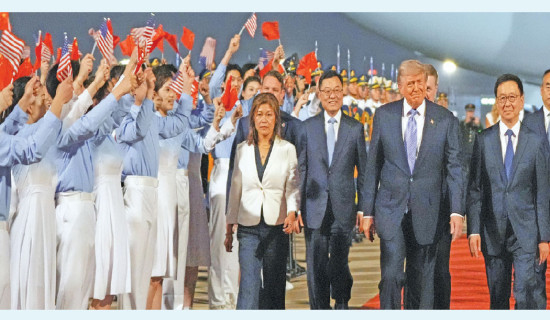
The Iran war is rapidly reshaping global diplomacy as US President Donald Trump and Chinese President Xi Jinping lead the much-awaited summit today. While all eyes are on concerns regarding the conflict, the talks are not yet over, despite a current stalemate. The logic of escalation is taking hold, contrary to what Winston Churchill said: jaw-jaw is better than war-war. On their own terms, both Iran and the US want to end the air war now turned to hostilities. Air confrontation, Iranian blockade over a 45-km active waterway met by US blockade, Pakistan-mediated talks, and Trump's paused the project freedom programme may be about to change in a compromise as the two leaders hold talks.
Trump does not want to close the Iran page without sending a loud and clear message to his allies and his citizens. He wants to end the narrative that the US is fighting without winning, and China is winning without fighting. Trump would like to play tough guy while sitting next to Jinping. Beijing has tried to keep its policy away from the entanglement in conflict, but is now looking to engineer an off-ramp to end the hostilities. Recent concern conveyed by the Chinese premier signaled an urgency to end war, keeping their eyes on avoiding Beijing as part of a broader geopolitical struggle with Washington over trade, energy and global influence.
Trump is also aware that a prolonged Hormuz crisis could severely damage China’s energy security, supply chains, export-driven economy and financial lifeline to Iran. Moreover, a report published by Financial Times in mid-April claimed that the Iranian military purchased imagery from a Chinese-operated commercial satellite to target US military infrastructures, including radar, communications equipment and air command platforms.
It might be argued whether this type of maximum pressure necessarily delivers long-lasting results. The answer is possibly yes because this pause has already produced little evidence of progress. Such evidence is: Trump's strategy to escalate to the extreme while bearing some kind of risk alongside a surprise step to take back, while the Chinese side focuses on immediate and full ceasefire.
Chinese priority
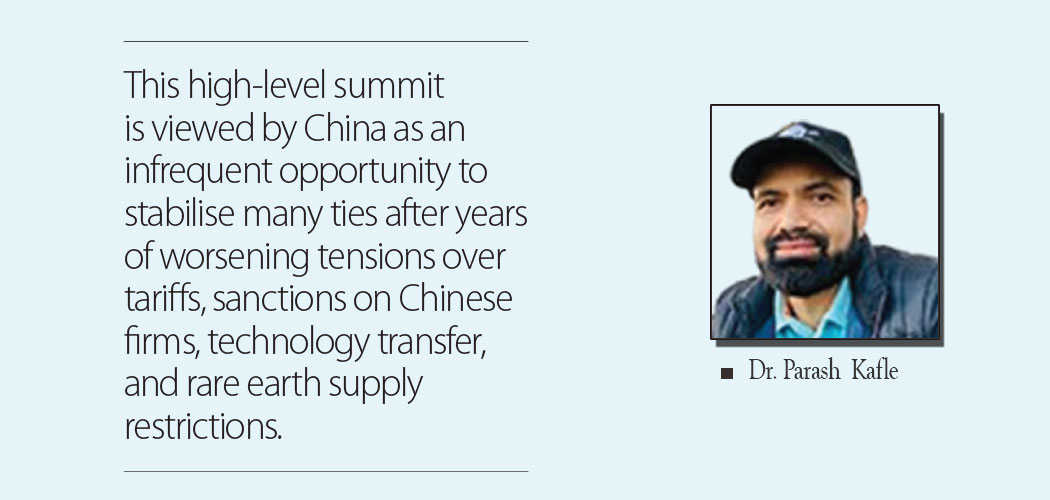
The US president has visited China in nearly ten years. This high-level summit is viewed by China as an infrequent opportunity to stabilise many ties after years of worsening tensions over tariffs, sanctions on Chinese firms, technology transfer, and rare earth supply restrictions. This is why any renewed fighting in the Gulf and the collapse of the delicate ceasefire could quickly overshadow the summit.
President Xi must be aware of the American strategy to target Chinese entities and banks tied to shipping Iranian crude even within sanctions, and providing dual-use military goods to Iranian security. Given that Trump has already stirred against China's interest in Venezuela, and it’s not wrong for Beijing to look at this summit as a carefully managed diplomatic showcase. However, President Xi faces a two-fold dilemma: avoiding concessions to President Trump while maintaining strong ties with a long-time, strategic Middle Eastern ally.
Under dust and debris, now the Islamic Republic is fighting in economic war with enormous domestic and regional stakes. After facing a lethal aerial strike and US naval blockade in the Strait of Hormuz, Iranian oil exports and the value of currency have fallen to near all-time lows, pushing inflation to an all-time high. The only upper hand that Iran holds right now is control in the Strait of Hormuz, and the regime would like to end negotiations maintaining this advantage until the end.
A military victory without a long-term peaceful and political solution is always considered incomplete. Thus, Iran knows that most of its demand must and will eventually be met through negotiations, except for uranium enrichment under the NPT (Non-Proliferation of Nuclear Weapons Treaty). Iran has shown an asymmetric campaign over the waterway to target ships, disrupt energy flows, and apply pressure to the neighbour. Such endurance and response have placed their upper hand in Hormuz. In the worst-case scenario, instead of NPT, Iran seeks complete control over the Strait of Hormuz to operate as a sovereign asset and has already formed the Persian Gulf State Authority.
Questions are being raised pertinently against Trump regarding why the outcome of the war and the stability of the global supply chain are in jeopardy. The accurate one-line answer for this prolonged ceasefire depends on the condition of the victory. Trump is seeking a comprehensive deal and attempting to get an answer to those critics who have criticized that Washington still lacks a clear path to ending the war.
Voter’s perceptions
Trump is acutely aware of voters’ perceptions that they have been facing a harsh reality every time they feel the pinch of the new prices at the gas station. A survey conducted by NPR and Marist reinforces this and shows that sixty-two per cent of Americans believe Trump has weakened the country's role on the world stage. Conversely, Iran will never back down on their survival and a full-scale ground operation in the scorching heat of the Gulf has no way out. Trump also knew voters would like to know why at least 13 US service members have died in action, why oil and shipping disruptions have complicated supply chains, and why rocketing food prices have depleted their savings.
Despite such different realities at the negotiating table, one must understand why Trump continues to refuse a compromise and maintain a carefully staged pause in war. This is a well-thought-out strategy for reclaiming America's hegemony over the Persian Gulf and to alter the European and Indian crude dependency away from the Gulf. This maneuver effectively addresses the challenges and weaknesses faced by the Petrodollar in recent times.
(The author is a PhD graduate in Economics and Finance and pursuing a Post-Doc.)