- Monday, 8 June 2026

RSP Bets On Reforming Provinces

Rastriya Swatantra Party (RSP) took over the reins of the government last month, with Balendra Shah at the helm as the new prime minister. The Balendra Shah-led government is viewed with tremendous hope and expectation, coming against the backdrop of the Gen Z movement, in which youths taking to the streets had called for thoroughgoing reforms in governance, development, and public service delivery. Accordingly, RSP pledged reforms in several critical areas of governance and service delivery, reposing full trust in which people voted en bloc in support of the party.
The voters gave a huge majority in the parliament to enable the RSP to fulfil its promises on its own without seeking the support of other parties represented in the parliament. This leaves no room for RSP to take recourse to this or that excuses for failing to deliver the promises made to the people. The RSP manifesto has made a distinct departure from the conventional usages, coining the term Thiti Basaalne Baachapatra, which can be translated as a system establishing a covenant or document. Baachapatra connotes a binding promise offered to the people as an obligatory set of tasks to fulfil. The massive vote RSP was able to garner in the polls indicates the acceptance of the people of the offer made by it in the form of Baacha (promise).
Constitutional amendment
RSP has offered a one-hundred-point covenant (Baachapatra) to the voters, and out of them, almost one-fifth are related to reforms focused on the areas of governance structures, public service delivery and democratic constitutionalism. One of the points in the promises is concerned with constitutional amendment, for which RSP commits to prepare a draft proposal for broad-based consultations within three months of taking over the reins. The constitution needs to be amended to execute reforms in critical governance issues. RSP has made its position clear to introduce necessary reforms, among others, in the provincial architecture of the federal governance, taking cognisance of the resentments expressed over its performance and delivery.
Provinces have been installed as the new intermediate tiers of the federal structure. They have been widely lamented as a burden on the state exchequer sans commensurate results. While mulling the reform of the sub-national architecture, it is important to set forth a proposal in restructuring provincial governance by introducing a directly elected chief minister as the executive head of the provincial government. This can prove to be an effective way to strengthen federalism, improve governance, and enhance accountability. Under Nepal’s existing parliamentary system, as envisaged in the federal constitution, chief ministers are elected indirectly by provincial assemblies, similar to the way the prime minister is elected at the federal level by the members of the House of Representatives.
This author had led a team of researchers on behalf of Policy Research Institute (PRI) to investigate into issues and challenges faced by the provinces with particular attention to policy making process a few months ago. In the course of collecting relevant data, the study team had candid discussions with several provincial lawmakers, senior bureaucrats and civil society stakeholders. Most of the key stakeholders suggested that it was necessary to introduce reform in the electoral system for electing chief minister directly by the people. This can help maintain political stability and reduce frequent turnover of the provincial governments. They had also suggested that there is a need to downsize the number of provincial lawmakers and ministries as well to ensure that provincial set up is lean, efficient and effective to deliver the mandates.
Under the current parliamentary mode of governance, provincial governments have become dependent on unstable and unprincipled coalitional arrangements. Frequent party switching, no-confidence motions, and fragile alliances have led to instability and incessant political feuding. Over the past few years, there have been repeated changes in provincial government leadership. Currently, conflicts have reportedly brewed among coalition partners, especially in Sudur Paschhim and Bagmati provinces over spoil sharing, threatening the survivability of the government. A directly elected head of the provincial government would have a fixed tenure, reducing instability to ensure continuity in policies and development.
A directly elected chief minister derives authority straight from the people rather than unprincipled political alliances and bargaining within provincial assemblies. This enhances public trust and democratic legitimacy of the provinces. In the current system of provincial governance, accountability is diffused and dispersed among coalition partners and legislators. If the chief minister is directly elected by the voters, he or she can be held clearly responsible for any lapses in performance and delivery. A directly elected chief minister cannot be easily removed by shifting alliances and horse-trading practices.
Executive mandate
Coalition governments often delay decisions due to internal disagreements and power-sharing issues. A directly elected chief minister has a clearer executive mandate and can take quicker administrative decisions. Nepal’s federal system is in its incipient stage. Weak provincial leadership, characterised by frequent changes of government, undermines the edifice of federalism. There is a need to correct it. This can be addressed by the constitutional provision for direct elected executive chief in the provincial governments.
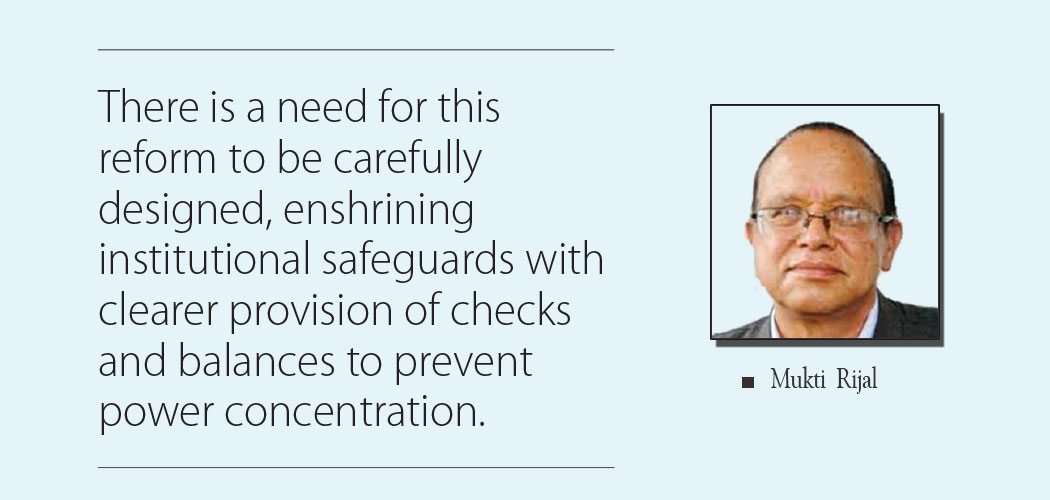
A directly elected chief minister can have an appeal to a broader electorate, reducing dependence on party hierarchy and internal lobbying. Directly elected governors in such countries as the United States and regional presidents in Indonesia provide a model of stable and effective provincial leadership. Though directly elected chief ministers have several advantages, there is always the risk of authoritarian and hegemonic tendencies in decision-making. There is a need for this reform to be carefully designed, enshrining institutional safeguards with clearer provision of checks and balances to prevent power concentration.
(The author is presently associated with Policy Research Institute (PRI) as a senior research fellow. rijalmukti@gmail.com)