- Friday, 15 May 2026

Strength Through Struggle
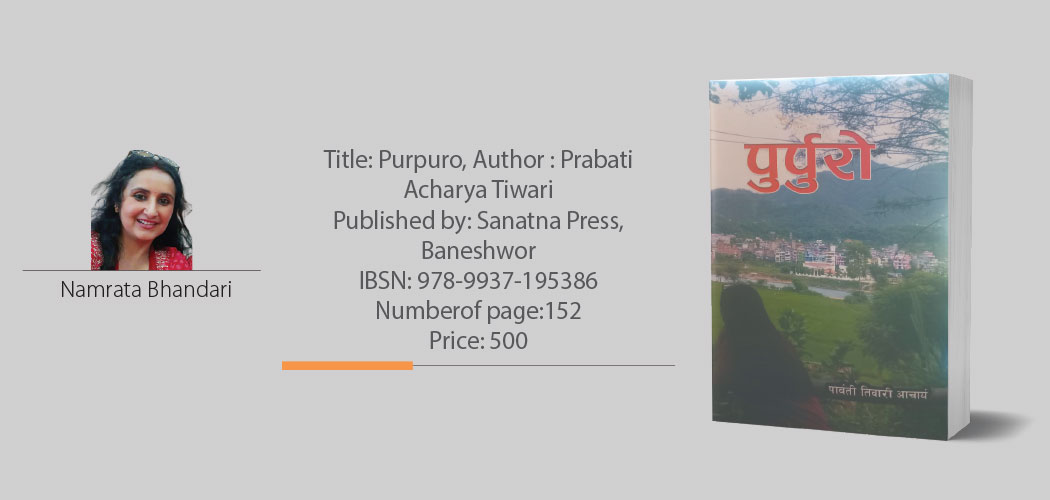

An emerging Nepali writer, Prabati Acharya Tiwari’s Purpuro is a deep, painful and emotional piece of writing. Struggle and hard work are interrelated, and her life itself is a result of many tests. The pain of her difficult childhood days and the joys of the present are incomparable. Inspired by her mother’s love, the autobiography revolves around her own nature of never giving up.
Life itself is hard when one’s father is an alcohol abuser. For rural people who are uneducated and suffering from poverty, struggle is the core element of life. Perseverance and survival are essential for lower-class families undertaking a long journey. The remarkable theme of the book is that without struggle, a person cannot achieve anything in life. In poverty, no voice is heard, as scarcity persists for a long time.
After reading the memoir, I could not sleep easily for two or three days. Surprisingly, I began pondering the possibilities and the troublesome, stressful and hard-working life that influenced the writer to produce such a poignant book. It is a symbol of love, struggle and resilience.
Mother’s love and feelings of nostalgia embrace the writer through emotional bonding and passion. At the age of thirteen, her mother was married in Patale village of Kavrepalanchok. Patriarchal ideas, old traditions and superstitious beliefs were deeply entangled in her surroundings.
During those early years, women hardly had a voice or self-respect. From early dawn until late at night, her mother worked continuously, taking care of the children, cattle and fields. On the other hand, her father was busy with toxic friends and alcohol. Nevertheless, he paid little attention to his responsibilities toward the children. As a little girl, the writer closely observed how her mother became the breadwinner. Yet she still had no role in the decision-making process. Women were often blamed for not giving birth to sons and were subjected to unfair treatment. Life was extremely hard for women who dared to raise their voices against injustice. Even though the writer’s mother suffered from asthma, she continued to work amid smoke and dust. As a result, her health deteriorated continuously.
The protagonist faces different dilemmas in life, including family separation and unbearable poverty. As a result, she wandered aimlessly and lived as a street child. Everything appeared dark and dangerous. The so-called gentle society revealed its real face during times of crisis. Untouchability and other social burdens intensified their hardships.
The memoir poignantly shows how street children are viewed in our so-called civilised society. Poverty and discrimination are shown as a thin line that society and the government urgently need to address. Why children are forced into street life is a crucial theme in Purpuro. Society always knows how to question, but rarely knows how to solve problems. At one point in life, the writer had no place to go and no means to survive. Unable to pay the rent because of the father’s drunken behaviour, the family moved from Kavrepalanchok to Kathmandu Valley. They stayed in Kumari Galli. In their dark and damp single room, sunlight could hardly enter. On the floor, the mother arranged a heap of sacks to serve as a bed. The roof was covered with tin sheets, and the walls were made of mud.
The writer recollects painful moments when they survived on beaten rice with water. The situation became so serious that, in order to survive, they began begging in local areas. Her mother worked in other people’s houses for a livelihood, but there was often no trace of her father. In the absence of a father’s love, the situation became even more painful. She felt a deep ache in her heart, especially when friends shared experiences about their fathers. She could hardly remember her father’s face or his affection toward them.
In the absence of a father’s love, her mother raised them on her own. During storms, the tin roof made such a gigantic sound that they huddled together as if it were their last day. Similarly, during the rainy season, water filled the room, causing utensils to float.
Due to food scarcity, they used to roam around the Pashupatinath and Guheshwari areas. The hot meals offered by others during Bhandaras made them happy and satisfied. But because of their circumstances, some people called them beggar children. In response, the writer bitterly questions whether, if that is the case, we are all beggars, as our country frequently seeks aid and donations from other nations without hesitation. Yet no one objects when powerful people do so.
In the meantime, both brother and sister worked in a carpet factory for their livelihood. Luckily, they encountered the Nepal Rugmark Foundation, which sought to create a child-rights-friendly environment in the Nepali carpet industry. Seeing their condition, the organisation examined their situation and asked about their family status. Through its multifaceted approach and regular inspections, they were effectively supported.
At present, GoodWeave Nepal protects children from entering factories as child labourers. It provides a meaningful and sustainable model for street children. For the children, it felt like a cosy home where they were safe and cared for. Fortunately, education and skills development training brought them new hope through various programmes and activities.
Menstruation and hygiene were among the most vital topics they learned there. Previously unaware of such issues, the writer and her companions became more conscious about health.
Later, with the help of self-reliant British citizen Ian Wekins, the writer completed her SLC examination. Help2Educate further supported her education. She eventually began working and supporting herself. The hardships she endured enabled her to achieve what she had once only dreamed of.
Through her writing, the author raises her voice to question why women are labelled merely as child-bearers.
The suffering and struggles women face in society are often dismissed as ordinary household matters. At present, the writer holds an esteemed job as a banker. Living in Kathmandu with her husband and two children has not been an easy journey. Looking back, she sees herself as a traveller who can show the path to others as well. Although her journey was filled with ups and downs, troubles and countless lessons, life taught her how to survive in this cruel world. Through every challenge, she stood firm with patience and grew stronger.
Especially for girls and for those who value girls’ education, the book is emotionally powerful and inspiring. More importantly, readers can strongly feel that all these experiences made the writer a stronger and more active person. The book is worth reading for the honesty with which it presents the writer’s achievements despite the harsh realities of poverty.
(Bhandari is a high school English teacher and a freelance writer.)