- Friday, 15 May 2026

The Content-driven Generation
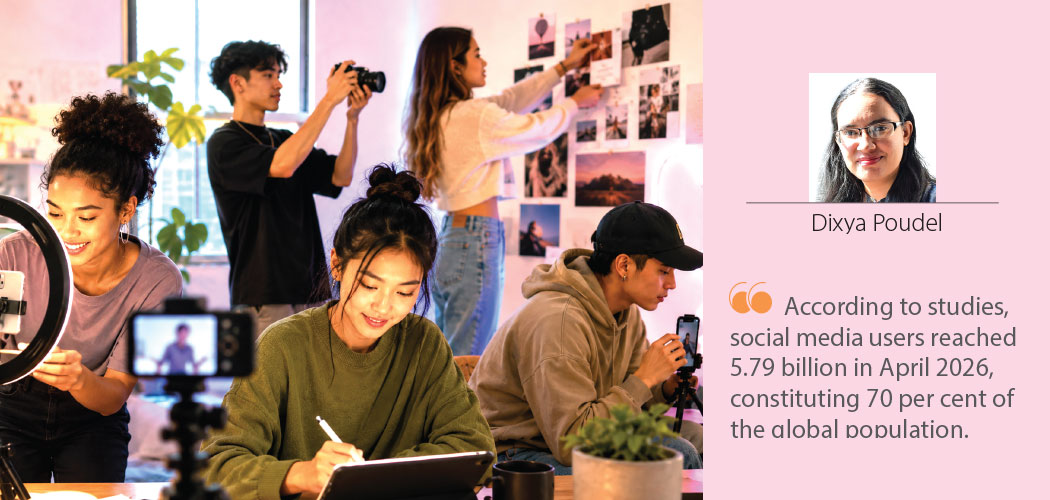

Social media has ensnared the world with its easily accessible and highly addictive content, especially among the youths. It is surprising how normalised it has become. For example, TikTok is a growing platform that is popular with the youth globally, and it has extended its reach to Nepal as well. And today if one visits a popular tourist destination, one can find young Nepali girls and boys posing for the camera. Instead of taking in the allure of the sites, they are busy photographing. Their pouts earn a slew of likes and comments on social media. Nothing escapes the megapixels of a smartphone's camera, which is directed for the purpose of display in the high-definition screens. It has called into question the zeitgeist among Gen Z, in an age when content is fuelled by and through the screen.
Everything can be content these days. Today's outfits bought in a shopping spree from a newly opened clothing store are immediately showcased on screen. Likewise, fine dining is a cause for uploading the photos of mouth-watering cuisines online. Then there are the current favourite reads that are shared on the internet, birthday and anniversary celebrations that are uploaded online with fitting captions and promotions and accolades that are shared profusely. It seems the combination of the mobile phones, internet and social media is obligatory. Life is now lived on the screen, whether one likes it or not.
As such, social media statistics are staggering. According to studies, social media users reached 5.79 billion in April 2026, constituting 70 per cent of the global population. And it continues to grow as more and more users peruse the social networking sites. Especially, the pandemic relegated people to the confines of their homes, from where they conducted their classes, work and businesses. Necessities aside, social media became a haven for connection in the social spheres.
What could be so addictive about social media? Could it be the gratification that comes from likes, comments and shares? Could it be the praise and appreciation from the social networks? Or could it be a cycle of connection, comparison and competition that leads us to tap a like on the screen? As a social animal, there is a deep obligation for connection among us. Previously, we mostly connected through face-to-face conversations or through a landline. We may even have written letters or sent a postcard. We were alerted to social news either through the vine of gossiping relatives or the whispering rumours through friends. In contrast, now social news and events are displayed on the screen. Birthdays, anniversaries and other important social events are marked on the online calendar, and the invites are sent on virtual groups. The photos of such events promptly follow with deeply curated captions. Meanwhile, the international and national news and current events disseminate through the threads of social media apps to the eager users. With such apps one cannot escape the viral news and posts that inundate the online feed.
In a way, the world has lately become a science fiction reality and is working its way towards an increasing scientific and technological advancement. Today, thanks to social media, millions of people who are influencers, activists and digital creators have earned a stable livelihood, started movements and found a platform to raise awareness of social issues. Activists are known to take to social media to pour out their outrage over current issues such as climate change and equal rights. And people are more tuned to news and current events and happenings that take place around the world, all from the comforts of their homes, thanks to social networking sites.
In the palm of the hand, we have a miniature computer that can multitask, entertain and educate us. The ease with which one can post and share photos and videos while also sending out likes and comments makes social media quite appealing to the users. However, its effects depend on how one uses such media. To those who seek to educate and inform themselves, it can be a learning experience. Further, one can also make friends all over the world or follow accounts of news sites as well as educational sites. But it is important to question the validity of news that percolates through social media.
Keeping a critical eye and an open mind is thus necessary in the virtual world. Like most aspects of life, social networking sites have their pros and cons, which is why it is important to use them prudently. Particularly the young minds should be able to discern both sides to the use of Facebook, Instagram, TikTok, etc.
They should be educated so that they can make the best of their online time. Parents have the responsibility to inform and moderate the online behaviour of their children who are growing up with the ubiquity of such apps. Thus, youths should be encouraged to navigate their time towards resourceful and meaningful online activities.
Like the rest of the world, the Nepali community too is active in social media, where photos, videos and posts congregate to form a virtual domain. It has brought a unique sense of communication wherein Nepali people can connect across cities, nations or continents. However, moderation and regulation are key when it comes to perusing social media content, especially as lives are increasingly documented online.
(Poudel is a freelance writer from Kathmandu, pursuing her MA in English Literature.)