- Friday, 15 May 2026

COP30 Fails Fossil Fuel Phase-out
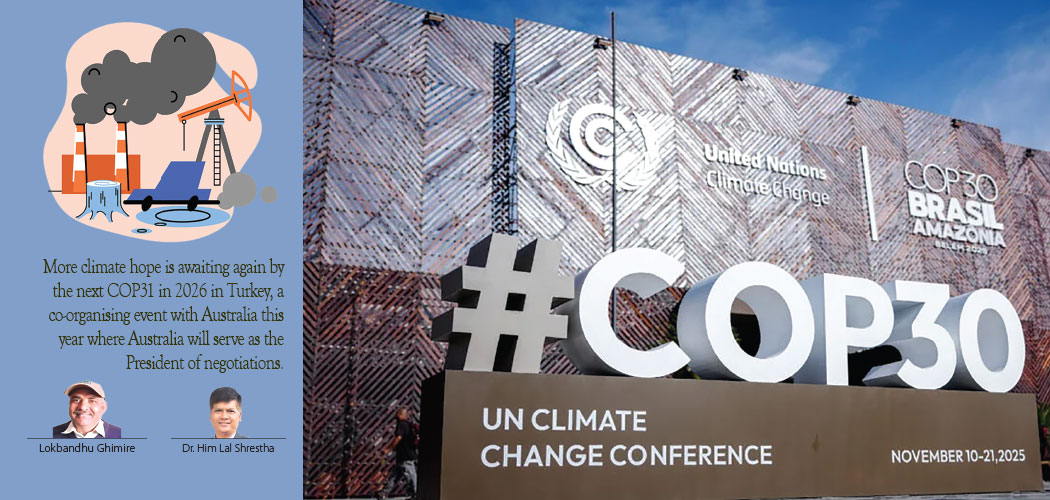

The Belem conference on climate change (COP30) was widely considered a decisive moment in global climate change dialogues. It was expected that the event could contribute to transforming the earlier political signals into concrete actions on fossil fuels. It was also envisioned that COP30 would be instrumental in formulating clear and time-bound global commitments building on the outcomes of COP28 held in Dubai, UAE, in 2023. Despite all these expectations, it concluded without any explicit agreement to phase out fossil fuels and marked a significant setback in the international climate negotiations, raising concerns about the effectiveness of multilateral approaches to climate change mitigation (World Economic Forum, 2025).
COP30’s unfinished transition
Last year, from June to August, the earth experienced a series of hottest days, with the temperature tipping point crossing over 42°C in southern Europe. Rivers dried up and water levels decreased. Spain recorded it at more than 46°C, and Turkey observed 50.5°C. Furthermore, several forest areas around the world, including California, USA, Brazil, Portugal and Spain, have been facing fire problems. And other perennial rivers have dried up across global water bodies covering richer biodiversity hotspots. The UN general secretary António Guterres has said that the global boiling era will be started now instead of ending the global warming era.
In this context, the Global Climate Report (WMO-2025) confirms that 2015-2025 are the hottest 11 years on record and that 2025 was the second or third hottest year on record, at about 1.43°C above the 1850-1900 average. Extreme events around the world, including intense heat, heavy rainfall and tropical cyclones, caused disruption and devastation and highlighted the vulnerability of our interconnected economies and societies.
So, climate change is the biggest existential problem for humanity, altering food and agriculture production which is bringing tougher challenges for all. Historically, at the beginning of the 19th century, industrial development had made a positive impact on human livelihood by enhancing socio-economic productivity as well as providing more facilities to humankind, but so far, including other anthropogenic activities, it is negatively altering our livelihood due to a higher increment in global temperature and making environmental pollution everywhere. Thus, rainfall is now being extreme and abnormal; more floods have occurred, more air pollution has been in urban areas, and more drought and much land infertility are rising, which is bringing a big challenge on ecosystem imbalance and biodiversity loss. This abnormality of climate phenomena has been exacerbated by more greenhouse gases being emitted through industrial activities.
It has been reported in 2023, on top of the Sixth Assessment Report on Climate Change by the IPCC (2023), that the accumulation of major detrimental greenhouse gases like CO₂ in the atmosphere is now 411 ppm, methane is 1922 ppb and nitrous oxide is at the 337 ppb level, and thus global temperature has been raised by 1.1°C on average. This parameter is showing an alarming situation, and the future is critical for anthropogenic civilisation. Currently, in September 2025, a published article in the journal Science has mentioned that the level of CO₂ now reached 419 ppm, which is too high on the historical record of the evolutionary palaeoclimatic timeline after 66 million years ago. The CO₂-induced increasing temperature on earth may lead to more loss and damage or casualties and can cause severe catastrophic events in society. To decrease that level, we must cut down at least 61 per cent of CO₂ emissions by 2050 with alignment to the Paris Agreement (2015) target of keeping the global temperature below the 1.5°C limitation. Hence, carbon dioxide abatement is the most urgent task through the decarbonisation of the global economy. The Paris Agreement has made a setup of a 43 per cent reduction goal to cut off CO₂ emissions from developed nations (G7) by 2035, and a faster energy transition is required through the Paris Accord to stabilise the 1.5°C temperature limit. The current publishing carbon data shows that G20 nations are responsible for two-thirds of carbon emissions globally as compared to developing nations because poor nations have no such quantitative big figure on carbon emission trajectory.
Only the USA (19 per cent), China (29 per cent) and India (7 per cent) share more than 55 per cent of CO₂ emissions in recent decades. It is indicating that setting a goal (net zero by 2050) of the Paris Agreement (2015) to stabilise the 1.5°C temperature limit is staying on the edge of peril. Therefore, the UN has always made the louder voice to phase out fossil energy and to adopt a less dependent economy on oil, gas, and coal energy systems by greener and cleaner energy transition by 2050. At that moment global civilisation was hopefully watching the COP30 negotiation result. Whereas developed nations (G7) and other G20 nations are unable to make adoption of the decoupling action plans for the fossil fuel energy transition roadmap. It was duly expected that they would be able to transform the current economic growth modality towards the cleaner and greener one.
Furthermore, eight billion people, small island nations, least developed countries (LDCs) and mountainous countries – those who are more climate-vulnerable nations – also prayed with blanket hope for a faster transition away from fossil fuel to decarbonising the global economy.
When Dubai COP28 had already internalised the fossil fuel transitional principle, everyone had been looking forward to this mandate, whatever the Brazilian COP30 would negotiate on the fossil fuel phase-out roadmap and action plan. But there has been pouring water on this issue by 1600 big petro-giants and oil companies and fossil fuel lobbyists. They poured cold water on the Paris agreement target of 1.5°C and made a more complicated or impossible task to achieve climate net zero goal by 2050.
Escalating climate disasters
According to the World Meteorological Organization (WMO), there have been a lot more climate-accelerated hazards and loss & damage incidents than in previous decades. The climatic data from 2011-2023 have concluded that there has been a threefold increase in severe climate disaster impacts by raising temperature as well as greenhouse gases in this timeline . In 2023 we saw a Libya flash flood that caused more losses of infrastructure and caused 70,000 casualties. Likewise, the Pakistan flood of later years caused heavier loss and destruction of billions worth of property. In 2024-2025 we also saw extensive loss in the Vietnam flood and, moreover, the Humla flood, Kagbeni flooding in Mustang and GLOF outburst in Rasuwa and the Thame region of Nepal resulted in more destruction of many households and livestock properties. The climate change impact has made severe losses on the forest ecosystem, which released more than 400 million tonnes of CO₂ into the atmosphere within one month. In this decade the speed of climate change has increased dramatically, and it is the warmest decade on climate record. The continuous rise in greenhouse gases lowers the humidity and leads to record rises in wetland and ocean temperatures, making the sea surface rise up to 3 metres in the coastal zone. The annual release of CO₂ is 40.20 billion tonnes, leading to more severe impacts and catastrophic events such as El Niño, heatwaves, drought, abnormal monsoon rain, sea level rise, and faster ice-melting phenomena in Antarctica and the Himalayan cryosphere.
A recent study showed that global climate disasters' economic cost is $2.8 trillion over 2000-2019, or an average of $143-300 billion per year. Hence, a lot of economic, environmental, cultural and infrastructural losses are increasing at an exponential rate that will worsen the livelihoods of poor nations and developing countries' adaptation capacity. A study report of the World Bank (2023) also estimated that the Asia-Pacific region’s 11 developing nations having mountain economies (i.e., Nepal, Cambodia, and Bhutan) may suffer from losing 4-12 per cent GDP annually by 2035 through climate change disasters.
No fossil fuel roadmap
Despite that, US president Donald Trump and Chinese president Xi Jinping were absent from the spotlight of the climate change arena where more than 193 nations' top leaders across the world had a gathering on the 30th UN climate summit in Belem, Brazil, amidst the host nation's frame of 'Global Mutirao', meaning 'collective effort on climate actions'. It is also rumored that Saudi Arabia, Russia and the UAE block petro-state representatives from negotiating a failure to phase out the fossil fuel (oil, gas and coal) transition working plan.
Even though at the frontline of this high-level summit of UNFCCC, nested discussions were made on four topics, including putting priority on the fossil fuel phase-out timeline (TAFF), collecting more forest finance, arranging the 1.3 trillion NCQG fund for adaptation and mitigation and collecting more ambitious NDC-3.
Hence, this COP is even slowly becoming successful in collecting some green finance on forests and adaptation but is fully a failure in bringing to the front discussion on a fossil fuel phase-out roadmap and got an unworthy result over the naming agreement by UAE consensus of COP28, which included a sentence calling for "transitioning away from fossil fuels in energy systems in a just, orderly and equitable manner".
There is no clearer roadmap on a transition plan that can deal with how much fossil fuel will be transitioned and what the future timeline is to be far away from it? There are completely unclear pathways. Many climate activists, climate scientists, public institutions, civil society members and AOSIS nations with climate-vulnerable countries' delegates have criticised Brazilian president Lula da Silva and his team for failure to achieve this top-priority action plan.
Unfortunately, saying that COP30 is unable to adopt the core climate action plan for a total phase-out of fossil fuel burn leads towards more uncertainty in finding global decarbonisation targets. Even though Belem COP30 was considered the Peoples’ COP, it was unsuccessful – why? The Conversation newspaper (Sep 23, 2025) pointed out five reasons for failure. First, not involving the indigenous people. And others are the power of protest, absence of the USA, the weaker Belém Package of negotiation that did not have text about fossil fuel ending, and the last one is the missed opportunity of Global Mutirao.
Forest stewardship fund
One of the long-term goals of the Paris Agreement includes making all finance flow consistent with a low-carbon economy and climate-resilient development, as called for in Article 2.1(c). Ensuring such a type of finance flows from a developed nation's side only can assure upgrading the capacity for achieving the CO₂ emission reductions, promoting mitigation, resilience and adaptation for global climate stability. In this context, COP30 now finally has agreed to establish a Tropical Forest Forever Facility (TFFF) as a stewardship fund. Similarly, to help climate-vulnerable nations and to provide more financial resources to them, this COP30 is partially successful in elaborating the New Collective Quantified Goals (NCQG) fund, having a 1.3 trillion dollar annual payment by 2035 for poor and least-developed countries.
A few months ago the world's apex supreme court – the ICJ – gave an advisory opinion to the UN mentioning the duty and obligation of the state to provide climate justice to poor and vulnerable nations and to the global South. In contrast, veteran climate activists Greta Thunberg and Harjeet Singh have said the Belem consensus of COP30 is a bad result and the climate hypocrisy of rich nations; moreover, it is a victory of climate deniers and fossil fuel companies by turning aside the fossil fuel phase-out agenda.
The Global Stocktake Report (2023) also suggested all parties take actions towards achieving, at a global scale, a tripling of renewable energy capacity and doubling energy efficiency improvements by 2030. It also includes suggestions on accelerating efforts towards the phase-down of unabated CO2 emission by measures that could drive the transition away from fossil fuels into renewable energy systems in a just, orderly and equitable manner. However, the cunning tactics of fossil fuel giants and petro-states did wrong to humankind. Even COP30 has declared the formation of the Belem Action Mechanism (BAM) but it cannot do effective work in the Transition Away from Fossil Fuels (TAFF) Roadmap, and it is hampered by political and financial hurdles.
There is also a lack of a concrete global climate action plan for adaptation that still has less green finance. So that COP30 agreements are politically weak and lack several financial specifics on the future climate mitigation pathway. There is a widening climate chasm between the Global North (global petro-state) and the Global South. It clearly shows the climate-colonial mindset of rich nations. Anyway, more climate hope is awaiting again by the next COP31 in 2026 in Turkey, a co-organising event with Australia this year where Australia will serve as the President of negotiations.
(Ghimire is a senior forest officer at the Ministry of Forests and Environment, and Shrestha is a faculty member at Kathmandu University in the Department of Environmental Science.)