- Friday, 15 May 2026

Lush Chitwan Rewards Every Traveller

After a disappointing trip to Mustang some six months ago, I decided to go on a short trip somewhere near Pokhara. Being a fastidious traveller, I hate going out of my comfort zone, meaning that I prefer road trips over trekking in the mountains. After weighing all the possible destinations, I made up my mind to visit Sauraha—a popular tourist destination located in Chitwan. Since I had not explored Chitwan thoroughly and because the place is close to my home city, I set off for a two-day trip to Chitwan on my two-wheeler.
What made me opt for a two-wheeler to travel is the newly constructed road from Pokhara to Mugling. Though not devoid of treacherous parts, the four-lane road up to Mugling was an easy ride. But when I took a right from Mugling Chowk and headed towards Narayanghat, I was quick to recall my family's instructions to be careful with heavy trucks and buses on the way. Just a few minutes into the Mugling–Narayanghat section, I observed heavy trucks and vehicles driving recklessly, trying to overtake small vehicles in a condescending manner. Throughout my whole journey up to Narayanghat, I kept on witnessing careless driving, especially by the drivers of heavy vehicles. What struck me was that no traffic police were deployed to monitor road safety. It is the very route where accidents occur every year, especially during the monsoon season. The road was quite better this time than the previous time I visited, but it still sparks ample doubts about travelling through it. In contrast, the wide, spotless roads of the Bharatpur area gave an impression of a grand city somewhere outside Nepal. In terms of road infrastructure, I felt that Chitwan stood way ahead of other major cities, if we excluded the perilous Mugling–Narayanghat section.
Bustling sidewalks
Since I was riding my own vehicle, it was easier for me to travel from one place to another. Had I relied on local vehicles, the need to frequently change them would seize my time, making me skip some important places. If you are a skilled and experienced driver, you should avoid travelling to Chitwan on public vehicles. In less than ten minutes from Bharatpur, I reached Beeshhajar Taal—a wetland inside the buffer zone of Chitwan National Park. Being a resident of Pokhara, I had thought that this “taal” would resemble popular lakes from Pokhara. Only when I reached its main gate did I realise that it is part of Chitwan National Park, thus requiring security forces and strict monitoring. Unlike the lakes in Pokhara—that are always bustling with tourists—Beeshhajar Taal offers tranquillity, accompanied by the melodies of birds. I walked by the banks for an hour in the hope that crocodiles would emerge from the water. Unfortunately, it didn’t happen, but I was not disappointed, thanks to the greenery around. If you don’t compare this wetland to other famous lakes across the country, you’ll discover its uniqueness, because the lake is more about the jungle than the water itself.
It was not the first time I had walked along the banks of the Narayani River. After spending almost a couple of hours in Beeshhajar Taal, I returned to Bharatpur, ate a heavy lunch at a famous restaurant, and headed towards the river in the evening. From my previous visits, I had picked up that this place was ideal for an evening walk. The pavement was lined with stalls that sold chatpate, ice cream, and other fast food items. People sat by the river and enjoyed the fresh air. For people exhausted after a long day in Chitwan’s heat, this place invigorates and prepares them for the next day. It is not an extraordinary place by any means, but as on previous visits, I relished my evening before heading off to my final stop: Sauraha.
Amazing Sauraha
Upon reaching the heart of Sauraha, I almost compared the place with the Lakeside of Pokhara, solely because of the large presence of resorts and restaurants. Looking at the crowd, I observed that the hospitality business in Sauraha has been enjoying significant growth. The elephants graced the streets as if welcoming the tourists. Even though it was just the beginning of summer, the heat was unbearable for me. If you are one of those who can’t tolerate the heat, your stay in Sauraha will not be pleasant. In the evening, the resort owner suggested I experience a Tharu cultural show to be exhibited nearby. My expectation was that I would be taken to some Tharu village nearby, where I would get to see their iconic dance—something that I had observed on social media. To my disappointment, the show was exhibited in a commercial hall. Though the show was thrilling—especially the part where performers deftly swung their sticks—it felt more commercial than cultural. If only the performance were done in the courtyards of some Tharu village, the show would duly carry the essence of their culture.
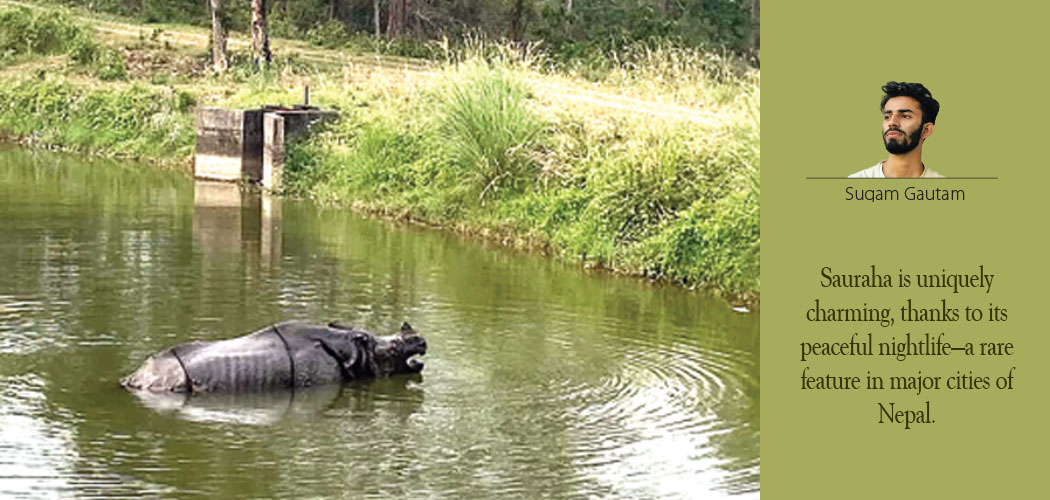
The next morning, I booked a jeep safari that would ferry me and other visitors through the wild forests of Sauraha. My mind had already mapped out the figures of a tiger and a rhino. When the guide travelling with us instructed everyone to be quiet so as not to disturb the wild animals, I was pretty sure that I would get to see tigers from a close distance. The mere imagination kept me on edge. But as we kept moving to the inner core of the jungle, I could only see peacocks, deer, crocodiles, and at one point, a rhino soaking itself in a pool. Because the guide later mentioned that one should consider themselves lucky if they saw a tiger, I labelled myself unlucky.
Throughout the two hours of the jeep safari, I liked how the guide kept describing whatever we came across. Regardless of his old age, he exuded the aura of a curious young man. The guide was exactly how a guide should be—no wonder the hospitality business in Sauraha is flourishing. One particular thing I liked the best about Sauraha is its quiet simplicity. You don’t hear raunchy lyrics emanating from the restaurants. The locals were humble and responsive to my queries. Sauraha is uniquely charming, thanks to its peaceful nightlife—a rare feature in major cities of Nepal. For someone who prefers a peaceful vacation, Sauraha should come as a first choice. What I regretted after coming to Pokhara was that I didn’t try Ghongi, a Tharu food that has increasingly become famous in Chitwan and beyond. Perhaps my subconscious mind dismissed that food so that I would have some excuse to return to Sauraha again.
(Gautam is a writer from Pokhara.)