- Friday, 15 May 2026

Dolakha Coin: Myth And Reality
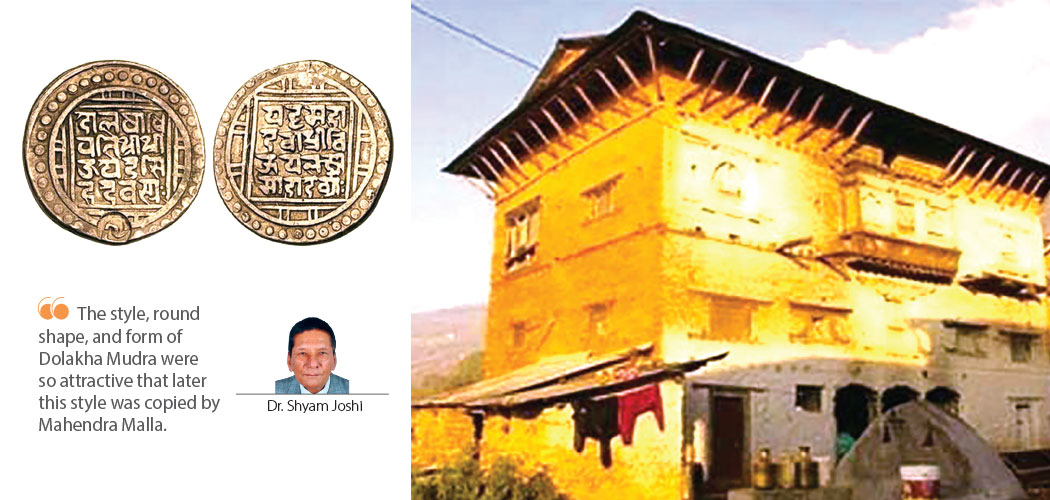

As written in history, Kirti Singh was the ruler of Dolakha from 1510 B.S. to 1531 B.S., followed by Uddhav Dev. After the death of Yachhe Malla, king of the Kathmandu Valley, in 1548 B.S., Indra Singh Dev, the ruler of Dolakha, tried to free Dolakha from the centre and began to address himself as "Dolakhadhipati". Indra Singh Dev freed Dolakha from the centre by making the treaty of 1605 B.S. and began to write "Rajadhiraj", which is used to address a king. He minted and brought into circulation his own silver money in the form of coins in 1603 B.S. Earlier, Mahendra Malla of Kathmandu minted and circulated “Mahendra Malli". The term “Dolakhadhipati” is clearly inscribed in the coinage. As a result of increased trade relations with Tibet, there was an increase in the economic prosperity of Dolakha.
Thus, Dolakha was an independent kingdom for about a century and ceased to be independent when Dolakha was conquered by Shiva Singh, the Malla king of Kathmandu, in about 1600 AD. Contrary to the view that Mahendra Malla was the first to mint large silver coins in Nepal, he minted silver coins only more than a decade later. He had to take approval from an emperor in Delhi by sending him valuable gifts, whereas Indra Singh, the ruler of Dolakha, minted independently. This shows that the kingdom of Dolakha was fully independent, while Kantipur was not in the real sense.
Formerly, there was a biased view even among historians that Mahendra Malla of Kathmandu was the first to mint silver coins (mohar) in Nepal. However, according to Nicholas Rhodes, the first state to strike large silver coins in Nepal was the little ancient kingdom of Dolakha, situated in the “valley of the Tamakoshi", predating the Kathmandu Valley Malla coins. In the mid-sixteenth century, Jaya Indra Singa Dev, the king of Dolakha, struck fine silver coins known as 'tankas' around 1545 AD (Nepal Era 666), weighing about 1 tola (11.6 gm). It should be clear that 'tanka' means one rupee and 'mohar' denotes fifty paisa in Dolakha, but the mohar stated about these coins is a rupee.
Dhanabajra Bajracharya and Tek Bahadur Shrestha (An Outline of the History of Dolakha) opine that Indra Singh Dev seems to have brought gold from Bhot to exchange with silver from India for minting coins. They mention that all the coins minted during the reign of Indra Singh Dev were fine silver tankas, and no minor denominations are known. However, the coinage was short-lived, and all known specimens were of the same basic design. The inscription on the coin may be translated as “(coin) of Jaya Indra Singh Dev, Lord of Dolakha, and of Queen Vijaya Lakshmi Mahadevi".
Bajracharya and Shrestha do not deny that Dolakha was the first kingdom to mint silver coins when they write, "Indra Singh Dev, the ruler of Dolakha, was the first to introduce silver money among the rulers of Nepal in the mediaeval period." The other rulers of Dolakha did not mint coins, and even his coins do not seem to have come out in large amounts.” However, N.G. Rhodes contradicts some of their views in these words (The Coinage of Nepal): 'Very few of these tankas have survived, although the fact that the six known specimens are struck from six different obverse dies and four different reverse dies indicates that the issue was on a reasonably large scale. Certainly, it cannot have been purely ceremonial in nature.”
According to historian Mohan P. Khanal, Shri Indra Singh Dev (1540–1548 AD) was the first ruler of Dolakha to be called 'Rajadhiraj'. He minted coins in his own name and brought independent silver mohar (tanka or rupee) into circulation. Top historian Babu Ram Acharya opines, "The kings of the four Newar kingdoms of the mediaeval period used to address themselves as 'Nepaladhipati', but he began to address himself as ‘Dolakhadhipati’ instead of 'Nepaladhipati', thus limiting the boundary of then-Nepal to only up to Sunkoshi.” So, minting coins by Indra Singh Dev in his own name was also to assert Dolakha as an independent kingdom.
Contrary to earlier views, Mahendra Malla (1560–1574) was the first king to introduce a silver mohar (rupee) only among the Malla kings of the valley. Bajracharya and Shrestha opine, "The style, round shape, and form of Dolakha Mudra were so attractive that later this style was copied by Mahendra Malla. However, the significance of these two coins is so great that Dolakha Mudra together with Mahendra Malli replaced the Indian currency in circulation to a greater extent.”
The National Museum notice informs: “A silver coin of 10.49 grams was issued for the first time in the Kathmandu Valley by King Mahendra Malla; hence, the coin is named ‘Mahendra Malli Mudra.’” It was sold by Rhodes for £580 in a live auction. Its auction notice mentions the following: Obverse: Srimat Kathmandu pasyadhipati; reverse: Sri Sri Jaya Mahendra Malla Devasya. Its weight is 10.08 grams. But as mentioned by Rhodes, the coin sold was a forgery, not a real one.
Similarly, the National Museum notice informs, "A silver coin is issued for the first time in Nepal’s history in Nepal Era 666 (1545 AD) by Indra Singh Dev from Dolakha, 138 km east of Kathmandu, and the coin is named ‘Dolakha Mudra’ with a standard weight of 11.6 grams (1 tola).” Its auction notice mentions the coin has the legend “Dolkhadhipati Sri Sri Jayendra Singh Devasya” on the obverse and “Patta Mahadevi Sri Vijaya Laxmi Maha Debya” on the reverse. At the time of auction, its weight was 10.36 grams. The silver tanka (or rupee) of the Kingdom of Dolakha was sold by Rhodes for £6000 in a live auction, or about 12 lakh rupees today.
Rhodes mentions that the design of the coins of Indra Singh Dev was very similar to certain Muslim coins, with a legend in a square within a circle. The Dolakha coins were, however, the earliest Hindu coins we know of that have the legend in a square. These coins mark a pivotal moment in Nepali numismatics, establishing silver coinage in the region.
Only two Dolakha Mudra were found—one in the Nepal Museum and the other in the collection of Nicholas Rhodes, the author of The Coinage of Nepal. As the auction notice describes: “This coin is very fine and extremely rare, a unique specimen of this variant. This is the first Nepalese coin of the Malla Era that mentions the name of a queen: Lakshmi Devi.”
(Joshi, a professor of business economics, writes on economic and cultural topics.)