- Friday, 15 May 2026

Sawe Breaks The Two-Hour Barrier

Along the Victoria Embankment, where the River Thames bends toward the heart of London, the air usually carries the heavy weight of expectations and the distant roar of 800,000 voices. But on the morning of April 26, 2026, as the lead pack of the London Marathon turned toward the final stretch, the atmosphere shifted into something closer to a collective intake of breath. The red digits on the lead car’s clock were doing something the world of athletics had long considered a mathematical hallucination. They were ticking toward a number that began with a one.
In the centre of that wavering heat of effort was Sabastian Sawe. For nearly two hours, the 31-year-old Kenyan had moved with a rhythm. His feet were barely whispering against the pavement in shoes that weighed less than a bar of soap. As he rounded the corner past Buckingham Palace and onto the Mall, a realisation hit the crowd: the most famous barrier in sports was not just being challenged; it was being dismantled.
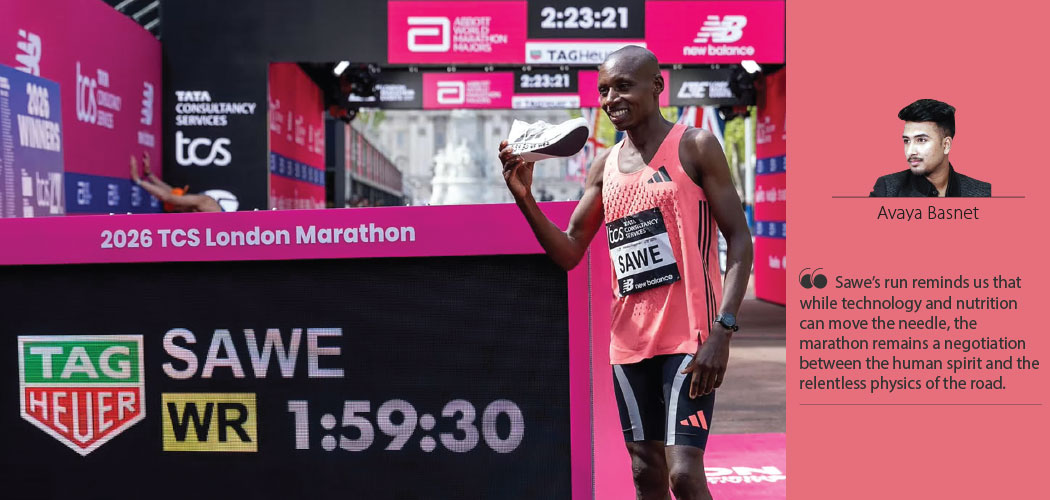
When Sawe crossed the finish line in 1:59:30, he didn't just win a race. He resolved a decade-long debate about the outer limits of human endurance.
The journey to this sub-two-hour reality began far from the streets of London, in the village of Barsombe in Kenya’s Rift Valley. Sawe grew up in a house with mud walls and no electricity, raised primarily by his grandmother while his father worked as a maize farmer. He was a late bloomer in the marathon world, originally a middle-distance runner who only ran his first 5,000-meter race in 2019 because he arrived late to a meet and it was the only event left.
That coincidence set him on a path to the 2Running Club in Nandi County, under the guidance of Italian coach Claudio Berardelli. Sawe became known as the "Silent Assassin", a man who preferred the repetitive, lonely work of high-altitude training to the spotlight. In the six weeks leading up to London, he averaged 125 miles a week, peaking at a staggering 150 miles—a volume that sits at the very ceiling of what the human frame can withstand.
The significance of Sawe’s 1:59:30 lies in its officiality. In 2019, the great Eliud Kipchoge famously ran 1:59:40 in a Vienna park, but that effort was a choreographed exhibition, aided by rotating teams of pacemakers and hydration delivered by bicycle. World Athletics, the sport's governing body, refused to recognise it as a record. Sawe’s run, by contrast, happened in an open, mass-participation race under strict competitive rules. He had no wind-blockers cycling in and out; he only had the raw, unrelenting pressure of world-class rivals.
The race was a "perfect storm" of conditions. The temperature hovered at a crisp 11°C, and a rare tailwind along the Thames pushed the leaders home. Sawe was not alone in his pursuit. He was shadowed for 40 kilometres by Ethiopia’s Yomif Kejelcha, a track star making his marathon debut, and Uganda’s Jacob Kiplimo.
The strategy was a masterclass in the "negative split"—running the second half of the race faster than the first. After passing the halfway mark in 1:00:39, Sawe surged. He covered the final 21.1 kilometres in an astonishing 59:01, a time that would win most standalone half-marathons. In the final two kilometres, Kejelcha finally buckled, his legs "done", while Sawe seemed to find a hidden reservoir of energy and sprint alone toward the tape.
"I have shown that nothing is impossible," Sawe said afterward, still wearing the 97-gram Adidas "Super Shoes" that have reignited debates about "technological doping". To combat the inevitable scepticism that follows record-breaking Kenyan performances, Sawe and his sponsors had paid for a "mad" regime of drug testing—25 tests in the months leading up to the race—to ensure his legacy was beyond reproach.
The reaction from the running world was one of shock. Steve Cram, commentating for the BBC, compared the moment to Sir Roger Bannister breaking the four-minute mile in 1594. "None of us ever thought we would see that, especially in London," Cram said. Even his rivals were stunned; Kiplimo, who finished third in a time that also would have broken the previous world record, admitted, "At 35 km, I thought these guys were running too fast... it was amazing."
For the future of the marathon, the 1:59:30 has moved the goalposts. The two-hour mark, once a mythical ceiling, is now a baseline. Both Sawe and his coach believe a 1:58 is possible on a flatter course like Berlin or Chicago.
As the sun set over the Mall, Sawe celebrated with the same simplicity that fuelled his 150-mile weeks: a quiet night of rest. He had fuelled his record-breaking morning with nothing more than two slices of bread and honey for breakfast.
It was a grounded end to a day that reached for the stars. Sawe’s run reminds us that while technology and nutrition can move the needle, the marathon remains a negotiation between the human spirit and the relentless physics of the road. On a spring morning in London, the spirit won, and the impossible simply ceased to exist.
(The author is a sports journalist.)