- Tuesday, 2 June 2026

Applauding Legacy Of Teacher
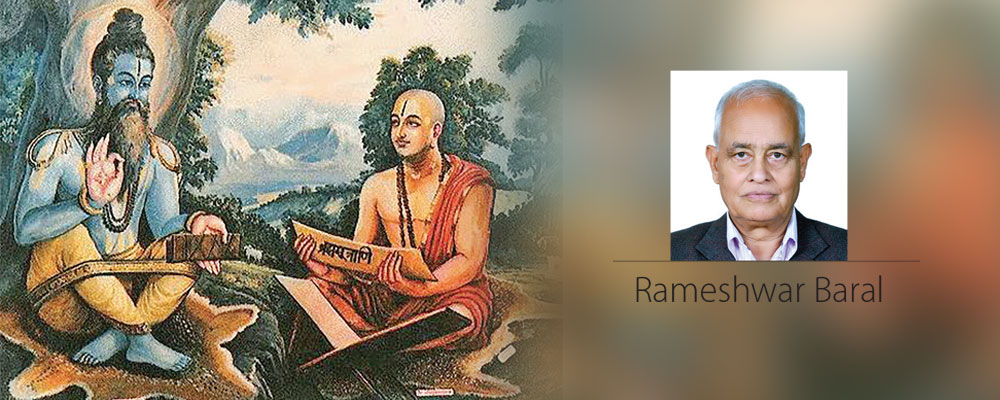

A book is a silent teacher, and a teacher is a loud book – it’s inspiring to hear when students say that they have two kinds of teachers. Until the university level, students are associated with such silent and loud teachers. After school and college, the university becomes their ivory tower, which is beyond the reach of the common people. When they come down from the tower to be in a profession, their inner tool of knowledge and wisdom exposes them to the outer world. They have a lifelong obligation to the teachers (and professors) who were their guides, instructor, mentor, and more during their learning periods. Knowledge and wisdom are life forces that help them become ideal citizens towards their nation’s liability. Therefore, as they were praying to Saraswati, the goddess of learning, in student life, they express respect and regard also to the virtual teachers on the birth anniversary of Veda Vyasa. On one hand, they express honor and respect to the teachers and professors on this day, while on the other hand, they commemorate the birth anniversary of Veda Vyasa.
Guru Purnima occurs on the full moon day of the Bikram calendar of Ashadh every year. It is a special day when students honour and praise their teachers outside the classroom. It is also an auspicious occasion of the holy birth anniversary of Vyasa, who wrote the Vedas. In Vaidic Hindu culture, Ved Vyasa is known as Maharshi - Rishi the Great - and is revered in the gurukul tradition by the learners. On this day, school and college students offer flowers and garlands and respect their teachers with mantras and gift packets. In the Devanagari script, the guru has two syllables: gu and ru. ‘Gu’ means darkness or ignorance, and ‘ru’ means light or enlightenment. Gurus are mentors who lead their disciples from ignorance to enlightenment. They instruct them on how to live well in tradition, ethics, and discipline, and then release them in the outer world to begin their own families and lineages. The term “guru” has a broader and deeper meaning than “teacher”, which may imply a narrower and shallower role of someone who only teaches their subject matter.
Vaidic history has a great respect for Maharshi Vyasa for his Vedas, Upanishads, Mahabharata, and Gita. It is believed that he was powerful in the creation and composition of whatever is in his name now. However, his writing skill was not as strong to write them down. Therefore, another revered god Ganesh wrote down as per the Maharshi’s dictation. It’s amazing to imagine how quickly Maharshi, a super-fluent composer, and Ganesh, a super-fluent god, worked together to take dictation over a huge volume of papers (in truth, Bhojpatra tree barks served as paper than to write on!) required to write out all the works.
Birth legend of Vyasa
Maharshi’s birth in the Dwapara age was surrounded by a unique and miraculous event. As the legend goes, Rishi Parashara (Maharshi’s father) wanted to cross the Yamuna River on a boat one afternoon. The only person who could help him was a young daughter of a fisherman guarding the boat. As soon as Parashara spoke to the girl, he foresaw something special in her and asked her to bear his child. At this the girl laid down three conditions: that she should be mature, that she should lose her fishy smell, and that they should not be seen by anyone during those particular moments. Parashara granted her wishes with his superhuman power. First, he made her mature; second gave her body a sweet fragrance instead of a fishy odour; third, he instantly created a fog in the surroundings to hide their activities. There was also a fourth blessing: her virginity would be restored! Thus, they had a physical union, and the girl immediately gave birth to Vyasa. As soon as he was born, Vyasa immediately said goodbye to his mother and left for the Himalayas to meditate, still carrying his umbilical cord over his shoulder. But he promised his mother, “I’d visit you whenever you need me.” After the birth of Vyasa, Parashar dispelled the fog he had created to return to the same bright daylight. It is said that this was the first fog on Earth’s atmosphere, which we see repeatedly today. Vyasa attained great success in meditation, became a Maharshi, and performed great deeds. He also authored the sacred books mentioned above.
According to one legend, the Maharshi fathered Dhritarashtra and Pandu through a mystical union called Niyoga with their mothers separately who were the widows of his half-brother Vichitravirya. The widow Ambika closed her eyes during the union with Vyasa and as a result, her son Dhritarashtra was born blind. Similarly, another widow Ambalika turned pale during the union with Vyasa, and her son Pandu was born pale. However, Vidur was born to their maidservant who willingly and cheerfully agreed to bear Vyasa’s child. This is how Vidur was born wise and clever, as he received the blessings of Vyasa and his mother who had cooperated in the Niyog. Vidur played important roles as a minister and adviser in the court of Dhritarashtra.
Vyasa’s teachings
Besides the Vedas, Maharshi Vyasa wrote the 18 Puranas and established the system of teaching them as true gurus through ‘upakhyans’ or discourses. He stressed karma, devotion and dedication, knowledge and wisdom. The entire works contain a lesson in a capsule: helping others is virtue; harming others is sin. In other words, the message promotes the ethical principle that the whole world is one family in fellow feeling and peaceful living. He also composed the Mahabharat which holds a distinct message – if two cousin families fight, they end themselves mutually. The battle of Mahabharat demonstrates the negative consequences of family conflict and the need for peace and harmony. This epic contrasts with the theme of Rishi Valmiki’s Ramayan, which teaches the ideals of respecting elders and obeying parents. The Ramayan narrates how Ram sacrificed his kingship and kingdom to carry out his father’s order. In today’s turbulent world, Vyasa’s realistic teachings may be more relevant than Valmiki’s idealistic ones.
(Baral is a retired lecturer of English.)