- Tuesday, 2 June 2026

The Culture Of Responsibility

We learn some words and phrases in our childhood that shape how we think and behave throughout our life. One such phrase we have internalised is “rights and duties,” applicable to all spheres related to household works, group activities, and state affairs. The same phrase has now changed into “rights and responsibilities” across many cultures. This phrase has not changed with a group decision one fine morning. No deliberate effort of a small group can abruptly introduce a word and have full control over its meaning. Language borns and develops in a specific linguistic community over time and space. Usage is the judge of language forms and meanings.
As soon as people began to live in a tribe or a larger community, they developed a sense of duty in several domains of life. Under feudalism, the masters used to keep servants as they tamed cattle, whose duty was to serve their masters. Even women had to serve men in household chores as duties. At the community level, the serfs had to perform their duties in service to the landlords. In state affairs, the subjects had to impart their duties to the luxurious kings, who belonged to the feudal upper class.
Different connotations
But in the aftermath of democratic revolutions such as the American Independence (1776), American people considered themselves endowed with the inalienable rights of “life, liberty, and pursuit of happiness.” French Revolution (1779) ensued, which also declared people free from all bondage, so the French people thought of themselves to be equal to the ruling class. With the Marxist revolutions, the Russian and Chinese communists began to address each other as comrades, intending to mean they all were equal. These revolutions led to the growth of awareness in people to use words that connote equality rather than hierarchy. Despite similarities in denotations of the words “duty” and “responsibility,” their connotations are thus apparently different. It is thus essential to understand that the two words have different connotations.
Suffice it to suggest that language change largely depends on the socio-political context. While the word “duty” was previously associated with feudalism, “responsibility” has more to do with democratic principles and values that have evolved in modern times. Today we like to talk of our “responsibility” to fulfill rather than to impart our “duty.” Since democracy is based on the rule of law, the statute stipulates that the heads of state or the government are bound by their responsibility in exactly the same way as the general people are, despite differences in the gravity of their responsibility. According to this dictum, an office clerk may have a lower degree of responsibility while the person of a supreme state position obviously has a larger degree. Their degrees are different because the impacts of their decisions and actions are also different. The violation of responsibility by a clerk may not be detrimental to the larger society.
But what would happen if, for instance, the commander of riot police orders its troop to shoot at a gathered mass which, in fact, was not essential in the context? What, for instance, would happen to the entire nation and its people if a supreme ruler decides to allow the annexation of their country to another powerful country? But these unfortunate events do not usually happen because the persons in charge are highly guided by a sense of responsibility. Yet, a multimillion-dollar question lurks in our mind: to what extent have we been responsible for fulfilling our responsibilities in the aftermath of revolutions? The tentative answer to this intricate question is: citizens are responsible in a country where every citizen sincerely follows the rules of law, but they are not much responsible in a country where democracy hangs overhead and the rule of law is suspended for the interest of the ruling class.
In our dear homeland, I regret to say we have not yet developed a sense of responsibility. I do not say we once had it, but now it is degenerating, just as some nostalgic people would rather say feudalism was better than democracy. The people were indeed conscious of their “duty” under the absolute monarchy because they were under the sword. Today we are free, so we must cultivate a culture of “responsibility.” Business enterprises in the private domain are slightly better at fulfilling their responsibilities. Those enterprises which have a better management system have prospered while others have declined. But even the workers in business enterprises appear responsible without being so. They work not much because they have cultivated a sense of responsibility but more because they fear being sacked by the employer.
Public domain
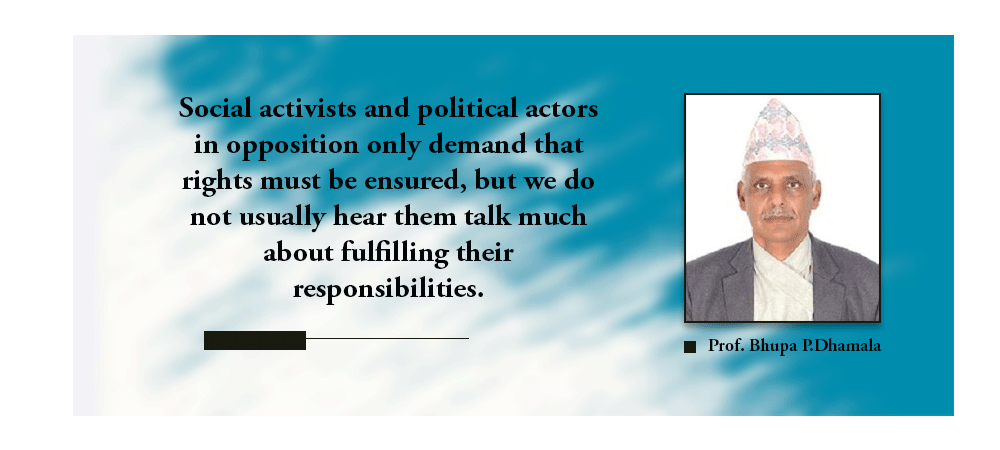
The worst cases are found in public domains. When we go to government offices, we often find the official desks empty. Even though we see the concerned officials at the desks, they are reluctant to serve us without their interest. The situation of public schools is not better either. The teachers may not be found in the classroom. Even if they are present, they are reluctant to teach well. These are representative examples to suggest that the persons in public positions who are expected to be accountable to the stakeholders are nonetheless irresponsible. The most detestable thing we often hear in Nepali society is that social activists and political actors in opposition only demand that rights must be ensured, but we do not usually hear them talk much about fulfilling their responsibilities.
We cannot be assured that the leaders of what they call marginalised groups, such as indigenous communities and gendered groups, are engaged in social activism without their personal interests. It is essential to understand that rights and responsibilities go together, so we must act accordingly. In order for this to happen, first and foremost, the leading class – social activists as well as political actors – must be responsible as ideal examples for others to follow. Then the rest of the citizens begin to think and behave responsibly.
(The author is the chairman of Molung Foundation. bhupadhamala@gmail.com)