- Friday, 29 May 2026

The Onus Of Keeping Promises

We make many promises to our family, friends, and others in a special context, but we fail to keep some of them for one reason or another. While some promises are made only to avert immediate nuisance at work in everyday affairs, others are consciously made to solve problems or alter the existing situations that come across the life of an individual or institution. I wonder if we remember many such promises made to our children whom we need to encourage doing things we want them to do and prevent them from harming their health or overall personality development.
We can keep some of the promises, such as purchasing a new school bag or clothing. But can we, for instance, buy a bicycle or bike which is not appropriate for the age of our children? Or can we buy a luxurious car for our spouse without an adequate bank balance? Or can we lend the amount of money to our relatives or friends which we ourselves do not have? These are some obvious examples of promises that often come across in everyday mundane activities, but we are presumably not able to fulfill them. Individual promises are limited within personal relationships, so they are not as serious as institutional promises. Among others, most impact-making institutional promises are cultural and political, as they affect the life of a community or the society as a whole.
Religious promises
One of several cultural institutions is religion. In both eastern and western cultures, religious leaders projected their religions as a source of bliss and perfection. The concept of everybody's happiness in Rama's Kingdom was an ideal promise. But toward the end of his life, believing in the words of the quarrelsome conversation of a washer man with his wife one night, Rama himself was skeptical about Sita's faithfulness to him and abandoned her as his wife forever. How then can his people be assured of promise while his own dear wife had to spend solitary life longing for her dear husband?
Gautam, the Buddha, also promised to free all people from pain, saying that the source of all dukkha (suffering) was desire. Despite the promise of making all people free of suffering, it still exists on earth and recurs in the life of people persistently. The haunting desire for comfort and luxury is still hanging overhead, even within the Buddhist community, let alone in others. In the west, too, Christianity was another religious project promised by Jesus Christ. He professed his conviction to redeem all sinners by sacrificing his life in crucifixion. His disciples propagated the message that people would be free of sin, strictly following the principles of Christianity. But this promise with the blood of Christ has not been fulfilled either.
Not even crossing one millennium, Islam was born out of the womb of western religion. Islam, too, has an ideal promise to make all people happy by the grace of God. This religion has quickly spread worldwide, making its population 1.9 billion within a millennium and a half, nearly one-fourth of the entire population on earth. Beautiful though their promises are, religions have not united the world in one thread. Instead, they have divided people into different sects, triggering even the most unfortunate crusades resulting in bloodshed and genocide. Despite their commitment to being pacifists, followers of these religious sects are always in conflict – Vaishnava, Shakta, and Shaiva sects in Hinduism, Mahayana and Hinayana sects in Buddhism, Catholic and Protestant sects in Christianity, and Sunni and Shi'a sects in Islam.
The most debatable promises are prevalent in the political field. All modern states – autocracies or democracies – promise liberty, civil rights, social justice, prosperity, and happiness. But most political promises, by virtue of their being utopian, have turned dystopian in many parts of the world, Nepal not being the exception.
Thomas Jefferson (1776) inscribed a promise of ". . . life, liberty, and the pursuit of happiness" in the American Declaration of Independence. The United States of America, once a colony of Great Britain, is now not only decolonised but claims to be the most democratic country in the globe. But the promises Jefferson made almost two and a half centuries back have not yet been fulfilled. Instead, the disgruntled non-white Americans say that the USA is still a racist, classist, and sexist country practicing inequality at all levels.
Almost one century later, the German philosopher Karl Marx promised communism, where all people on earth would be absolutely equal. Many countries like Russia, China, North Korea, and Cuba followed the "Communist Manifesto" and brought about a revolution claiming that proletariat dictatorship would make all equal. But the promises have been frustrated by the communist parties being divided even in a single country, signifying nothing.
Political promise
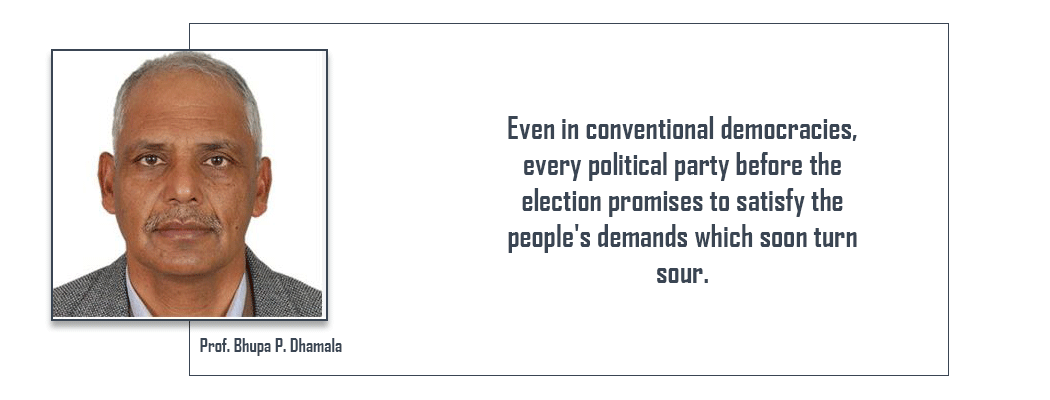
Even in conventional democracies, every political party before the election promises to satisfy the people's demands which soon turn sour. Among many things the leaders promise, there are some common promises such as "we put country before party," "we put people at the top priority," "we guarantee liberty and human rights," etc. But the moment they win the election, they are engaged in political affairs, forgetting their promises to the people. This does not mean, however, they are dishonest. Yet fail to deliver their promises being incapable of performing the promised acts.
The above instances are enough to suggest that it is easy to make promises but difficult to keep them. What might be the reasons for their not being able to keep promises? Most obviously, political parties and their leaders are constrained by opponent political forces, which may or may not have fair purposes in so doing. Those in power promise but the opposition only protests. This, unfortunately, is political malpractice. In the case of religious promises, leaders cannot fulfill their promises because people of different communities have divergent belief systems that are essentially in conflict.
(The author is the chairman of Molung Foundation. bhupadhamala@gmail.com)




-original-thumb.jpg)