- Friday, 29 May 2026

Using Aerosols To Tackle Climate Change

The issue of climate change has taken global proportions. The problem has risen since the Industrial Revolution. Anthropogenic activities are largely to blame for the emergence of climate change. Greenhouse gases - carbon dioxide, methane, nitrous oxide, water vapor and ozone - are responsible for raising temperatures. Efforts are being made around the world to limit the earth’s temperatures to 1.5 to 2 degrees Celsius vis-à-vis pre-industrial levels at the end of this century as put forth in the Paris Agreement. But it is estimated that the temperatures will be up by 2.5 degrees Celsius. Even if temperatures rise by only 1.5 to 2 degrees Celsius, humanity, ecology and global economic systems will be affected.
Amid growing fears of looming catastrophic impacts of climate change as well as challenges of tackling such impacts by taking climate action measures, the Expert Panel convened by the United Nations Environmental Programme (UNEP) published a report on February 27. The report prepared by as many as 70 scientists from around the world has suggested solar radiation modification (SRM) to tackle climate change to some extent. The report has highlighted the impacts of climate change on public health, economic security, international stability and the ecosystem and accentuated the need for mitigating such adverse conditions as climate change risks are rising. The report has mentioned that reducing greenhouse gas emissions to curb rising temperatures is important and that efforts being made to this end are not adequate.
Aerosols
On the one hand, there are greenhouse gases that are making temperatures rise, while there are aerosols that help cool the climate when emitted into the atmosphere. When sunlight falls on aerosols, it disperses. When aerosols mix with clouds, the clouds’ reflexivity increases. Aerosols also help control one third of greenhouse gas emissions. That is why it is not exactly known how much contribution greenhouse gas emissions make to increasing temperatures. The SRM is a technique under which three methods of reducing temperatures are used. The Expert Panel has also proposed these methods. All these methods are based on the use of aerosols. The basic thrust of the SRM is to reflect sunlight back to outer space or make heat escape from the surface of the earth.
The methods are aerosol injection into the stratosphere, marine cloud brightening and cirrus cloud thinning. When aerosols are injected into the stratosphere, they reflect sunlight away from the earth. Under marine cloud brightening, salt or other chemicals or particles are sprayed into marine clouds, enhancing their reflectivity. Likewise, under cirrus cloud thinning, cirrus clouds are thinned and harmful radiation is reflected back to outer space through aerosol seeding. However, this method is not effective in preventing sunlight from reaching the earth.
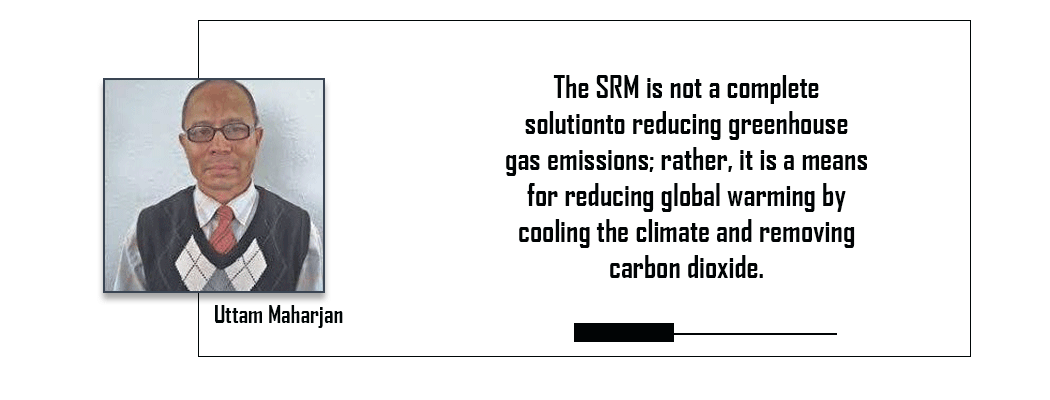
The scientists involved in preparing the report have claimed that there may be pressure on adopting any means of reducing rising temperatures given the dire effects climate change is producing all over the world. However, the SRM will not address climate change issues fully; it will not be possible to fix the impacts that have already emerged. The SRM is not a complete solution to reducing greenhouse gas emissions; rather, it is a means for reducing global warming by cooling the climate and removing carbon dioxide.
The SRM will take time for deployment. Scientists have not clearly understood the SRM and its potential risks. The impacts of the SRM on low- and middle-income countries are yet to be fully studied. Such countries may face SRM-generated impacts on agriculture and other sectors. The use of the SRM may produce adverse effects such as excessive rainfall or drought. The Expert Panel has, therefore, suggested that it is not advisable to deploy short- and mid-term large-scale SRM deployment right now. If climate action is not adequate, the SRM may be deployed. The SRM can be deployed one or two decades from now.
Additional discourse
So the scientists involved in the report have urged the world community to study and research on the SRM. They have suggested that an additional discourse on the SRM is imperative and cooperation at a global level is a must. The SRM and suchlike techniques are being raised in scientific and public forums. There has been much headway in understanding the SRM. Still, it is prudent to fully understand it in terms of its impacts before deploying it. The good point of the SRM is that it works quickly. It can cool the earth within months after deployment. Although damage already done to the environment cannot be rectified, the SRM can act as an effective tool for curbing rising temperatures by cooling the planet.
So the international community should heed the proposals on the SRM in earnest. As mentioned in the report, comprehensive regional and international review studies of the SRM are needed. The study should be transparent and open access to necessary data should be provided. Scientists are hopeful that at a time when global warming is impacting the earth, the use of the SRM will come in handy in reducing global warming. Climate models show global, regional and local temperatures and precipitation can be restored to the pre-industrial levels but it is not possible with the SRM. However, it can give some respite when it comes to tackling climate change.
(Maharjan has been regularly writing on contemporary issues for this daily since 2000.)


-original-thumb.jpg)