- Friday, 29 May 2026

Ukraine War, A Year On

Even as the Ukraine war has just completed its first year this week amidst a parallel war of black propaganda, there should have been “ground” for the West to be in an upbeat mood. But that does not seem to be the case. Is the exterior confidence on the Western front only a façade behind disquieting conditions? A “limping” Russian President Vladimir Putin, faced with “rampant disgruntlement” in the army over the Ukraine crisis together with obsolete weapons, was projected as someone close to suffering a military coup. Reports originating in Western press since long have been reporting that Putin’s health is in serious conditions. According to European agencies, 50,000 troops and civilians have been killed.
But why, then, the prevailing panic in the ranks of Putin’s vehement foreign opponents? The fear of having to concede agenda setting roles to also others and share space with various groups in a multipolar world hurts the traditional powers’ pride. While the war between Europe’s two largest territories rages unabated, its spillover has created anger and division in Europe in general and the European Union in particular. For the cheap oil from Russia has had difficulty in flowing to EU because of the sanctions clamped on Putin and his government.
While the major powers are testing the war breeding waters to gauge each other’s strength and strategies, the rest of the world cannot ascertain what’s what. Precedents set by expedient practices of the West will begin boomeranging in the ensuing run among major powers and would-be superpowers.
Prolonged pain
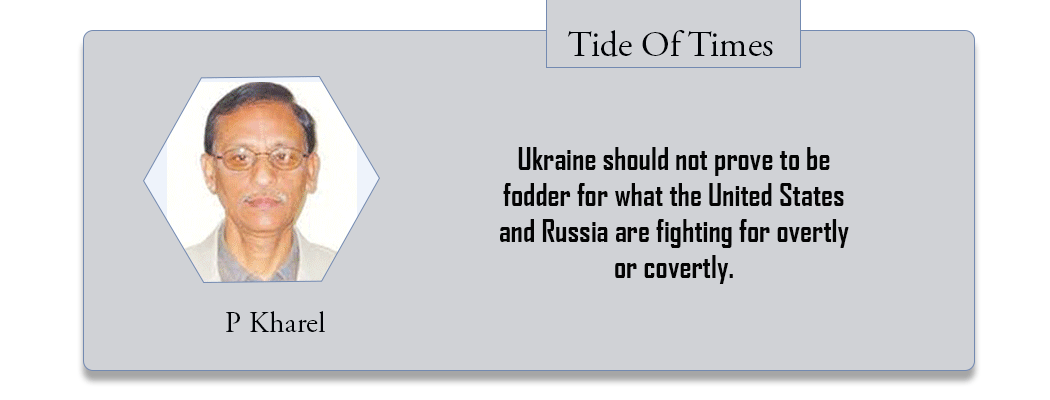
Ukraine should not prove to be fodder for what the United States and Russia are fighting for overtly or covertly. A prolonged war will reduce large parts of Europe to the sick man of the West within the next decade. The US functions as an island in itself. All its wars have been on other continents, i.e., barring the Japanese air attack on Pearl Harbour during World War II. The superpower’s super losses since the outbreak of the Ukrainian war is growing in terms of international credibility.
Countries and corners that previously thought thrice before summon courage to protest a Washington’s move, now have begun to oppose ideas and initiatives not in their best of interests. They are beginning to taste the voice of their independent sound. All because of the alternative they begun to sense. During the November 2022 mid-term election campaign, Kevin McCarthy, the future House of Representatives’ speaker, warned sternly that a Republican victory would mean a blank check on the existing volume in the flow of financial help to Ukraine.
Now that the Republicans have a thin majority in the House, financial support to Ukraine might no longer go uncontested, unlike previously when the Democrats controlled both the chambers of the Congress. A survey in January showed that 52 per cent of Republicans want the Congress to oppose any more funds to Ukraine. They think that Ukraine does not have the capacity to the win the war triggered by the Russian invasion after Ukrainian President Volodymyr Zelenskyy moved to seek a NATO membership. Republicans prefer by 63 per cent to 33 per cent a peace deal “even if that means Ukraine will lose some territory”.
Republicans want investigation into Joe Biden administration’s “too much aid to Ukraine without accountability”. So far $45 billion in weapons and humanitarian aid has already provided to Kyiv. Half of Republicans think that the Biden administration is “doing too much for Ukraine”, hence the call for aid audit. An end to war not yet in in sight amidst speculation in other countries that Washington might not want the conflict to end. Some Republican members of the Congress have concluded that the US is waging a proxy war in Europe’s poorest and most corrupt nation. And Republicans are not the only ones who want the war to stop without any delay.
Is the West losing or winning in the Ukraine war? Honest news media headlines would have explained a lot, except that heavy propaganda of various hues infects information channels. There have been no NATO troops on the Ukrainian soil, whatever the veiled threats of their direct involvement. A year of sanctions at the call of the US against Russia has not cut short the war. As the war rages, its effects have begun to be painful on much of Europe — a situation that has generated anger especially over the manner in which the quality of life for an average citizen has visibly fallen. Poverty has increased. For example, thirty million Britons are reported to have lost a “decent living standard” since the Ukraine war began.
Disconcerting
A British ministry of defence claimed securing an official but confidential survey that showed only 25 per cent of Russians supporting the war to go on. London and Washington are banking on their assumptions that Putin would face increasing difficulty in justifying to Russians the war with Ukraine. Threats have not worked with Moscow. A draft resolution was circulated at the United Nations for a Nuremberg-style tribunal to hold the Russian leadership accountable for crimes of aggression in Ukraine. The taunt did not have the intended effect. Instead, some of Washington’s close allies cautioned the US leadership of aggravating the existing conditions more.
In the first few weeks of the war, French President Emmanuel Macron warned against “inflammatory words”. He was referring to Biden terming Putin a “butcher” and announcing that the Russian leader had committed “genocide” and “cannot remain in power”. Macron was joined in chorus by other leaders, too, calling for restraint. Moscow’s restrained but firm reminder was that “personal insults” only undermined bilateral relations between Russia and the US.
The world should not just watch the war in Ukraine — a war also fuelled by others. Serious search for sanity is called for bringing the armed conflict to an end. Delay in doing so would mean more destruction of Ukrainian economy, adverse effects on the rest of Europe and nightmarish prospects of a nuke war.
(Professor Kharel specialises in political communication.)
-original-thumb.jpg)