- Friday, 29 May 2026

Keep Service Delivery Above All Else

Prime Minister Pushpa Kamal Dahal ‘Prachanda’ called for a review of public holidays last week. According to him, the existence of too many public holidays has affected service delivery. The matter has also been discussed at a meeting of the Council of Ministers. He also said that an overlapping of special days such as Democracy Day, Loktantrik Day and Republic Day should be integrated, and programmes formulated in such a manner as to enlist enthusiastic participation of the public.
There is truth in the argument of the Prime Minister that too many public holidays affect service delivery. But holidays are not a single factor that is affecting service delivery. There is more than meets the eye. It is one of the responsibilities of the government to make service delivery effective. In fact, effective service delivery may be crucible for measuring the government’s popularity. However, people are not satisfied with the state of service delivery in the country.
Rules and regulations
Whether service delivery is effective or not depends on the rules and regulations, and procedures. It also depends on the efficiency and capabilities of employees. As things stand now, the efficiency and effectiveness of service delivery are marred by bureaucracy and red tape. The procedures for seeking service are complicated, forcing service-seekers to literally run from pillar to post. And there are middlemen, who are perhaps in collusion with high-ranking officials. The state of service delivery is such that without middlemen, it is difficult to get service in most cases. Service delivery is so shambolic that people have to seek the help of middlemen to get service in such important government offices as land revenue offices.
When this government under the leadership of ‘Prachanda’ was formed, it stressed effective and prompt service delivery. Some offices such as the Passport Office and the Transport Management Offices were also inspected, arousing hopes in people that service delivery would be prompt and hassle-free. But this was not to be. The state of service delivery has not seen any improvement. Online service delivery is not effective now. The system is such that online forms have to be filled in, the forms have to be printed and people have to rush to the offices concerned with the printed forms. Fully digitalised service is still a far cry in the country.
The government has introduced national identity cards for all Nepalis. But the government has not been able to manage its distribution. The government has made national identity cards compulsory for the issuance or renewal of passports. As such, those who need new passports or who have to get their passports renewed are facing hassles. However, the government is distributing national identity cards from ward offices in Kathmandu. Still, there are crowds of people lining up to have their national identity cards issued. There is a practice of issuing tokens to service-seekers on a daily basis. This system would discommode service-seekers because if they cannot get a token, they will have to keep visiting the government office concerned till one is received.
If tokens were issued to service-seekers continuously, they could visit the office on the day designated as per their token numbers. This would help them avail themselves of hassle-free service. It has been several years since the government introduced smart licences. With the seemingly never-ending problem with printing, one has to wait for eight or 10 months to lay one’s hands on one’s driving licence. Before the introduction of smart driving licences, one would get one within seven days. As such, people are forced to run their vehicles on payment receipts.
The same is the case with installing embossed number plates on vehicles. The procedures for installation of embossed number plates are lengthy. For a new vehicle, one cannot directly get an embossed number plate. First, a province-based number plate is given. After following the due procedures, an embossed number plate can be installed on a new vehicle. The question is, why cannot an embossed number plate be directly installed on a new vehicle? If embossed number plates had been directly installed on new vehicles, and any vehicles had been offered embossed number plates regardless of whether taxes of the current fiscal year have been paid or not, there would have been much more progress in implementing the embossed number plate system.
The existing procedures are responsible for the slow progress in the implementation of the embossed number plate system. So it is imperative to enhance the efficiency and effectiveness of service delivery. For this, procedures should be simplified so that people do not have to run from pillar to post to get service. Online service should be improved. And unnecessary middlemen should be eliminated. Sometimes, middlemen are nabbed but this is not enough. They should be removed completely.
Inconsistency
As far as public holidays are concerned, the government does not have a consistent policy. One government removes some public holidays, whereas another adds some. This is nothing more than a farce. Now, the government is mulling over cutting down on some public holidays. Before making such a crucial decision, the government should make a study as to which public holidays are required and which are not, and also if any other public holidays are required. There are also ethnic group-based holidays. Such holidays may be provided for a particular ethnic group. On the basis of a comprehensive study, a policy on public holidays may be formulated.
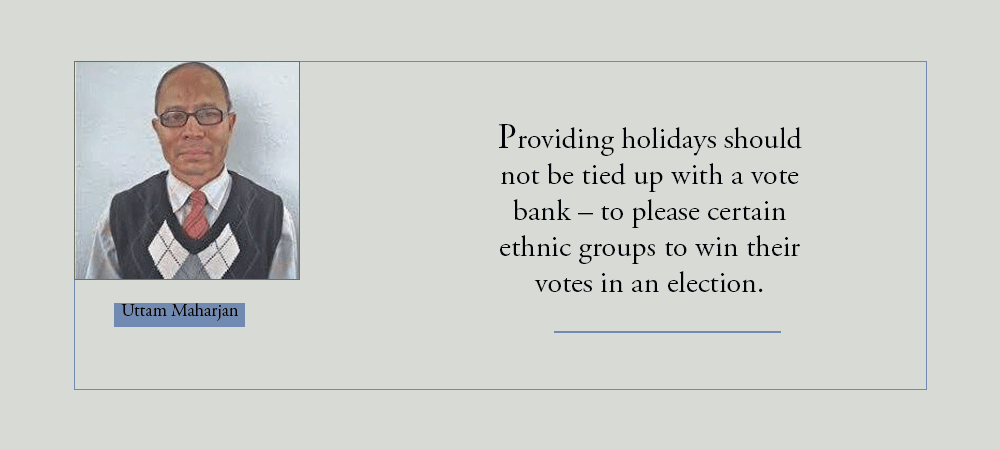
Providing holidays should not be tied up with a vote bank – to please certain ethnic groups to win their votes in an election. The policy on public holidays should not be changed when a new government comes up until it is felt extremely necessary. The government does not have a solid policy on public holidays. The introduction of the five-days-a-week working schedule and the subsequent scrapping thereof twice bear evidence. In fact, enhancing the efficiency and effectiveness of service delivery matters a lot.
(Maharjan has been regularly writing on contemporary issues for this daily since 2000.)



-original-thumb.jpg)