- Thursday, 28 May 2026

Develop Lumbini As Peace Station

At a very well attended conclave held to discuss the resource potentials and development possibilities of Lumbini Province at Bhairahawa, the other day, the high-ranking policy-makers, entrepreneurs, lawmakers and development practitioners expounded their views on how the available resources and potentials could be harnessed and capitalised for enhancing the development and prosperity of the province in particular and the country in general. The finance minister, Nepal Rastra Bank governor, chief minister of the province, federal ministers and representatives of entrepreneurs shed light on the current state of political economy with special reference to Lumbini Province and placed emphasis on the need to work sincerely for the implementation of the federal scheme of governance in the country.
Apostle of peace
What did transpire prominently in the conclave was the importance and value attached to Lumbini as the birthplace of Gautam Buddha globally known and adored as the apostle of peace and non-violence in the world. Around 5 billion people follow the creeds and ideas propounded by Gautam Buddha in the world. Most of the Buddha’s followers populate our neighbours, including China, Sri Lanka and East Asian nations who could visit the sacred destination in low budget connectivity. But a miniscule fraction of the Buddha’s devout followers have reportedly come for pilgrimage to this important Buddhist shrine. It shows the underutilised potentiality of Lumbini as a culturally important destination. If appropriate and strategic promotional activities are conducted in an effective way, Lumbini holds out the prospects of being transformed into an important tourist hub in the region.
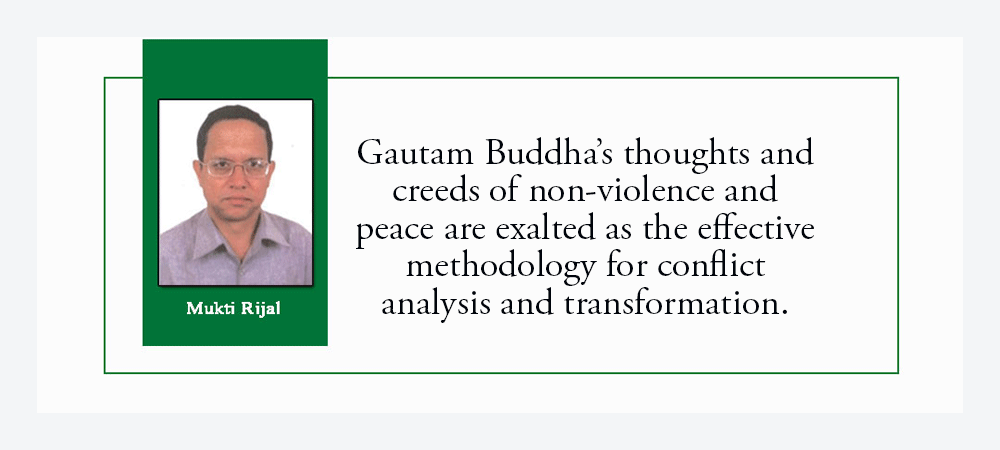
Gautam Buddha’s thoughts and creeds of non-violence and peace are exalted as the effective methodology for conflict analysis and transformation. Speaking at the abovementioned conclave, vice-president of the Lumbini Development Trust (LDT) Awadesh Tripathi appreciated Sidhhartha Gautam as a peace maker and dialogue mentor who not only defined and developed the seminal tools for conflict analysis and transformation but also applied them in the real situations. Siddhartha had, according to Tripathi, offered an important support in negotiating settlement of the resource sharing and distribution related conflict between Kapilvastu and Devadaha through recourse to a dialogic method.
Kapilvastu is the ancient kingdom ruled by King Suddhodhana, Sidhartha Gautam’s father, whereas Devadaha is the ancient capital of Koliya Kingdom. It is identified as the maternal home of Queen Mayadevi, Sidhhartha’ s mother, Prajapati Gautami and princess Yasodhara. The LDT official also indicated the possibility of promoting and developing the Lumbini as a safe and neutral venue for global negotiations and conflict resolution which could help to bolster the image of Nepal as a peace dialogue hosting nation. Given the geostrategic location and peace prone image, Lumbini, the birthplace of Siddhartha Gautam, is impregnated with the prospects of asserting its appropriateness as a space where world community could convene to hold negotiations and dialogue in sorting out contentious issues and find durable solution of the conflicts.
This may prove to be the right way to pay respect to Gautam Buddha and bring to practical use of the methodology of conflict resolution. The methodology propounded by Gautam Buddha for conflict resolution was a kind of collaborative round table reiterative dialogue to allow each stakeholder to freely articulate their needs, interests and concerns to find durable and lasting resolution of the conflicts. Siddhartha Gautam’s prescription to prevent conflict is middle path which can be practically translated as “moderation in all things”. According to the Buddha, “our wellbeing depends fundamentally on our recognition and nurturing our basic duality; as individuals with distinctive tastes and aspirations and as members of a society with responsibilities to and values shared with others.”
One must follow, according to the Buddha, the middle path to inculcate the sense of maintaining peace, tranquility and serenity in the world. It is considered as the suitable redress of common problems faced by human beings and tame structural issues giving rise to conflict. A resolution of conflicts will be possible if we are able to realise the necessity to learn how to loosen the grip exerted by the unwholesome “roots” on our collective character. The term ‘peace’ has both negative and positive meanings. In its negative sense, peace is an absence not only of war and conflict but also of social injustice, social inequality, violation of human rights, destruction of ecological balance and so on. In its positive sense, peace means the presence of unity, harmony, freedom and justice.
In Buddhist framework, the concept of peace is extended to include both inner and outer peace. Inner peace that is peace of mind is mental state free from disquieting or oppressive thoughts or emotions. The attainment of the ultimate peace of mind is the goal of good life in Buddhism. Inner peace is a pre-requisite for outer peace which involves interpersonal relations. A person is said to have outer peace when he has a harmonious living with his fellow-beings
Practical use
In Buddhism, peace is as much concerned with individuals as with groups and institutions. In fact, society can remain peaceful if its members have peaceful mind. Unless there is peace within, there will be no peace without which is also spelt out in the preamble of UNESCO which says since it is in the minds of men that wars begin, it is in the minds of men that the ramparts of peace should be erected. Mahatma Gandhi, Martin Luther King, Nelson Mandela and many others followed Buddha’s philosophy of peace and made practical use to free their respective countries from oppression and injustice. Nepal should take cues from these examples and initiate efforts to promote Lumbini as a destination for global peace making.
(The author is presently associated with Policy Research Institute (PRI) as a senior research fellow. rijalmukti@gmail.com)

-original-thumb.jpg)