- Saturday, 30 May 2026

Veteran Journalist's Wider Analytical Compass

Madan Kumar Bhattarai
There has been a spurt of new books worldwide on inter-connected areas of foreign policy, international relations, diplomacy, security and strategy in the context of China's rise as a major economic, technological and maritime power in recent years. The new book penned by eminent journalist M. R. Josse is a welcome endeavour in presenting a holistic picture of major international developments covering a period from the second half of 2020 to early 2021 with a major focus on India-China ties, the changing scenario of China's bid for primacy in international affairs that has so far been dominated by the United States and other topical issues spanning global politics.
A cursory look at the book shows that despite being comparatively short in length, its content is quite comprehensive, embracing a wide range of subjects in a more succinct manner. The first 4 chapters and chapter 12 are basically on India-China relations pertaining to diplomacy, security and strategic matters as he has an in-depth knowledge of the two most important neighbours of ours that is not only emerging as world economies soon but also share rivalries in various matters including regional affairs with impact on Nepal's foreign policy that the writer has devoted one separate treatment in chapter 9.
The writer even suggests a mutually beneficial arrangement on the part of India and China on Nepal with a perceptively tripartite accord so that our national interest is taken into adequate care and the so-called enlightened interests of both our major neighbours are also duly safeguarded. Reading between the lines, Josse seems to lament what he called political absurdities afflicting Nepali polity with the slogan of economic transformation remaining simply a pipe dream. The book has given a copious coverage of the leadership of Donald Trump with more focus on its negative side and the ultimate election victory of Joe Biden as the 46th President of the United States.
Mana Ranjan Josse, or MRJ as a popular acronym, has carved out a special niche in the field of English journalism of ours for more than five decades, dating back to his entry into The Rising Nepal as one of the founder members of the maiden English broadsheet of the country way back in 1965. He, therefore, does not need any introduction as he is a senior journalist, prolific writer and incisive political analyst with a special focus on Nepal's foreign policy, international relations, security domain, strategic affairs and contemporary developments in the region and beyond, and, last but not least, a forceful opinion-maker that people may not like him but can never ignore the range of his knowledge and analysis.
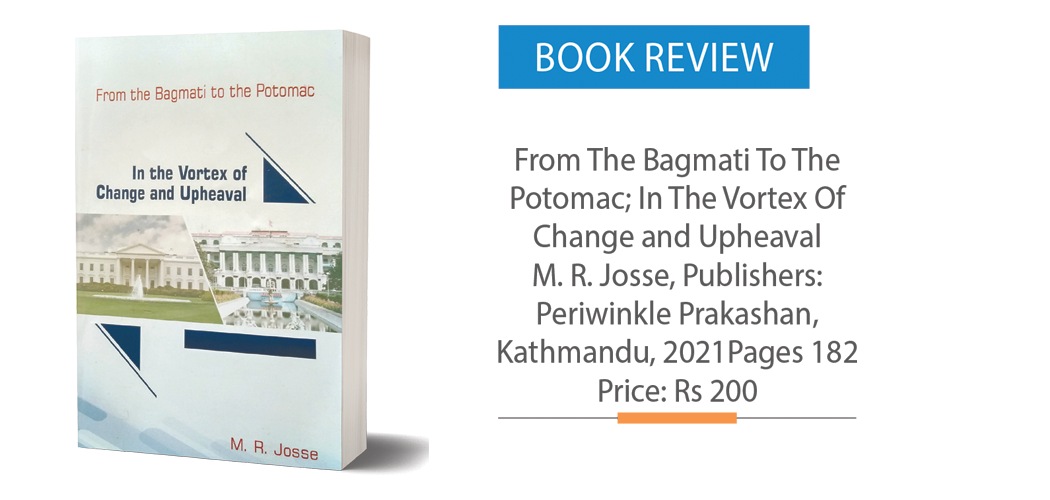
A brilliant student and product of such prestigious institutions as St. Augustine, St. Xaviers and Jadavpur University with a judicious mix of science and international relations as his subjects, Josse has contributed thousands of articles and published several books with more frequency in recent years. Mana Dai as we most respectively and affectionately address him has written this book with a rather deceptive title, From the Bagmati to the Potomac. This highly readable book dedicated to the memory of the author's mother Kalyani Devi Josse has 26 chapters on various aspects of contemporary international affairs.
While the two famous rivers, Bagmati and Potomac, are used as metaphors to indicate Nepal and the United States, this is not a book dedicated to the subject of Nepal-US relations as may easily be guessed from the elusive title despite giving some cursory references to Nepal in chapters 22 and 23 particularly our domestic political developments following the decision to dissolve the House of Representatives that the highest court of the land nullified twice. The cover page also depicts the White House and Singha Durbar, which represent seats of executive powers in the United States and Nepal respectively.
In a possible attempt to justify the metaphors, 14 chapters have been written in Kathmandu and the rest of the 12 chapters contributed from Maryland. In his own novel way, the writer has even toyed with the possible idea of a new QUAD emerging in the region comprising China, Pakistan, Nepal and Bangladesh.
It is not that easy to explain such a scenario in the context of new developments in India-China relations that seem to border more on rivalry than cooperation at least in the foreseeable future and the stagnant status of SAARC that Nepal is chairing for the last eight years.
On more personal terms, Mana Dai has remained a defining personality for us. Besides being mentor, supervisor and guru when I served in The Rising Nepal under his direct supervision as Editor-in-Chief, there is an interesting coincidence that both of us have a commonality in not only in having the same alma mater, Jadavpur University, Kolkata, but also the same discipline, International Relations.
Another connecting link is that his class friend and topper of the MA examination in which Josse stood second in order of merit, Professor Baladas Ghoshal, was my supervisor for the degree of PhD that the University awarded me in the nineties.
Last but not least, we served together under the Foreign Ministry for five years as he was deputed to the United Nations as our Deputy Permanent Representative during the period, 1985 – 1990, when Nepal was asked to discharge her responsibility as Non-Permanent Member of the UN Security Council for the second time. Ambassador Jai Pratap Rana, who was our Permanent Representative during this period, used to highly extoll manifold contributions of Josse in the task of projecting Nepal's image to the United Nations.
On the debit side of the book, the quality of the publication is rather poor and there are also quite many proof mistakes that could have been avoided. The second lacuna of the work is that it lacks symmetrical and systematic treatment of various factors underpinning international relations at large as chapters have been arranged rather randomly.
To conclude, Josse's new book is a welcome addition to the list of our books on international affairs and diplomacy. I congratulate the author for his constant endeavours to present a cogent analysis of various factors as he is a reservoir of information on matters relating to foreign policy and allied subjects and their impact on Nepal. Sadly, the country cannot fully utilise Josse's knowledge and expertise as he has started to spend more time in the United States than in Nepal.
(A former Sub-Editor of The Rising Nepal, Bhattarai is an ex-foreign secretary and ambassador. kutniti@gmail.com)