- Friday, 29 May 2026

Superpower Rivalry In South Asia

The simultaneous visit of the Secretary of State of the United States (USA), Marco Rubio, to India and Pakistani Prime Minister Shehbaz Sharif to China from 23 to 26 May reveals how aggressively the two global superpowers are promoting their competing visions of partnership. Viewed from the surface, both visits appear to be regular, high-level diplomatic exchanges. At a deeper level, they represent a highly strategic move on the chessboard of geopolitics. These visits have taken place during the period of heightened friction in the relations between the USA and India on the one hand and Pakistan and China on the other. USA-India relations were strained due to Trump's punitive tariffs against Indian goods and India's purchase of Russian crude oil. Pakistan and China's relations were on edge because of the delay in Belt and Road Initiative (BRI) projects, security threats to Chinese nationals and Pakistan's dual loyalty to Washington and Beijing.
This visit, therefore, can also be tracked as a damage control measure on the part of the United States and China. Over the years, the USA has been eager to develop a strategic partnership with India. But it has not succeeded in building the type of relation it wants due to historical and geopolitical reasons. Historically, India had a strategic partnership agreement with the Soviet Union during the Cold War. Even then, India avoided open alignment and projected neutrality and non-alignment as the foundational principle of its foreign policy. After the BJP came to power, India started to project what it called strategic autonomy as a foundational pillar of its foreign policy. Under this policy, India has been taking an increasingly bold stand on issues of security and national interest.
Strategic autonomy
Of late, India has been projecting multi-alignment as an extension of strategic autonomy, which allows collaboration with all the powers without being tied to any particular power block. This policy has allowed India to maintain a strategic partnership with Russia while maintaining cordial ties with Ukraine, as well. India has not taken sides in the Russia-Ukraine war but it has refused to join the Western sanctions against Russia. Moreover, India has been buying Russian oil despite Western sanctions, arguing that it has the right to buy energy from wherever it is cheap because the Indian government's primary responsibility is to serve the interests of its people.
In line with its policy of multi-alignment, India has also maintained transactional trade relations with the USA. Unlike its partnership with Russia, however, it has agreed to be part of the USA-led Indo-Pacific Partnership and has joined the QUAD grouping consisting of Australia, Japan, the US and India. Critics view that India's commitment to strategic autonomy and its involvement in IPP and QUAD are incompatible propositions. It is to be seen how India will exercise its strategic autonomy when the obligations to international power alliance clash with the national interest. Despite the existence of a relatively strong cooperative engagement with USA on defense and technology, India has protested against exorbitant tariff rates on its goods exported to the USA and a demeaning remark the US President recently made characterising India as a "hellhole" – an unprovoked stigmatisation of the Indian culture and the way of life.
During the visit of Marco Rubio, Indian Foreign Minister S. Jayashankar even went so far as to say that India is committed to pursuing a "India first" policy, an implicit challenge to the "America first " policy being propagated by Trump. At the same time, he also made it clear that India would continue to rely on multiple supply sources to meet the energy requirements of its people, irrespective of geopolitical pressure. The USA and India had a common view on the urgency of removing the supply chain disruption at the Strait of Hormuz but on this issue, India clearly stood on the side of a diplomatic settlement of the crisis.
Similarly, the just-concluded visit of Shehbaz Sharif to China also appears orchestrated to address the strained Pakistan-China relations. Pakistan has been implementing several jointly funded BRI projects —most notably the China–Pakistan Economic Corridor (CPEC). In recent years, questions of debt- trap, delay in project implementation, unequal benefit sharing and the security threat to Chinese nationals in Pakistan have fueled friction. Pakistan's growing engagement with the US on issues of jointly exploiting rare minerals and the projection of Pakistan as a successful mediator in the Iran war may have prompted Beijing to take preemptive diplomatic initiative to stop further erosion of trust. Pakistan has leveraged its diplomatic influence by convening Iran and the USA in Islamabad for a peace negotiation. This convening capacity of Pakistan amidst a complex conflict scenario has given it an enviable international pedestal.
Ideological plinth
Indian foreign policy appears to have been crafted around a relatively solid ideological plinth. But Pakistan's foreign policy is based on more pragmatic issues like strategic defense partnership, nuclear deterrence and containing Indian influence in South Asia. Historically, Pakistan has forged strategic partnerships with the USA or China to cope with the perceived Indian threat. Now it is trying to integrate its economy with China's BRI projects without disrupting its engagement with the USA. Its reliance on the USA's intervention for a ceasefire during the India–Pakistan War in 2025 and its collaboration with it in its mediation effort in recent ceasefire negotiations over the Iran war highlights its skill in balancing the relationship between two global superpowers.
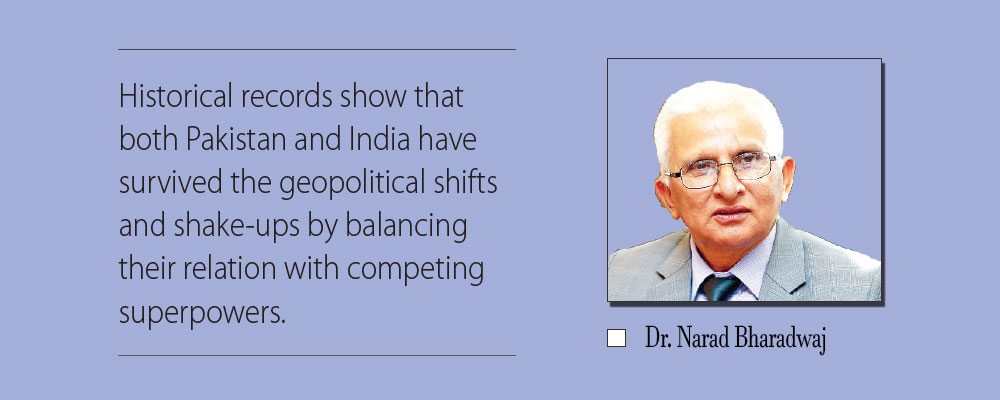
Historical records show that both Pakistan and India have survived the geopolitical shifts and shake-ups by balancing their relation with competing superpowers. But it will be too early to predict if they can successfully navigate their way through the present-day power rivalry for safeguarding their independence and sovereignty, and of course, a respectable place in the regional power hierarchy.
(Former ambassador and former chairperson of Gorkhapatra Corporation. bharadwajnarad@gemail.com )