- Thursday, 28 May 2026

The Future Of Digital Service Tax

Digital Service Tax (DST) is currently a hot topic in international taxation. Many nations, particularly in the Global South, have either implemented a Digital Services Tax (DST) or are currently pursuing legislative reforms to implement one. These legislative reforms are essential as stop-gap measures to assert their taxing rights over the digital economy. DST is simply a direct tax, normally levied on a turnover basis, with rates ranging from 1.5 per cent to 4 per cent, applied to digital services provided by non-resident companies to users within the recipient country.
Many advanced countries characterise it as an unfair and regressive tax regime. The United States often warns of Section 301 tariffs against countries that implement unilateral DST. While critics maintain that it contradicts the established principles and norms of international taxation, several OECD countries—including France, Italy, the UK, Canada, and others—that have long been champions of global tax rules, continue to rely on or transition towards this taxation in recent years. In this sense, DST has emerged as a protective shield for national tax bases, despite being officially called an interim step.
Tax bases
In the modern digitally connected world, DST is considered essential for many countries that heavily import digital products and use automated digital services (ADS). Digital giants such as Meta (Facebook), Google, YouTube, and Amazon are generating significant amounts of income and profit in countries where they don’t have physical presence or their offices or branches. They provide uninterrupted digital services, run targeted digital marketing, penetrate algorithmic product placement and monetise user data.
Quantifying and taxing on the income and profit generated from such activities has been a challenging endeavour for developing countries relying solely on conventional principles, existing legal framework and established practices of international taxation, that are mostly rooted in the traditional concept of a "physical permanent establishment". Leaving such activities untaxed in the countries where such income is created and users are located, erodes their tax bases and weakens the source-based taxing principles of sovereign nations.
A significant fragmentation exists at the global stage regarding how to tax on such digital transactions. The OECD and United Nations, which have a long history of shaping the global tax rules, provide competing solutions. While the OECD advocates for reallocating a residual portion the taxing right among the market jurisdictions under its “pillar one” solution, the United Nations is suggesting alternative principles, called Significant Economic Presence (SEP), which ensures primary taxing right for the developing countries on the value created withing their borders.
This concept is under intense debate in the United Nations Economic and Social Council Expert Committee under the United Nations Framework Convention on International Tax Cooperation (UNFCITC). This tug-of-war between these two competing solutions has made the adoption of a consensus-based taxation model increasingly uncertain.
The adoption of either solution faces significant headwinds. The OECD Pillar One solution, which many call it a historic attempt in modern tax law, seems nearly impossible to enter into force in the foreseeable future. It cannot enter into force without ratification by a two-thirds majority from the U.S. Senate. For the tax treaty to be effective globally, the Multilateral Convention (MLC) requires a Critical Mass Threshold (CMT).
Polarised politics
This threshold cannot be fulfilled without the US, as it houses many large multinational digital companies. Given the polarised politics in the US Senate, reaching this supermajority is extremely difficult, leaving the rest of the world in a “wait and see” posture. At the same time, jumping towards the UNFCITC solution may not provide an exact remedy either, because building consensus within the UN framework remains elusive due to sharp polarity between North and South at the UN venue.
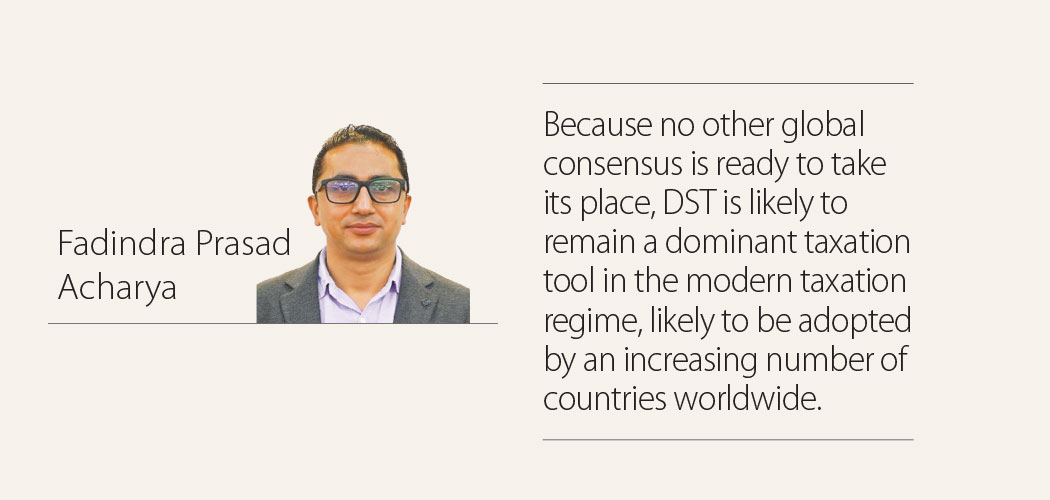
While DST is intended as a temporary solution, development of a global consensus on an alternative is less likely to emerge in the foreseeable future due to underlying geoeconomics and revenue concerns. Because no other global consensus is ready to take its place, DST is likely to remain a dominant taxation tool in the modern taxation regime, likely to be adopted by an increasing number of countries worldwide.
(The author works at the Inland Revenue Department, International Taxation Section.)






-original-thumb.jpg)