- Friday, 29 May 2026

Endless Delays Plague National Highways
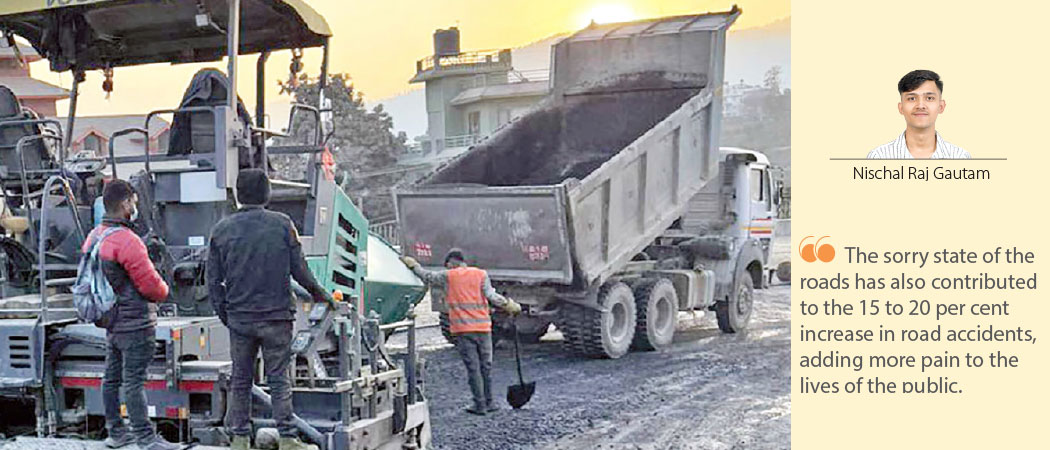

For many in the Kathmandu Valley, Dhulikhel remains one of the closest places to escape from the city, a quiet touristic hill station away from the capital’s congestion. Yet, the journey to get there has become progressively more difficult as Nepal’s infrastructure continues to suffer from poor governance and management.
The journey through the Suryabinayak-Dhulikhel stretch along the Araniko Highway, which is 15.8 kilometres long, has been expanding for 3 years, and the conditions have deteriorated further. The demolition and snarling construction work have turned the stretch into a dirt track, which is full of dust in the dry season and dangerously slippery during rainfall.
The road that connects Bhaktapur and Kavre has been under construction since 2023. Initially scheduled for completion within three years and divided into two sections, progress has remained consistently sluggish. With time running out, the work along the Sanga-Dhulikhel section in Kavrepalanchok has achieved only 68 per cent physical progress. On the other hand, the Suryabinayak-Sanga section in Bhaktapur lags further behind at just 46 per cent.
The situation is likely to worsen further with the monsoon less than 3 months away. The ordeal is set to return, as construction work would typically halt by mid-June. In this context, authorities' claims of completing the project by December appear increasingly unrealistic, if not misleading. This uncertainty is further compounded by the fact that the budget allocated by the government for the Suryabinayak–Dhulikhel road project for the current fiscal year has already been exhausted.
The 7.5-kilometre section from Suryabinayak to Sanga has been under construction since 2023 by Ashish Kumar Shrestha/Bandhan/Bhagwati JV for Rs. 3.8893 billion, including VAT. Similarly, expansion work on the 8.55-kilometre road from Sanga to Dhulikhel began in November 2022 after a contract worth Rs. 4.564 billion, including VAT, was signed with Lama Construction.
This stretch of the highway, first constructed more than two and a half decades ago, is expected to ease traffic congestion, but it is taking a toll on people’s health. Something envisioned as an infrastructural upgrade to ease traffic congestion has instead become a lingering blight for the public. It is impacting not only the mobility but also the health, safety, and livelihoods. A study conducted by students of Kathmandu University along this stretch has pointed out a broader spectrum of consequences: increased noise pollution, declining aesthetics, rising road accidents, risks for pedestrians, difficulties for cyclists, and growing mental health concerns. The report has specifically mentioned that noise levels have exceeded permissible limits, particularly near active construction zones. Continuous exposure to construction noise has increased stress, disrupted sleep, and reduced overall quality of life for local residents.
Local businesses have also suffered. The decline of customer flow has eventually led to financial losses. This situation occurred mainly due to obstructed traffic and reduced accessibility. This case serves as a testament to how infrastructural projects ripple into the local economies, disproportionately affecting small businesses.
The sorry state of the roads has also contributed to the 15 to 20 per cent increase in road accidents, adding more pain to the lives of the public. The inordinate delay has created a high-risk environment, which features uneven surfaces, a lack of proper signage and lighting along the stretch. Despite being a preventable factor, it has been overlooked, which has spiked the incidents of crashes by about 35 per cent, as per the data from the local police stations.
Beyond the regular commute, the implications might extend into life-and-death situations. Delayed and degraded road conditions significantly hinder emergency response, such as ambulances and fire trucks. In Nepal, where primary health care is scarce and tertiary-level health care facilities are mostly located in urban areas, road accessibility is a critical factor for survival. The perilous road conditions take hours or even days for patients to reach a well-facilitated institution.
Evidence from multiple studies reinforces this conclusion. A study conducted in Baglung, Ramechhap, and Dolakha regarding maternal mortality in hilly areas found that among 33 maternal mortality cases, 13 deaths were related to transport costs, eight to transport services, and four due to the long distance to healthcare facilities. A study by the BP Koirala Institute of Health Sciences (BPKIHS) among 2211 patients regarding transport and pre-hospital care before arrival in the tertiary care emergency department of eastern Nepal found that the median ambulance response time is 2 hours, with a median distance of 55 km and a median cost of Rs 3500. Delays were mostly due to long travel distances and high costs. Another study carried out regarding the impact of snake bites and determinants of fatal outcomes in south-eastern Nepal shows that among 10550 persons, only 143 had fatal outcomes due to snake bites, and among them, 16 patients died during transfer to health care centres. Poor road conditions directly exacerbate the long travel distance, which silently contributes to preventable deaths.
This pattern extends beyond the Kathmandu-Dhulikel corridor. The infamous Butwal-Narayanghat stretch stands as another prominent example of infrastructural failure due to systemic delay and working inefficiency.
Covering 114 kilometres, it is expected that the journey will not take more than two to three hours. So far, the travel time has doubled to 6 hours or more. In February 2019, Nepal’s Department of Roads signed an agreement with China State Construction Engineering Corporation to implement the project with the aim of expanding the existing two-lane road to six lanes within four years.
Despite the commencement of work seven years ago, the final phase remains incomplete, with multiple deadline extensions. The highway is being constructed in two packages: 65 kilometres (eastern section) from Gaindakot in Nawalparasi to Daunne and 49 kilometres (western section) from Daunne to Butwal. Despite this segmentation, delays have continued. Explanations from officials include issues such as tree felling, relocation of electricity poles, and the COVID-19 pandemic. The Narayanghat-Butwal project said it could not initiate the road expansion work, as the number of trees to be cut down along the road stretch was fivefold higher than estimated in the Environmental Impact Assessment (EIA) report. However, these repeated justifications signal failure of proper planning, coordination, and execution.
The Daunne section, in particular, has become a major bottleneck. This 14-kilometre stretch is notoriously dangerous, requiring high tyre grip even during light rain or mist. According to the District Traffic Police Office in Nawalparasi East, this section was obstructed 32 times between July 17, 2025, and January 4, 2026. Meanwhile, dust blankets roadside settlements, severely affecting air quality and public health. For local communities, the development promise has become a source of environmental and economic hardship.
The two cases that support the transportation system of Nepal reveal a pattern of undermined delays, weak contract enforcement, adversaries in planning, and no accountability from concerned authorities. The general public has always suffered the ordeal due to the failed bureaucracy, which has let the system down.
The road conditions and their increasing impact on public health, the economy, and other social aspects reveal a broader narrative about the normalisation of a failed governance system that has persisted for ages. The subsequent failure of government to hand over the problem to its successor proves the absence of accountability and serves as a parameter to define the failed development narrative of the parties who have come to power over time.
(The author is pursuing higher study in Journalism at St. Xavier's College.)