- Friday, 29 May 2026

Hog Deer Of The Lowlands
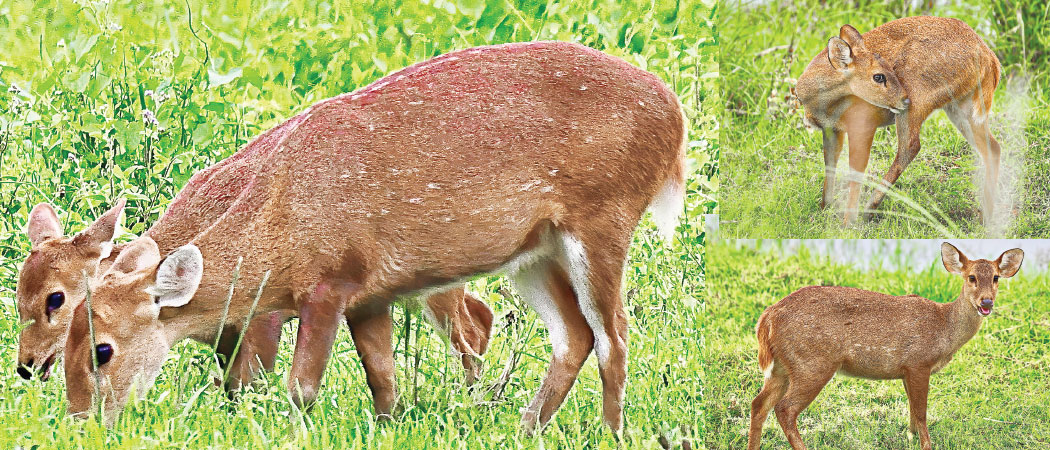
Rajesh Dhungana

The hog deer (Axis porcinus), referred to as “Laguna” or “pade” locally in Nepal, is a rare species of deer native to the lowland areas of the country. In contrast to more frequently sighted deer, hog deer are fond of open grasslands, floodplains, and shrublands but do not venture into dense forest areas. The hog deer can be found throughout Nepal’s national parks and community forests, prospering in the tall grassy environment and providing food and shelter.
This rare species of deer was scientifically classified in the late eighteenth century by German zoologist Eberhard August Wilhelm von Zimmermann. Traditionally, it has been divided into two subspecies—the Indian hog deer and the Indochinese hog deer—though recent studies suggest they may be distinct species. In Nepal, the Indian hog deer is the most commonly found, with a broader range extending from Pakistan and northern India to Bhutan and Southeast Asia. It has even been introduced in places like Australia and the United States.
Physically, the hog deer is compact and sturdy. A mature stag stands about 70 centimetres at the shoulder and weighs between 36 and 50 kilograms. The animal has an average body length of 3.5 feet to 3.8 feet, while the tail’s average length is 8 inches to 10 inches. Unlike other deer species, this animal has relatively short legs, giving it a peculiar posture that resembles that of hogs; hence the name. The body has a mottled olive-brown colour with white spots on it during the hot seasons. The ventral surface is white, while the round ears are light-coloured.
The males have three tines that are thick and grow from the prominent pedicles. Although the antlers are not as long as those of large deer species, they are very sturdy and grow up to 60 centimetres. When threatened, the hog deer will lower its head and elevate its tail, exposing the white ventral side as it runs across the grassland. Hog deer primarily inhabit solitary environments, but they occasionally gather in open areas with abundant food. They are usually more active during dawn and dusk, being inactive throughout the daytime. Males are extremely aggressive in terms of protecting their territories and mark them through the scent glands present within them.
Hog deer feed on plants and plant matter like grass, shoots, wild fruits, and leaves. Their mating period extends from August until October, when the males become fiercely competitive to attract females. The gestation period for the females lasts about eight months, after which they give birth to one fawn in a secluded area made up of grassy vegetation. The fawn usually stays hidden until the female comes back to feed her offspring. Despite being a highly adaptable species, several factors have drastically affected the hog deer's population in recent years. Habitat destruction caused by humans and the hunt for food have endangered their lives. In recent decades, the hog deer population has significantly decreased. The IUCN Red List currently marks the hog deer as an endangered species.
(The author is a wildlife photographer. The photos used in this article are by the author.)