- Friday, 29 May 2026

Time To Resolve Pressing Issues

With the formation of a stable government in the offing, the country is likely to sort out key socio-economic problems. They are associated with GDP per capita expansion, speedy infrastructure development, job creation, demographic stability, climate action, LDC graduation and affordable health care. Nepali people have given a huge mandate to Rastriya Swatantra Party (RSP) to run the government for five-year full term. In its poll manifesto, the RSP has outlined its plans and programmes aimed at ensuring good governance, stability and prosperity.
The RSP has envisioned an exponential growth over 5 years through tax reform and youth mobilisation across sectors such as startups, agriculture, tourism, and others. The economic 'rule of seventy' interprets that it requires an annual growth rate of approximately 7 per cent to double the GDP within 10 years. Nepal's average economic growth rate is around 4.5 per cent. So, the new government calls for smart economic policy and its implementation to touch the GDP ceiling of USD $100 billion in 5 years. Reviewing the current ratio of the 'fixed peg' between NRs and IRs could be the starting point.
Stable exchange rate
Instead of an independent monetary policy, it is better that pegging should be a 1:1 ratio, the same as between India and Bhutan, for keeping the exchange rate stable, lowering the overpricing of Indian currency, curbing any potential imported inflation, and, on top, boosting the trading ability of Nepali entrepreneurs for job creation. Maintaining demographic stability is the foremost challenge at this point; losing our demographic dividend means failing to capitalise on a one-time opportunity to propel the growth engines. Leapfrogging from a remittance economy to a diversified economy through capital and human investment in agriculture, tourism, IT and AI, water resource and hydropower, green energy-based industry, etc., could only retain the youth force, whereas a piecemeal reform will not work this time.
Being present in the grey list of the Financial Action Task Force (FATF) during two separate periods has added a new layer of pressure. Stoppage of capital flight and money laundering, structural management of real estate cooperatives, and introduction and enforcement of relevant laws could help Nepal get rid of the grey list of FATF at the earliest. Though we have adopted a British parliamentary model, in fact, it was born of the struggle and shaped by the resistance of the Nepali people at different points in our history. Even with its unique mix of experiences, it has repeatedly failed to deliver on people's aspirations. After prolonged trials and tribulations, many faults remain within. Last year's Gen Z revolution necessitates more vibrancy in it.
The protest movement evolves and enters a new phase; otherwise, the revolution remains unfinished. Therefore, duly addressing outstanding issues related to sustainable development, social and constitutional ones will definitely bring the country into the next stage; mere pacification of the roaring voices and genuine wishes of the people could always open the door to egg on unnecessary revolt. Despite having so many positive aspects, the promises made spelt out in constitution are yet to meet the people's aspirations. Federalism is not a mandatory option for all soils and societies, though there are around 27 countries, geographically big ones, like the USA, Russia, India, Brazil, Argentina, Germany, etc., that are opting for it. Small countries in Europe, like Belgium and Switzerland, are adopting federalism to prevent linguistic, ethnic, and cultural conflicts.
From a geographical, demographical, and socio-economic viewpoint, and given the last ten years of experience, federalism has left no such impressive roles that impede transformational change in the societies of a peaceful country like ours. It is also a moment to review some Clauses of the Constitution of Nepal 2072. One example can be drawn from its preamble, which praises the Maoist armed struggles as the glorious side of our history. On the contrary, the real glory made by the mighty Gorkhali soldiers was totally ignored. In the Nepali context, an evolutionary way of thinking, rather than a revolutionary one, is required to bring about concrete change rather than merely producing a cosmetic voice in society.
A new model of Sanatanism and its adaptation could foster a spiritual connection among South Asian, ASEAN, and East Asian countries. Pashupatinath, Lumbini, and a number of our religious sites, which are the divine sources of faith of billions of people, always hold the immense potential to open up the floodgates for religious tourism.
Pride projects
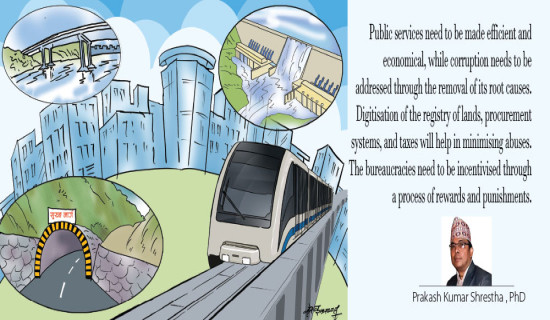
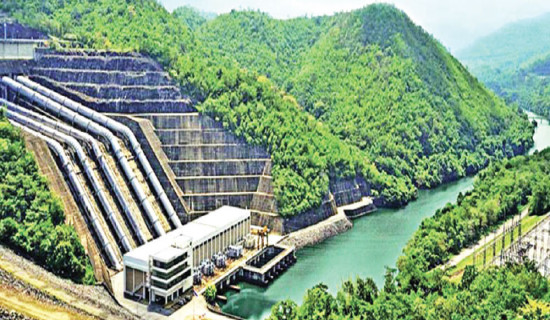
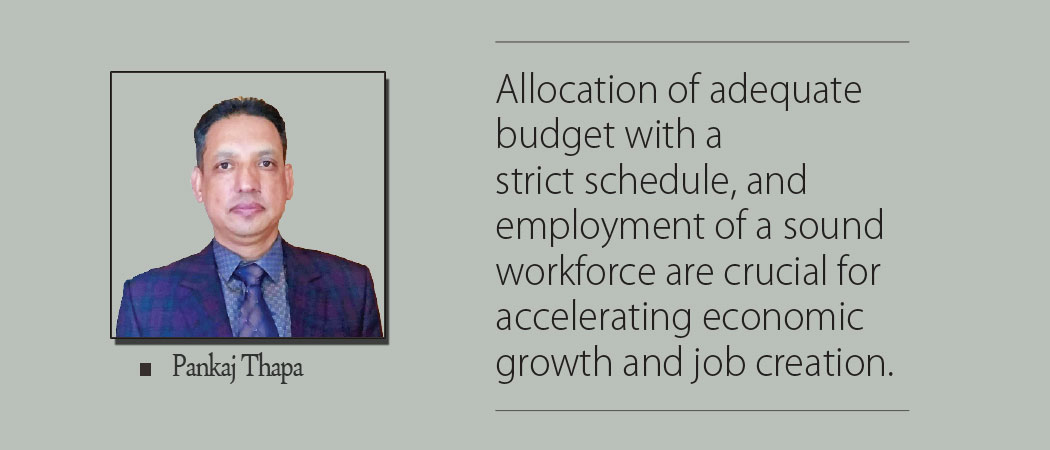
On the development front, it is imperative to effectively implement the National Pride Projects related to transport, tourism, energy and irrigation. If needed, related legal provisions should be amended for this. Allocation of adequate budget with a strict schedule plan, and employment of a sound workforce are crucial for accelerating economic growth and job creation. Any infrastructure project requires long-term capital, so investment from the Nepali diaspora needs to be encouraged along with healthy FDI.
The current turmoil at the Strait of Hormuz, one of the major global energy supply chains, has caused acute energy shortage and pricing disorder across the world, and Nepal is no exception. Further beyond, the Middle East war could invite additional uncertainty to our migrant workers if it goes on a little longer. Hence, the new government needs to ponder a situation from a security, economic, overseas work, and geopolitical standpoints. This war teaches us about the strategic significance of the terrain and need for strong security infrastructure for its protection.
(The author is a former senior engineer at Nepali Army.)