- Tuesday, 2 June 2026

Tourism in party's manifestoes
Focus on infrastructure, branding, security
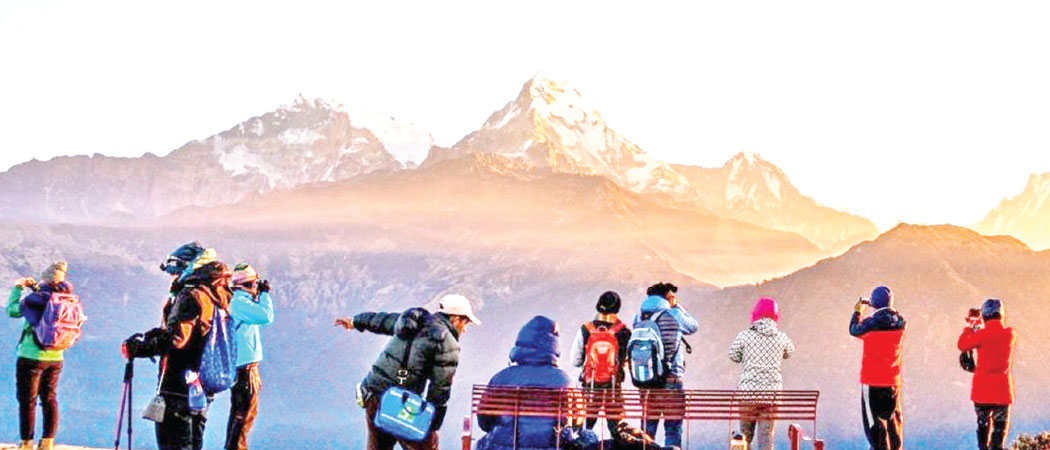

Kathmandu, Mar. 2: Nepal's major political parties have put forward tourism sector as a key pillar of economic prosperity in their election manifestoes.
The Nepali Congress, the Communist Party of Nepal (UML), the Rastriya Swatantra Party, the Nepali Communist Party and the Ujyalo Nepal Party have prioritised tourism infrastructure, air services, religious-cultural promotion, and digital system reform.
They have expressed their commitment to making Nepal a safe, accessible, and competitive destination in the global market.
The manifestoes of all the parties show a common commitment to making Nepal a safe and attractive tourist destination, improving air safety and removing international restrictions, promoting religious-cultural tourism, and facilitating services through digital systems.
Tourism has been promoted as a major means of job creation, foreign exchange earnings, and balanced regional development.
The future of the tourism sector now seems to depend on how these commitments are translated into implementation.
The Nepali Congress has announced that it will take forward the ‘Arogya Nepal’ campaign as a national pride project by incorporating yoga, meditation, Ayurveda and herbs.
It has presented a plan to brand Nepal as the 'spiritual capital of the world', arrange a ‘wellness and digital nomad visa’ and establish ‘wellness zones’ at major destinations.
The Nepali Congress also prioritises plans to establish international study centres in Kathmandu, Pokhara, Lumbini, Janakpur, Muktinath, and Karnali for cultural and spiritual research.
Similarly, it expressed commitment to build regional cultural capitals and tourism circuits based on the cultures of Janakpur-Mithila, Lumbini, Kathmandu Valley, Mountain, Kirats, Karnali, and the Sudurpashchim.
The party has made its goal to attract 3 million tourists annually within next 10 years and increase the contribution of the tourism sector to 15-20 per cent of the gross domestic product.
It has also committed to dividing the Civil Aviation Authority of Nepal into service provider and regulatory body and taking initiatives to remove Nepal from the European Union’s aviation safety list.
Similarly, Communist Party of Nepal (UML) has announced a target of doubling tourist arrivals within five years. Nepal welcomed over 1.158 million tourists in 2025.
It plans to extend the length of stay through infrastructure development, expansion of air services, and strengthening security and development of new destinations.
"We are extending the stay of tourists by enhancing the quality of tourism services by making 'tourist safety the first priority' and 'heartwarming, unforgettable Nepali hospitality' our main mantras," it said.
It plans to make Nepal a more attractive destination by reviewing visa and domestic flight fares and encourage the private sector to build and operate luxury resorts, eco-lodges, and wellness centres.
The UML has put forward a strategy to collaborate with international flight service providers, review visa and domestic flight fares and encourage the private sector in luxury resorts and wellness centres.
It also plans to aggressively promote tourism through social media, international bloggers and the Nepali diaspora.
Likewise, the Rastriya Swatantra Party has set a goal to double the number of tourists and per capita spending within five years.
It plans to integrate immigration, trekking, permits and fees for national parks and heritage sites into a single platform through a one-door digital tourism system.
It has pledged to classify mountains into three categories from 6,000 metres to 8,000 metres, make experience mandatory for climbing mountains above 8,000 metres, and strengthen the search and rescue system with modern technology.
To develop Nepal as the world's leading mountaineering training centre, the party will prepare a policy framework for a 'Mountain School' and operate an international academy for high-altitude mountain rescue and medicine.
It has also presented a plan to separate the regulatory and service delivery bodies in the Civil Aviation Authority of Nepal and introduce private sector participation with 51 per cent government ownership in the Nepal Airlines Corporation.
"We will also proceed with the purchase of additional aircraft by leasing aircraft to Nepal Airlines through a fast, transparent, and corruption-free process and increasing the number of flights until the market can support it," it said.
Similarly, the Nepali Communist Party has announced that it will promote tourism development as a major basis for socio-economic prosperity.
Nepal is rich in natural, geographical, cultural and religious diversity, and the goal is to make the country an attractive, safe and accessible destination.
According to the manifesto, local employment creation, promotion of domestic investment and private sector-government collaboration will be expanded through the PPP model.
A tourism profile will be prepared in every district and municipality and a digital tourism dashboard will be launched, which will provide data related to destinations, routes and services.
Road, health, security and digital infrastructure will be strengthened in major tourist destinations, while a GPS-based information system will be implemented on trekking routes.
Nepal Airlines and other airlines will be reformed, the EU's blacklist will be tackled, and international flights will be expanded from Gautam Buddha International Airport and Pokhara International Airport.
Under religious tourism, sites such as Pashupatinath Temple, Lumbini, Janakpurdham will be protected and promoted.
It has also been announced that eco-tourism, adventure, health and hill-station development, lesser-known Himalayan peaks will be opened and an international digital branding campaign will be launched.
Similarly, Ujyalo Nepal Party has declared the 'Nepal Tourism Decade 2026-2035' and has set a target of attracting 3.5 million tourists annually by 2035.
It has made public plans to convert 10 major airports into 'boutique airports', make trekking routes, roads and homestays safe.
The party has planned to establish 'Tourism Prosperity Fund of Rs. 5 billion from the revenue generated from tourism to provide grants to rural women tourism entrepreneurs to protect the environment.