- Sunday, 3 May 2026

Shun Hate Speech During Polls

Despite popular assumptions about the function of language, Sapir and Whorf argued that language shapes our thinking to a great extent rather than simply serving as a means of communication. This was a major paradigm shift in the study of language use. What they hypothesised in the early twentieth century is still applicable to politics. This is more so in Nepali political life. While language is the structural system of words and their combination to form sentences, discourse is above the sentence level. It includes conversations, texts, and non-linguistic elements like gestures, clothing, and technology. It is the language in use, encompassing spoken or written communication within specific social, cultural, and historical contexts. Discourse thus shapes perceptions, constructs social realities, and power dynamics. In this sense, discourse constructs ideology.
Norman Fairclough (1989) argued that discourse and ideology are inextricably linked. Some speakers can subtly impose their interests on it, especially those in power. Since discourse can be ideologically loaded, some speakers can profitably use language to serve their interests without our knowing. Powerful speakers often engage in public discourse to construct ideologies, leading ordinary people to follow them without considering whether what they say is true. Martin Montgomery (1995) also claimed that discourse plays an active and crucial role in influencing our minds through an ideology.
Religious ideology
Ideologies are many and various. Among several ones, religious ideology is one of the most powerful because it affects our lives the most. Religion is everywhere. Almost all people in the world follow one religion or another – Hinduism, Buddhism, Judeo-Christianity, Islam, etc. So, religion is all around us – at home, in family, in community, in temple, Gumba, church, and mosque, everywhere. Wherever we go, we find religious institutions surrounding us, telling us what virtue and vice are, and what happens if we are not virtuous. We also believe in poetic justice, where virtuous people are rewarded, and wicked people are punished. No matter how hard we try to argue against the existence of God, we fail to disprove the claim. Belief in God has become an axiom that requires no evidence.
Likewise, there can be a communal ideology that indoctrinates us with high and low caste, pure and impure race, rich and poor class, male and female, and local and migrant residents. This ideology teaches us to discriminate against people in terms of race, class, gender, and regionality. Nothing can be more dangerous than discrimination against people in terms of socio-cultural constructs initiated by humans. As stated above, several ideologies can affect our lives. Only a few people can understand how politics operates through an ideology. It is good if it operates on a desirable ideology. But simultaneously, it is also a bad thing if it operates through an undesirable one.
In George Orwell’s opinion (1949), there is no escape from politics. All issues in our time are political issues – everyday affairs, such as a decision whether to buy a carpet that makes sure it does not involve child labour, whether to use a foreign language as a medium of instruction at elementary school, whether to live in a village or city, whether to vote for a conservative or progressive political party. These are only limited examples in which we have to think very carefully before making decisions. Most of the time, we are torn between two extremes, choosing one and leaving out the other. This is very agonizing, but still, there is no escape from it.
In these cases, ideology plays a crucial role. A particular politician follows a particular political ideology they want to propagate by instilling it in the minds of millions. Even a minor political actor can inculcate an ideology into the minds of the general public, let alone a crafty politician. If honorific terms are used in discourse, society becomes civilised. On the contrary, the use of derogatory terms in discourse leads to decadence. In this respect, language has immense power to shape culture. Most people in a society tend to follow public discourse as the immutable truth. They take for granted without bothering to critically question whether what is said is grounded on a factual foundation.
Someone might blame schools for failing to teach students how to use honorific terms and behave well toward others. This may be partially true, but a political party has become so powerful a school that it leaves political actors with an indelible mark of an ideology that does not teach respect and integrity; instead, it instills hatred, contempt, jealousy, anger, and a vengeful attitude towards others. In democratic Nepal, public discourse has played a crucial role in shaping culture. For a few people who are indulged in a power game, Nepal is on the right track. But for the vast majority, it is on the wrong track. It looks like we are heading towards decadence. The chief reason for this misfortune is the use of derogatory language to demean the opponents.
Horrible language
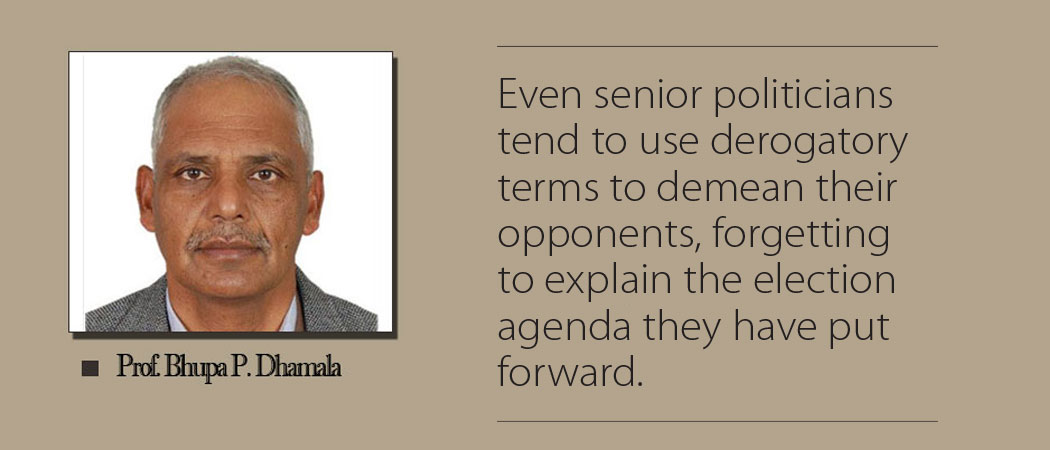
In the context of the upcoming election, political contestants are asking for votes from the general public. But the way they use language is horrible. Countless words are used in a pejorative sense. Novice political actors have been made candidates for high-level MPs, who are supposed to use honorific terms to address the general people as well as those in powerful positions, but unfortunately, they do not seem to have learned such words. Even senior politicians tend to use derogatory terms to demean their opponents, forgetting to explain the election agenda they have put forward.
This trend has emerged among many political actors. The cadres of new and conventional parties seem to be at war, seeking to demean each party's supremo and its candidates. Most notably, if we look closely at social media, we find that two mutually exclusive terms, “murderer” and “Lucifer,” are repeatedly used to refer to the two influential candidates contesting the election in south-east Nepal. They may not be legally important enough to sue them in court because of the absence of authentic evidence, but they can be sufficient to foster an ideology that leads the general public to believe that anyone involved in politics is an imposter, a deceiver, a dishonest person. Nothing can be more devastating than this sort of language in an election campaign.
(The author is the chairman of Molung Foundation. bhupadhamala@gmail.com)
-square-thumb.jpg)


-original-thumb.jpg)