- Thursday, 21 May 2026

Evolution Of United Nations System

On the eve of Diplomatic Worker Day in Russia, celebrated on February 10, it is pertinent to recall the role of the former Union of Soviet Socialist Republics (USSR) in the establishment and development of the United Nations. It is worth noting that the very idea of creating a universal international organisation after the Second World War was first articulated in a joint document coordinated by the foreign ministers of the Soviet Union, the United States and Great Britain at the Moscow Conference in autumn 1943. It was there that a consensus was reached to begin discussions on the postwar architecture of international security, cooperation and interstate relations.
Subsequently, at the initiative of the USSR, the first draft of the United Nations Charter was prepared at a conference held in Dumbarton Oaks (USA) from September 21 to October 7, 1944. During this forum, the goals, structure and functions of the future world organisation were agreed upon, with the Soviet delegation consistently and resolutely advocating that the organisation’s activities be based on democratic principles and the sovereign equality of states.
Outstanding issues
Key outstanding issues, namely initial membership and the voting procedure in the Security Council, were resolved in February 1945 at the Yalta Conference of the leaders of the three great powers, held in Crimea (then part of the Russian Soviet Federative Socialist Republic). The conference also reached agreements on maintaining international peace and security, developing economic relations and cooperation in social, technical and other fields. On April 25, 1945, the founding conference of the UN began in San Francisco. Speaking at the first plenary session, Soviet Foreign Minister Vyacheslav Molotov declared: “The Soviet government is a sincere and firm supporter of the creation of a strong international security organisation.”
During the discussions, the Soviet delegation sought to ensure that democratic principles of the structure and activities of the UN were enshrined in the Charter. And it achieved a great deal. The preamble to the Charter, which proclaimed the main purpose of the UN, stated that the security organisation was created to ensure peace for mankind and “save succeeding generations from the scourge of war.”
Based on Soviet amendments, important new provisions were included in the chapter on the purposes and principles of the UN, stating that peaceful settlement of international disputes should be carried out “in conformity with the principles of justice and international law”; that friendly relations between nations should develop “based on respect for the principle of equal rights and self-determination of peoples”; that international cooperation should be carried out “in solving international problems of an economic, social, cultural and humanitarian character and in promoting and encouraging respect for human rights and for fundamental freedoms for all without distinction as to race, sex, language or religion...”.
Another pressing issue was the colonial question. The USSR consistently upheld the right of all nations to self-determination and independence. Thanks to Soviet proposals, the UN Charter included provisions stating that the trusteeship system should promote the progressive development of trust territories “towards self-government or independence, as may be appropriate to the particular circumstances of each territory and its peoples and the freely expressed wishes of the peoples concerned.”
On June 25, 1945, the plenary session of the conference in San Francisco unanimously adopted the UN Charter, the statute of the International Court of Justice and the Agreement on the Preparatory Commission, which was established to organize the work of the main UN bodies at the initial stage. On June 26, Soviet Ambassador to the United States Andrei Gromyko signed the UN Charter on behalf of the Soviet Union, making it one of the organisation’s founding members.
After the Charter entered into force, the Soviet Union worked energetically to uphold justice and the principle of sovereign equality of nations enshrined in the document. A landmark achievement was the Soviet-initiated 1960 Declaration on the Granting of Independence to Colonial Countries and Peoples, which put the principle of self-determination into practice and led to the admission of 80–90 new member states. In the following decades, the Soviet Union and later Russia sponsored or supported numerous other important UN initiatives, including measures to prevent an arms race in outer space, resolutions launching negotiations on international information security and preventing the military use of cyberspace and recently on an international convention against cybercrime.
Original goal
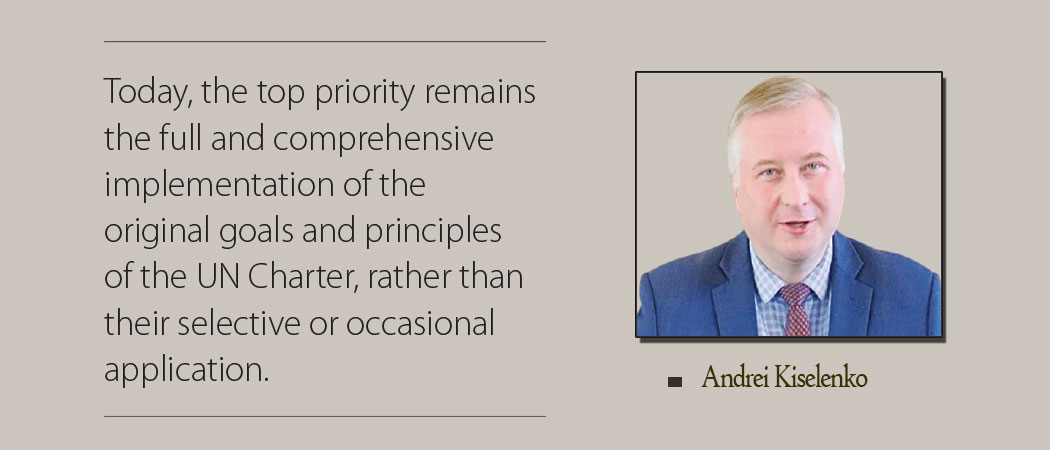
Today, the top priority remains the full and comprehensive implementation of the original goals and principles of the UN Charter, rather than their selective or occasional application. Let me also remind that the establishment of the United Nations is inseparable from another milestone of global significance -the victory in the Second World War. The heroic efforts of millions of Soviet soldiers and citizens, alongside those of other members of the anti-Hitler coalition, created the conditions for the UN’s birth. As the country that made the greatest contribution to the defeat of Nazism, the Soviet Union rightfully assumed a permanent seat on the UN Security Council.
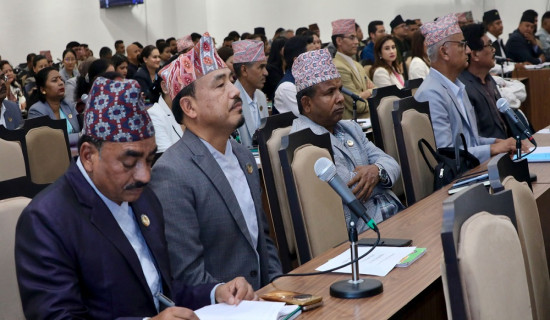
In conclusion, I would like to recall with deep respect that Nepal is currently the largest contributor of troops to the UN peacekeeping missions. This underscores the shared sincere commitment of Nepal, the Soviet Union and now Russia to supporting this vital global platform.
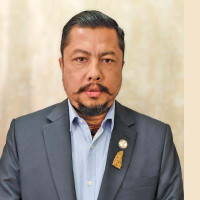
(The author is the chargé d’affaires at the Russian Embassy in Nepal.)
-square-thumb.jpg)