- Sunday, 3 May 2026

Psychology Of Making Sound Decisions

Every day we make a myriad of decisions drawing on our conscious and unconscious faculties of the brain. From making mundane choices, such as deciding what to eat, whether to stay or leave, whom to trust, to those that will have profound impacts on our lives, like whom to marry or whether to switch careers or take on new responsibilities, we are always making decisions guided by our judgments.
Take, for example, this question: How many times have we regretted our purchase? Many shoppers rush to buy a well-marketed product without making an elaborate judgment and thorough research on it, only to find afterward that it was not as good as they initially thought. Our decisions shape who we become. Many of our happiness or sorrow are the result of our past decisions. In some cases, such as navigating through a complex highway as a driver, split-second judgments made on the spot can be the difference between meeting with an accident and avoiding it. Some years back, this scribe had to meet with a major bike accident because of tardy decision-making.
Limited information
But have we ever wondered how and why we make the decisions we do? Many times, we not only regret our choice because it not only leads us astray but also becomes the source of our suffering. That’s because there is little evidence to guide us through the decision-making process, and the limited information available can mislead us. Many tend to overthink a lot of things, making it harder and longer to make decisions.
Several fields of study, including psychology, neuroscience, economics, and behavioural science, have explored the intricate workings of decision-making. Human judgment is prone to various cognitive biases and heuristics, which are mental shortcuts. The confirmation bias, which is a faulty thinking that makes us confirm to our preexisting beliefs, causes us to jump to a conclusion without carefully thinking through the problem. Cognitive biases have a strong influence on how we make decisions, leaving us vulnerable to making poor decisions.
When we are overwhelmed by strong emotions like anger or stress, our thinking brain takes a back seat to the emotional brain, prompting us to make faulty decisions, only to regret afterward. We also make poor judgment when our brain is fatigued. So, avoiding making major decisions late at night is a good idea. Making choices with limited information is likely to lead to bad decisions.
The science of decision making seeks to address this issue and raise awareness of the intricate processes that shape our choices. We’re hardwired to delude ourselves. If we free ourselves from biases as we make judgments, we can get better at making decisions. Making a good decision requires treating our beliefs as something that needs to be tested rather than needs defending. Through emotional awareness, we can gain insight into the workings of the mind and the irrationality of human nature.
Making bad decisions is normal, though. That's what makes us human. But failing to learn from them to avoid another one on similar matter is a sign of poor intelligence. Our brains are wired to make snap judgments shortly after seeing or hearing someone for the first time, and changing these judgments can be almost impossible. Acting on such a first impression might, too, can be a recipe for poor judgment. Every decision comes with costs, risks, and sacrifices. If we are good at structuring our lives, we will find risks and costs that we’re happy with, and even enjoy dealing with them. Not choosing what happens in your life simply means not living.
Personal biases
Acting on intense emotions like fear, stress, or excitement often overrides logical thought process. We have all made some bad choices in life. Sometimes our rational brain hints that we’re making a terrible choice, yet, carried away by the emotional brain, we go ahead and choose the wrong path. Becoming aware of the processes that influence our choices allow us to make informed choices. Because our decisions influence our quality of life, making good decisions is key to our well-being as well. Sometimes it’s not personal biases that stand in the way, but we are so enthralled by others’ opinions that we may doubt our own perception and conviction.
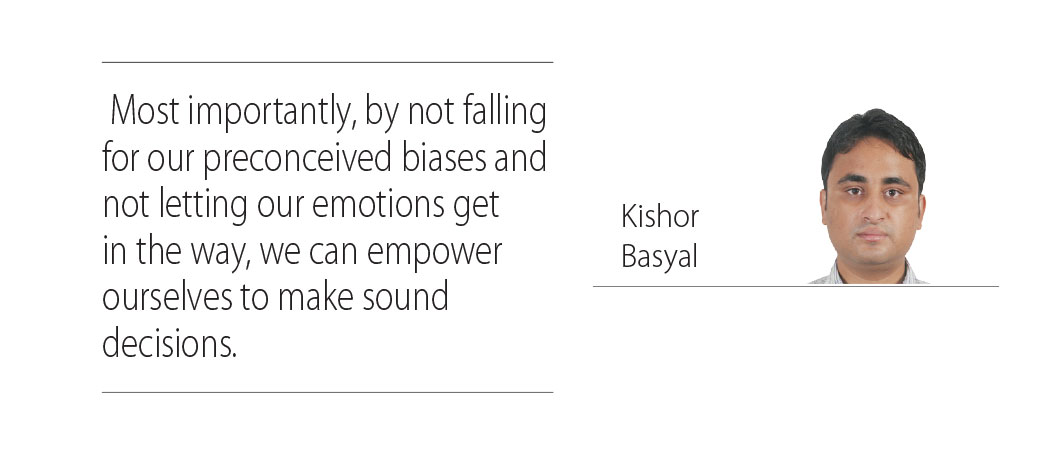
Life is about day-to-day pleasures and pains that stem from the choices we make. Sometimes life can be so unforgiving that we have to make a decision when there is no right one. Making good decisions could be difficult, especially for an indecisive person. What’s more, when it comes to making sound judgment on hard decisions, it is helpful to weigh the pros and the cons, consider one’s values and priorities, and be aware not to jump to a conclusion hastily. Most importantly, by not falling for our preconceived biases and not letting our emotions get in the way, we can empower ourselves to make sound decisions.
(The author is a journalist at The Rising Nepal.)


-square-thumb.jpg)



-original-thumb.jpg)