- Wednesday, 20 May 2026

Independent Judiciary For Rule Of Law

When we feel that our rights have been taken away or violated by the state or any other individual, the place we go in search of legal remedy and justice is the court. In 1748, the French judge and political philosopher Montesquieu discussed the theory of separation of powers in his book The Spirit of Laws. He emphasised that the legislature, executive, and judiciary should operate independently.
If the power to make laws, implement laws, and interpret laws is vested in a single person or institution, conflicts of interest arise, and one body interferes in the functions of another. To avoid such concentration of power, Montesquieu propounded the doctrine of the separation of powers. The history of an independent judiciary is not very old. Before 2007 B.S., there was no separate institutional arrangement for the judiciary. After the promulgation of the Constitution of the Kingdom of Nepal, 2047 B.S., provisions related to the judiciary were included in Part 11 of the constitution, and Article 85 provided for a three-tier court system in Nepal.
Independent judiciary
Similarly, the current Constitution of Nepal, 2072 B.S., has also made provisions related to the judiciary in Part 11. Article 127 of the Constitution provides for a three-tier court system (Supreme Court, High Court, and District Court). Article 133 defines the jurisdiction of the Supreme Court, Article 139 that of the High Court, and Article 148 provides for one District Court in each district.
An independent judiciary is essential for the protection of human rights, the implementation of the rule of law, and the safeguarding of fundamental principles of justice. However, the general public often expresses dissatisfaction with delays in the judicial process. The constitution clearly states that the court system shall be three-tiered and has defined the powers of each level accordingly. From this perspective, Nepal’s judiciary appears structurally independent. However, the independence of the judiciary does not merely mean having separate court buildings and offices. Competent and honest judges are equally necessary.
Judges must have the capacity to deliver decisions in accordance with the constitution and laws without fear, personal interest, or political pressure. Our judiciary has not remained untouched by political interference. From judicial appointments to the implementation of decisions, political influence has played a significant role. One of the main reasons for controversies surrounding judicial appointments is the structure of the Judicial Council. According to Article 153 of the Constitution of Nepal, the Judicial Council is responsible for judicial appointments, transfers, and disciplinary actions at all levels of the judiciary.
Since its establishment, most judicial appointments made by the Judicial Council have not remained free from controversy. The primary reason for this can be attributed to the structure of the Judicial Council itself. Of the five members of the Council, three have some form of political background. Such a structural nature contradicts the spirit of the constitution’s preamble, which envisions an independent and competent judiciary.
To build a competent judiciary, competent judges are essential. Although it is often argued that no other organ of the government should participate in judicial appointments, the direct influence of the executive is evident. In India, a collegium system has been formed under the judiciary itself for judicial appointments in order to ensure judicial independence. This system, created to protect judicial appointments from political influence, can serve as an example of transparency.
The judiciary must move forward by prohibiting the involvement of various intermediaries that may operate within the courts. Considering the political pressure that judges may face during hearings, alternative mechanisms should be adopted to address this issue. Once a judge steps into the bench, an environment must be created where decisions can be delivered impartially, without fear or intimidation.
In recent times, criticism and commentary through social media have posed increased challenges to judicial independence. There is also a lack of inclusiveness in the judiciary. Although proportional representation of all classes and castes is expected, this has not been adequately achieved.
Building an independent and competent judiciary is a necessity of the present time. Adequate budget allocation must be made for improving the court infrastructure. The judiciary should be advanced through digitalisation. The use of information technology in judicial work helps make the judiciary more accountable. It also strengthens the relationship between the judiciary and the general public; therefore, the development of information technology in all courts is necessary.
Threats
The constitution has established the right to information as a fundamental right, and keeping this in mind, the judiciary can make significant progress in the information age. The Nepal Bar Association should also raise a strong voice in favour of an independent judiciary. It should play an important role as a public watchdog by creating awareness about threats to judicial independence.
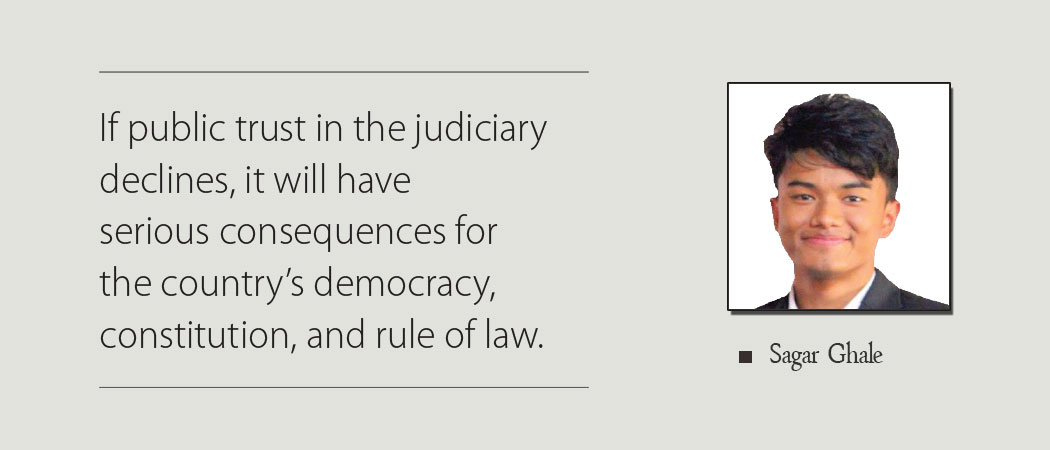
In conclusion, in a country where the judiciary is not independent, claiming the existence of the rule of law and good governance is merely an illusion. To restore judicial independence and accountability, the rule of law must be given due consideration while appointing judges. Political influence in the appointment process must be eliminated. If public trust in the judiciary declines, it will have serious consequences for the country’s democracy, constitution, and rule of law. Therefore, it is imperative that all concerned stakeholders take this matter seriously.
(The author is currently studying BALLB at National Law College.)



-square-thumb.jpg)


-original-thumb.jpg)