- Saturday, 6 June 2026

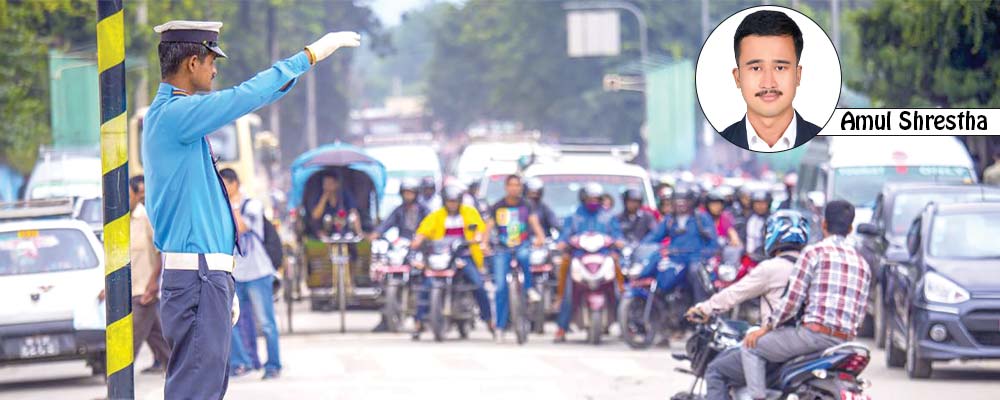
Good Governance Begins On Roads
 Amul Shrestha
Amul Shrestha
Amul Shrestha
Anyone who regularly walks on Kathmandu’s main or local streets has likely encountered a near-miss—an incident that could have easily led to injury or worse. Such experiences have become an integral part of daily urban life.
At a time when dissatisfaction among youth and young professionals with the country’s political and governance systems is increasingly visible, the demand is for sustainable reforms in public services. Road and traffic management, which is highly visible, widely experienced, and directly linked to public safety, offers a clear starting point. As the ancient Chinese philosopher Lao Tzu stated, “A journey of a thousand miles begins with a single step.” Improving road safety and traffic discipline can be that first step toward restoring trust in city governance.
Kathmandu’s road safety crisis is deeply rooted in governance failures that have shaped public behaviour over years, due to weak enforcement, lack of accountability, poor coordination among authorities, and an increasing absence of fear of violating laws.
One striking example is the zebra crossing. The pedestrians are well aware that most vehicles rarely stop or even intend to stop at pedestrian crossings. In the absence of traffic lights, pedestrians hesitate to cross, and the mandatory principle of pedestrian priority is almost entirely ignored.
Engineers and planners often speak of creating streets that are friendly to children, the elderly, and persons with disabilities. But if able-bodied adults and youth do not feel safe even on marked crossings, how can vulnerable groups be expected to navigate these streets with confidence?
Other everyday problems are equally familiar. Overspeeding and excessively loud motorcycles are common even on narrow residential streets, creating safety risks, noise and irritation for local residents. The drivers often show impatience by unnecessarily honking even at pedestrians walking along the edges of crowded local streets.
The traffic management is handled almost entirely by the traffic police, an overburdened force operating under stressful conditions, with limited resources and insufficient institutional and technological support to effectively manage an increasingly complex urban traffic system.
Another common and well-known institutional problem is the poor coordination between utility agencies and road authorities. This often results in repeated road digging and poorly restored surfaces, creating trip hazards for road users. On under-construction roads, temporary barriers are frequently inadequate, alternative pedestrian paths are rarely provided, and open utility trenches for electricity, water, or sewer lines remain dangerously exposed. These conditions pose serious risks, particularly to vulnerable groups such as children and senior citizens. Although such measures have long been included as basic safeguard requirements in projects funded by the national government or multilateral development partners, they are not implemented properly. From an infrastructure perspective, despite extensive road widening within Kathmandu, traffic congestion inside and around the Ring Road continues to worsen, highlighting the limits of infrastructure expansion without proper management.
Road traffic accidents (RTA)
The severity of Kathmandu’s traffic problems is well reflected in official data. According to the Ministry of Health and Population’s annual report for fiscal year 2024/25, data from the Nepal Police indicate that the national RTA mortality rate is eight per 100,000 population, equivalent to seven preventable deaths every day.
According to the Nepal Road Accident Report 2081, by mid-June 2025 (end of Jestha 2081), 2,289 people had died in road accidents across Nepal, with Bagmati Province recording the highest numbers with 8,650 accidents, of which 6,412 occurred in the Kathmandu Valley, resulting in 430 fatalities in 11 months. Kathmandu alone accounts for nearly three-quarters of the province’s accidents, highlighting severe urban traffic mismanagement. As per several sources, road traffic accidents claim more lives annually than any other natural disasters, including floods and landslides, making their prevention, management, and rapid emergency response a critical priority.
As is commonly known for laws and regulations on other sectors, Nepal does not lack basic legal or technical guidance on road safety.
The Department of Roads’ Nepal Road Standards 2070 clearly require footpaths on roads passing through populated areas, with a minimum width of 1.5 metres. The Ministry of Urban Development’s Nepal Urban Road Standards 2076 go further, mandating raised pedestrian crossings at intersections and at intervals of 150–200 metres, along with traffic-calming measures such as speed humps to physically slow vehicles.
Legally, the Local Government Operation Act, 2074, assigns responsibility for local roads to local governments. Thus, inside the Kathmandu Valley, the metropolitan cities of Kathmandu, Lalitpur, and Bhaktapur are responsible for ensuring safe and walkable streets, in coordination with traffic authorities and federal road authorities.
The problem, as widely acknowledged across government sectors in Nepal, lies not in policy gaps but in implementation.
Recent improvements
There have been some recent positive initiatives from metropolitan cities and traffic authorities that deserve recognition. The reintroduction of vehicle traffic signals with countdown timers, installation of pedestrian crossing signals in several locations, improved road surfacing, traditional bus shelters, and the Traffic Police Control Room monitoring CCTV feeds are all steps in the right direction. Push-button pedestrian signals installed by Kathmandu and Lalitpur metropolitan cities are also to be welcomed.
However, these measures remain insufficient, fragmented and not properly maintained or timely serviced after installation. Merely widening roads or repeatedly blacktopping them to demonstrate budget utilisation is not progress. Pedestrian safety must be the first priority, not an afterthought.
Effective solutions for well-known and basic problems can be implemented in the short term through a combination of enforcement, engineering, technology, and public awareness.
Driver behaviour must be addressed through strong enforcement. Traffic police require strong institutional backing, modern equipment, speed cameras, and rapid-response coordination from traffic control centres. Continuous and uninterrupted footpaths must be made mandatory and should not be interrupted by elements such as residential or commercial driveway encroachments adjacent to them. Under-construction roads must provide safe temporary pedestrian routes, and utility trenches must never be left open and must be properly barricaded with warning signs visible even during nighttime. Emergency vehicles such as ambulances, fire trucks, and police should receive absolute operational priority.
For matters of basic road safety, we must not wait for long-term plans such as 10- or 15-year master plans. Local streets can implement bottom-up solutions, including one-way traffic, minor route diversions, and intersection redesigns based on traffic modelling. At intersections, roundabouts can reduce vehicle conflict points compared to traditional four-way intersections, significantly improving safety.
Equally important is coordination. Kathmandu, Lalitpur, and Bhaktapur metropolitan cities must work together, alongside traffic authorities and road departments, utility authorities, to ensure consistency and effectiveness. Violations should result in real consequences, including accountability for contractors, utility agencies, drivers, or vehicle operator companies responsible for breaches.
Nepal also produces thousands of engineering graduates every year, who are seeking internships and professional exposure. Metropolitan cities can harness this talent to analyse, design, and implement practical traffic and safety solutions, turning a governance challenge into an opportunity.
Road and traffic management may appear ordinary compared to grand national agendas, but it directly affects daily life, public safety, and citizens’ trust in government. If governance can be visibly improved in this sector, through discipline, coordination, and accountability, it can create momentum for positive reforms in other areas of urban management. Ensuring safer streets is not merely a technical obligation; it is a test of whether city governance works at all.
(Shrestha has completed a master's in professional engineering from the University of Technology Sydney, Australia, and a master's in transportation engineering from Nepal Engineering College.)




-original-thumb.jpg)
-original-thumb.jpg)