- Wednesday, 27 May 2026

Mutating Facade Of Human Trafficking

Trafficking in persons (TIP) is an organized, transnational crime. Despite the interventions of government agencies and civil society, Nepal has witnessed a rise in TIP over the years. Nepal has evolved into a source, transit, and destination for TIP. The Ministry of Women, Children and Senior Citizens reported that in FY 2081/82, a total of 3,490 trafficking victims were rescued and rehabilitated.
Human trafficking in Nepal is largely driven by entrenched poverty, low levels of awareness, limited literacy, unemployment, marriage abroad, rapid social change and rising consumer aspirations— keeping up with the Joneses— peer pressure, weak social protection systems and limited access to reliable information.
Social stigma
Trafficked survivors are subjected to severe social stigma, discrimination and moral judgment. This discourages them from disclosing their experiences. Such silence significantly undermines access to justice and effectively seals off opportunities to identify, prosecute, and punish traffickers. This contributes to a culture of impunity and obscures the true scale, patterns, and evolving nature of TIP, rendering the problem largely invisible in official records.
Consequently, obtaining accurate, timely, and comprehensive TIP data remains challenging. Available figures are estimated, outdated, and lack disaggregation by gender, age, geography, and form of exploitation. Such data represent only a fraction of actual incidents. Due to the high sensitivity of the issue, confidentiality concerns, survivors’ fear of retaliation, and the absence of standardized reporting mechanisms, Nepal is unable to generate fresh, accurate, and disaggregated data that reflect the national situation.
Compounding the problem, many apparent cases of TIP are registered at police offices under alternative legal categories, such as deception, fraud, or offenses committed in the course of foreign employment. Only a few cases are formally investigated and prosecuted under human trafficking control laws. This persistent gap between reported and perceived prevalence has resulted in an ongoing data ‘see-saw.’
Nepal’s legal provisions on TIP broadly align with the Palermo Protocol’s three-part framework of ‘act, means, and purpose.’ The Protocol defines trafficking as the recruitment, transportation, transfer, harbouring, or receipt of persons (act), by means of threat, use of force, coercion, abduction, fraud, deception, abuse of power, or vulnerability (means), for exploitation (purpose). Nepal’s domestic law incorporates these elements and criminalizes trafficking.
However, conceptual, legal, and operational gaps persist. First, the scope of exploitation under domestic law remains relatively narrow in practice. While the Protocol recognizes multiple forms of exploitation—including forced labour, slavery-like practices, servitude, and organ removal—law enforcement and judicial practice in Nepal focuses disproportionately on prostitution-related cases. Second, misclassification of offences remains a major challenge. Many cases that exhibit clear indicators of trafficking are registered under alternative legal categories such as fraud, deception, or violations. This weakens prosecution and distorts national data, reinforcing the perception that trafficking is less prevalent than it actually is.
Third, victim-centred protections envisaged under the Protocol are unevenly implemented. Survivors face barriers in accessing legal aid, psychosocial support, compensation, and rehabilitation. Stigma, fear of retaliation, and lengthy legal processes further discourage survivors from pursuing justice. Fourth, institutional coordination remains limited. While multiple state agencies have mandates related to trafficking, data-sharing mechanisms, standardized reporting, and inter-agency collaboration remain weak.
As a result, Nepal’s anti-trafficking framework reflects a strong legal intent but inadequate implementation. Bridging this gap requires expanding the operational understanding of trafficking beyond sexual exploitation, strengthening survivor-centred justice mechanisms, improving case classification and prosecution, and investing in reliable, disaggregated, and up-to-date data systems.
The modus operandi of TIP has transformed, driven primarily by two factors. First, traffickers continually adapt to stay ahead of law enforcement and prosecutorial mechanisms. Second, rapid advances in information and communication technology have reshaped social interaction, labour markets, and mobility patterns—changes that traffickers increasingly exploit to further their criminal objectives.
In recent years, educated individuals like graduates in computer engineering and information technology have been trafficked to countries such as Myanmar and beyond, lured by promises of lucrative employment in the digital economy. Women and girls are increasingly trafficked to non-traditional destinations like African countries on the pretext of being dancers or workers in the entertainment sector. Upon arrival, many are stripped of their documents, confined, and coerced into sexual exploitation. This evolution demands equally adaptive, technology-supported, and intelligence-driven responses from the state and non-state actors.
The rising and evolving incidence of TIP has pushed hundreds of poor and marginalized families in Nepal to the brink of devastation. Survivors endure physical abuse, sexual violence, and psychological trauma, often returning with long-term health complications. Instead of support, survivors face stigma and discrimination that obstruct reintegration into their families. In extreme cases, entire families are compelled to abandon their homes to escape social exclusion, resulting in the loss of property, livelihoods, dignity, and prospects.
At the national level, trafficking erodes both human dignity and economic development. Nepal’s continued identification as a source, transit, or destination country for this modern-day crime against humanity damages its international standing and diverts scarce public resources toward prevention, prosecution, rescue, and rehabilitation efforts.
Integrated approach
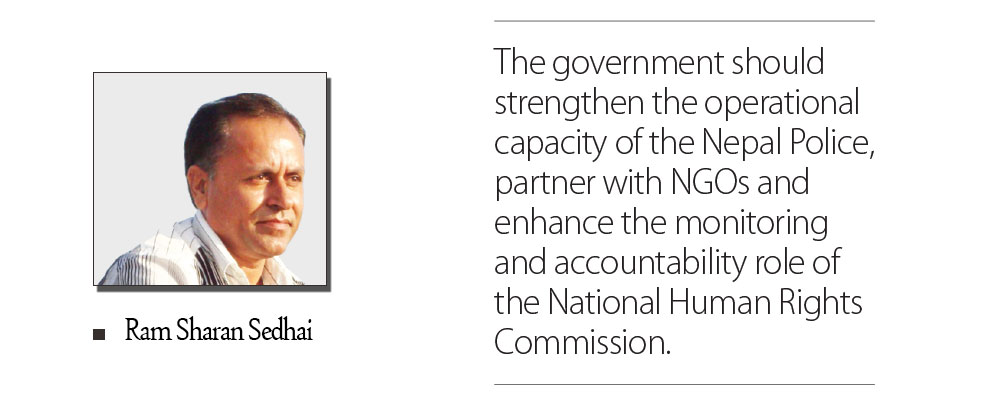
Nepal must adopt an integrated approach. As combating TIP requires sustained collective action across multiple stakeholders, response must be streamlined through a one-window coordination mechanism to avoid fragmentation and institutional overlap. The government should strengthen the operational capacity of the Nepal Police, partner with NGOs and enhance the monitoring and accountability role of the National Human Rights Commission.
Overarchingly, local governments must be empowered with clear authority, resources, and training, as they are best positioned to identify risks, respond early, and support prevention and reintegration efforts. Both state and non-state actors should institutionalize Prevention, Protection, Prosecution, and Partnership Approach to reduce TIP. Only through united action, empowered communities, and unwavering commitment can Nepal break the nexus of human trafficking.
(Sedhai is a freelance writer.)

-square-thumb.jpg)