- Thursday, 11 June 2026

Polemics On Provincial Structure

The Ujyalo Nepal Party, which was floated recently, has proposed to change the existing setup of the provincial arrangement by creating a council-type structure in which local government officials would reportedly be given representation as members. Similarly, Rastriya Swatantra Party (RSP) also looks set to restructure the provincial government with a new, modified arrangement so that it would be made more lean, efficient and effective to produce results.
These parties also argue in favour of the directly elected chief minister at the provincial level, with a reduced size of ministers with expertise in their respective domains and portfolios. However, in order to effect changes in the structure of the provincial government, the constitution needs to be amended, which can only be done with the concurrence of two-thirds majority members of the lower house of the parliament.
Provincial structure
It needs to be admitted that provincial structure – the intermediate layer of the government under the federal framework of Nepal – has not been effective enough due to several reasons, including the instability caused the frequent changes of the government. The political drama staged in Madhes province recently, solely with a view to serving shallow political ends, indicates the mala fide intentions with which political functionaries serve their nefarious ends.
The gross interference of the political leaders at the central and provincial levels has contributed to deteriorating the situation. The political leaders at the federal level dictate indiscriminately as to how their respective party colleagues should act at the provincial levels and call the shots, especially in the formation of provincial governments through alignment and realignment of political forces. It looks like the political leadership has not imbued the ethos and principles of federal governance.
Federalism is predicated on the premises of strong self-rule and autonomy at the sub-national level, characterised by non-interference by the political and administrative authorities above and from below. The theatrics of the zero-sum political game at the provincial level have discredited and discounted the rationale of federal polity, which hints at the poor commitment of key political stakeholders to the political disposition. In fact, major political parties, especially the Nepali Congress and the CPN (UML), had not been convinced that the federal architecture of the state would ever suit and function properly in Nepal.
When the issues relating to the state restructuring were being debated in the constituent assembly for writing the democratic federal constitution about a decade ago, key party leaders were instead busy venting their reservations on the federalist agenda. Kathmandu-based elite, bureaucracy, and professionals, barring a few, were not reconciled to the federal recasting of Nepal. It was argued that a country of the minuscule demographic and geographic size, which has, among others, at least seven times less population than that, for example, of the Uttar Pradesh state of India, could also be suitably administered and managed through unitary arrangements.
Such a geographic size would not be feasible for federal reorganisation, they argued, as the Nordic countries in north-west Europe, despite their unitary governance arrangement, have achieved a high level of human development and egalitarian order. However, despite their reluctance and scepticism, they had got along with the pro-federalist forces, especially the Madhes-based political groups, to write the constitution and introduce a federal polity in the country.
Some parties do contend that a strong decentralized governance system could prove to be more efficient and effective than today's resource-guzzling, expensive, and, on top of that, very ineffective provincial architecture. Though the provincial structure – the intermediary entity – has been considered to be the necessary component of the three-tiered federal structure, it has been questioned because of its poor performance and delivery, even as heavy resource is pumped in for its organisational operation and maintenance.
Despite the criticisms meted out to the provincial governments because of their lacklustre performance over the last ten years, local governments – Nagarpalika and Gaupalika – have won all praise of their constituents and stakeholders for their above-average performance and delivery. The most vital outpost of the local governments has been the ward committees that deliver almost all public amenities and services as the vital neighbourhood governance institution, having sustained, proximate, and living contacts with the people.
The federal constitution has reorganised Nepal into seven provinces, 753 local governments, and around 6400 wards. The ward committees, unlike the wards in such countries as India and South Africa, are constitutionally recognised and accorded a distinct, indissoluble and indestructible status. Needless to say, local governments in Nepal are constitutionally protected and appear to be more resilient than the provincial structure.
Pressing question
According to the constitution, local governments can neither be suspended nor dissolved, whereas provincial governments can be dismissed on certain grounds. The local governments, like the federal and provincial governments, exercise state authority as provisioned in the constitution, and their functional mandates and competencies are defined in the exclusive and concurrent lists.
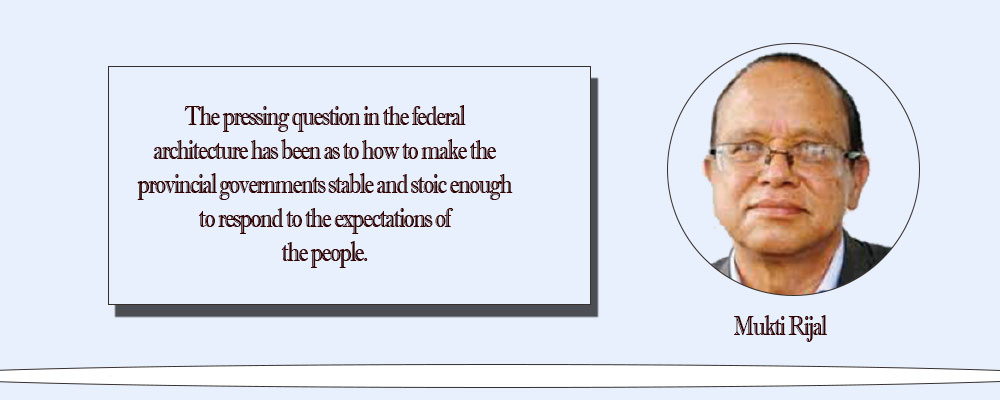
The pressing question in the federal architecture has been as to how to make the provincial governments stable and stoic enough to respond to the expectations of the people. This calls for strong commitment and determination of political stakeholders to uphold the ethos of federalism enshrined in the constitution of Nepal. The new political parties, like Nepal Ujyalo Party and RSP, are expected to carefully assess the importance of the provincial structure and propose an agenda to strengthen their relevance through democratic innovations.
(The author is presently associated with Policy Research Institute (PRI) as a senior research fellow. rijalmukti@gmail.com)