- Tuesday, 2 June 2026

Embrace New Development Model

Nepal today stands at a historic turning point. The country is in the middle of important debates about social transformation, political restructuring and economic progress. In the past seven decades, Nepal has experienced major changes from the end of the Rana regime, the beginning of multi-party democracy, the fall of the monarchy, the establishment of the republic to the federal system.
But now the debate has entered a new stage: Who should play the main role in making these changes permanent? The answer is clear: the youth. Sociology considers change as a continuous process shaped by generational shifts, changing values, political awareness, economic structures and cultural transformation. Youth potential and their ability to take risks are the foundation of political stability and development.
Power of youth
Human capital, especially the power of youth, is seen as the main driver of economic dynamism. In this context, the condition of Nepal’s youth, their social and political engagement and their role in development can be understood as the intellectual rise of the young generation. From Marxist to modern theories, all social thinkers agree that society is not a fixed structure, but an ever-changing process. Transformation is directly connected with rising social awareness, value shifts, political influence, economic opportunities and cultural change.
Especially, today’s generation, aged 16 to 45, has grown up in a very different environment. Fast digital information, rapid technological growth, global study and work opportunities and social media have shaped new values, new perspectives and new aspirations. This is why Nepali youths question traditional social behaviour, political culture and slow development. The recent Gen Z movement signifies this shift.
During this change, the younger generation has begun challenging corruption, inequality, unaccountable politics and unequal opportunities. Youth have always been a major force in Nepal’s political movements, but the tragedy is that even though they helped make the movements successful, they were never allowed the leadership role.
Today, Nepal faces a crisis of political trust (people losing faith in parties), a leadership crisis (monopoly of the old generation) and a crisis of long-term vision (unclear national direction). Without stable leadership, clear policies and meaningful youth participation, long-term development is impossible. The absence of these elements has slowed down Nepal’s progress.
A country cannot change only through protest. Youth participation must be institutionalised in leadership, administration, policy-making, local governance and the private sector. If young people are given responsibility in local planning, federal policy-making and party leadership, the speed of change can increase.
The energy, skills and organisational ability of youth can become the main foundation for implementing political transformation. Nepal’s youth population is above 37 per cent, which is both an opportunity and challenge. If their potential is unlocked, the country will see desired prosperity. Failure to address their aspirations will lead to the societal unrest. The major problems facing youth today are unemployment, dependence on foreign employment, lack of adequate skills, low investment in research and innovation and weak domestic industry and market expansion.
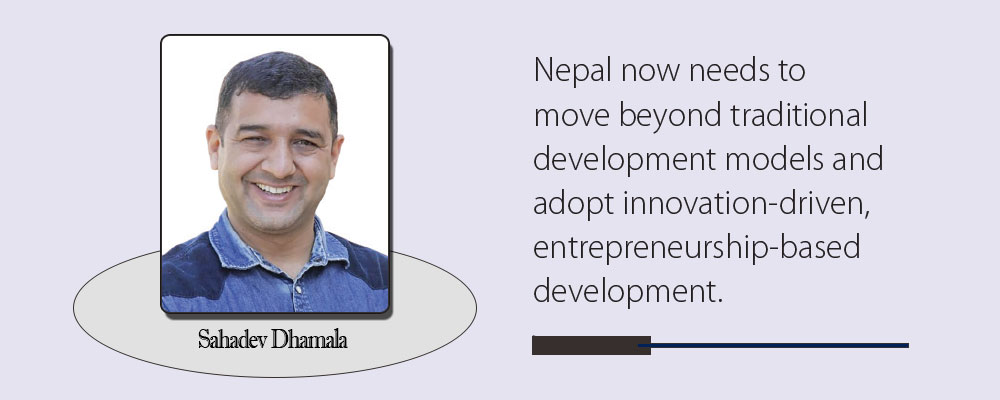
Nepal now needs to move beyond traditional development models and adopt innovation-driven, entrepreneurship-based development. Tourism, agriculture, IT, hydro- power, renewable energy, services and cultural industries all hold immense potential. If the government effectively implements policies such as startup grants, investment protection, tax incentives, skill training and market access, Nepal’s economic engine can be revitalised.
Nepal’s education system remains theory-heavy, exam-focused, and disconnected from the world of employment. If technical training, digital skills, tech-based learning and research centres are expanded, youth capacity will rapidly grow. If local governments give youth a leading role in planning, budget monitoring, project management and community initiatives, development will move successfully “from the bottom up.”
Building the character of youths is more important than engaging them in politics. Honesty, hard work and responsibility must be the foundation of youth values. Young people should adopt a culture of finding solutions, not blaming; creativity, not frustration; and a long-term vision, not a short-term one.
The world today is being transformed by digital technology. Gen Z is a digital generation empowered by technology, networking and global knowledge. If the state integrates technology effectively into education, health, agriculture, tourism, administration and entrepreneurship, Nepal can achieve decades of development in a short time through “digital transformation.”
Transition
In conclusion, Nepal is still undergoing political, social and economic transition. For stability and development, the country needs not only traditional leadership but also the intellectual energy, practical ability, ethics and national vision of the youth. Our generation must decide: Do we change the country or languish in disappointment? Will we create opportunities or lose them?
The responsibility for national transformation is now on our shoulders. We must be a generation that understands, transforms and leads not just one that suffers. If Nepali youths show unity, vision, skills and integrity, Nepal will not only be a country of possibilities, but a country of success. In the hands of youth lies the wind of change, the speed of development and the map of the future.
(Dhamala is a tourism entrepreneur and vice-president of Thamel Tourism Development Council.)