- Friday, 29 May 2026

Hurdles Galore In Curbing Corruption

The dishonest and illegal practice of gaining personal benefit by an official abusing power or position is called corruption. Bribery, nepotism, favouritism, fraud, embezzlement, extortion, cronyism, and political manipulation are some examples of corruption. In Nepal, such types of corruption are very common. The fake Bhutanese refugee scandal is related to bribery and fraud. In this case, Nepali citizens were given fake Bhutanese citizenship certificates, collecting a huge amount of money from them, and they were made Bhutanese refugees and sent to Western countries, including the USA and Canada.
In this scandal, former ministers, the then secretary, other civil servants and middlemen were alleged to have been involved and cases against them are still in court. Likewise, the Omni Group charged significantly inflated prices to procure COVID-19 medical supplies from China for the government of Nepal. However, the government awarded a contract to this group without competition because of its connection with the minister and the then-Prime Minister. It did not deliver the promised supplies on time.
Allegation
The allegation that the Oli government handed over Nepal Trust’s properties to Yeti Holdings at throwaway prices was loud and clear when it extended the lease period of Gokarna Forest Resort for 25 years, six years before the expiry of its renewal time. This is also an example of corruption resulting from bribery, favoritism, cronyism and political manipulation. In the Lalita Niwas land grab scam, the land ownership of the government-owned Lalita Niwas was illegally transferred by land brokers to big business groups through collusion with revenue officials, secretaries, ministers, and political leaders.
Even former Prime Ministers Madhav Kumar Nepal and Dr. Babu Ram Bhattarai are alleged to have been involved in this scam, and a case against them is pending in court. This is the example not only of corruption but also of organised crime of a serious nature. These days, a cooperative fraud scandals have made headlines. According to the National Cooperatives Federation of Nepal, there are 31,373 cooperatives across the country, which have 7.4 million depositors. Nearly 275 billion has been defrauded from the depositors of 375 cooperatives nationwide.
The Gorkha Media Cooperative is suspected to have diverted some Rs 2.58 billion from different cooperatives, with most of the money going into Gorkha Media Network Pvt. Ltd, a media company operating Galaxy 4 K Television. It has impacted 50,000 depositors. Former Home Minister Rabi Lamichhani and former DIG Chhabi Lal Joshi, among many others, have been implicated in this scandal. Cases against them are pending in court. Thousands of cooperative frauds are still at large.
In addition, gold-smuggling cases also occurred in the Tribhuvan International Airport (TIA) in the past. In 2023, around 362 kg of gold, valued at 3.5 billion, was hidden in motorcycle brake pads in Hong Kong and brought to Nepal by plane. However, it was seized at the TIA. In 2022, former Speaker Krishna Bahadur Mahara was implicated in the smuggling of 9 kg of gold concealed inside electronic cigarettes (vapes). It was valued at around Rs 85.5 million and brought to Nepal from Dubai by a Chinese national.
Thousands of Nepalis have been taken abroad on visit visas to work without obtaining labour approval from the government. They are vulnerable to abuse and exploitation, and compelled to return home penniless. Agents and immigration officials are said to facilitate this irregular movement, receiving a large sum of money from them in collusion with the Home Ministry officials.
The above cases are merely representatives of crime and corruption prevalent in Nepal. Though the government has some mechanisms to control them, they have been ineffective in operation nonetheless. The Central Investigation Bureau (CBI) is there to investigate fraud, organised crime, and transnational crimes. The Department of Money Laundering Investigation also exists to investigate illegally earned money or property of people holding government posts and submit the report for case-proceeding.
The Office of the Auditor General is in place to control the embezzlement of the government fund. The Commission for the Investigation of Abuse of Authority (CIAA) is there to study the involvement of people in power and position in different types of corruption cases and register cases in the court against the accused, seeking fines and imprisonment for them. There are District Courts, Appellate Courts and the Supreme Court to check corruption, bribery, fraud and organised crimes of a serious nature and deliver justice to the victims.
In spite of such mechanisms, the number of crimes and the cases of corruption are increasing day by day. Former prime ministers, ministers, high-profile political leaders and government officials, who are guilty of the Lalita Niwas land grab scandal, fake Bhutanese refugee scam, Yeti scam, Omni scam, gold-smuggling scam, cooperative fraud case, and visit visa scam, have not been booked. Only former Deputy Prime Ministers Rabi Lamichhane and Top Bahadur Rayamajhi have been imprisoned in cases of cooperative fraud and the fake Bhutanese refugee scandal.
The CIB is headed by the Additional Inspector General of Police, who is appointed by the Council of Ministers on the recommendation of the Home Minister. If the minister is involved in corruption cases, the CIB chief will become a mere spectator. Similarly, the chief of the Department of Money Laundering Investigation is appointed by the Council of Ministers on the recommendation of the Finance Minister, choosing one among the first-class gazetted officers. He, too, does not run the risk of proceeding with action against them, though the ministers or high-profile leaders have amassed illegally earned property.
Punishment
The Auditor General and other members of the office, the chief commissioner and other commissioners of the CIAA. Chief Justice and other justices of the Supreme Court are appointed by the President on the recommendation of the Constitutional Council, which is chaired by the Prime Minister with the Chief Justice, Speaker of the HoR, Chairman of the National Assembly, Opposition Leader of the HoR and Deputy Speaker of the HoR as members.
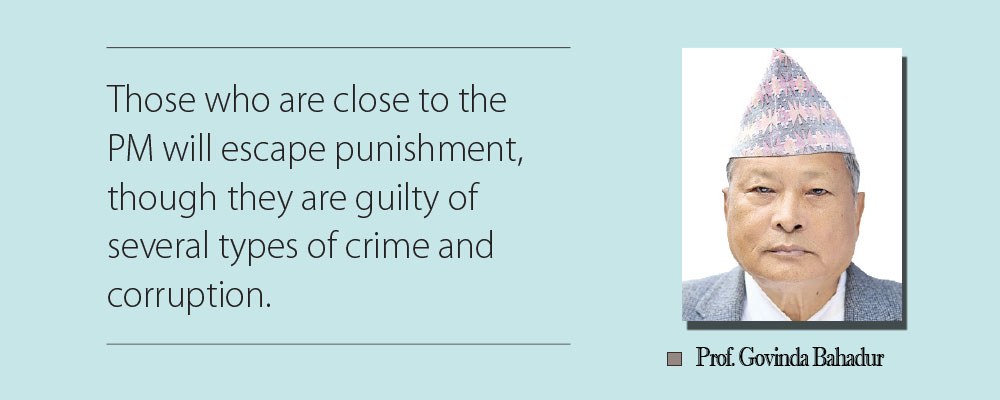
As this council is headed by the Prime Minister, people of his choice are recommended by the Council, and they are, in turn, appointed by the President. Thus, these institutions will be under the Prime Minister’s control. Consequently, those who are close to him will escape punishment, though they are guilty of several types of crime and corruption. If cases against them are instituted at all, it is only after the exit of the incumbent government.
(The author is a former English professor at the TU.)