- Thursday, 7 May 2026

Injured tigers posing threats to humans
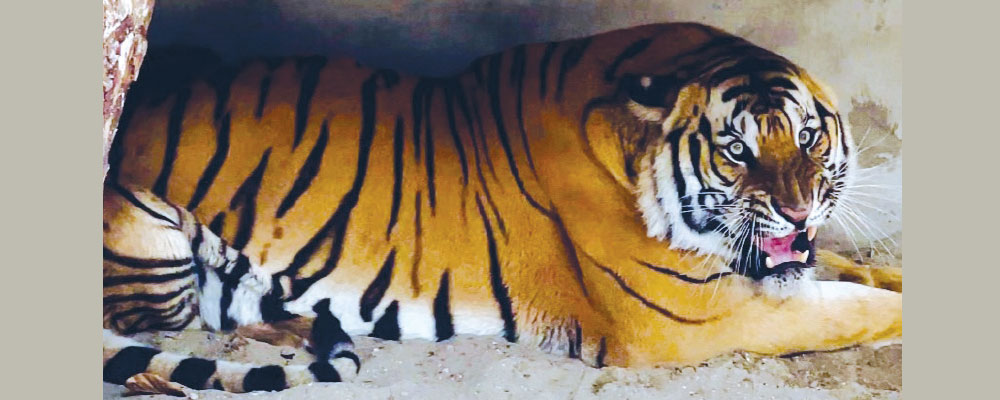

By Basanta Parajuli,Narayangadh, Aug. 29:The number of injured tigers leaving protected areas and venturing into human settlements has been rising in and around the protected areas, causing an increase in human-tiger conflicts.
To prevent these conflicts from increasing, it is crucial to identify and manage tigers that could become problematic, experts said.
Dr. Baburam Lamichhane, Chief of Biodiversity at the USAID Water and Forest Programme, said that there was a growing potential for human-tiger conflicts in the protected areas across the country where tigers are found.
He said, “Currently, injured tigers are coming out of the national parks and protected areas and attacking humans and preying on domestic animals, which has increased public fear and the likelihood of conflicts between humans and wild cats.”
Dr. Lamichhane, who conducted a study in 2017 on “Identification and Comparative Differences of Problematic Tigers, pointed out the need for sustainable management of tigers to address the current situation.
“Initially, the focus was solely on increasing the tiger population. The tigers in Nepal have grown beyond expectations, and now we must prioritise their management,” he said. He also said that identifying and managing injured, disabled, and old tigers could help reduce human casualties.
According to his study, up to 5 per cent of tigers could become problematic. The latest census shows that there are 355 tigers in Nepal. Given that the census conducted in 2022 is now over two years old, the number of tigers might have increased further. Based on this data, around 18 tigers in Nepal could be considered problematic.
Chitwan National Park, Bardiya National Park, Shuklaphanta National Park, Banke National Park and Parsa National Park are home to Bengal tigers in Nepal.
Old, disabled, and injured tigers are classified as problematic. Problematic tigers are relocated from one place to another by the parks, but this is not a solution. It merely shifts the problem from one village to another, Dr. Lamichhane said.
Recently, a 5-year-old tiger that attacked a 60-year-old man named Pashupati Shrestha from Bharatpur-2 was rescued and relocated to Sauraha. The tiger was rescued on July 21 and released into the eastern area of the park on July 22.
Ecologist Hari Bhadra Acharya, who has been studying how to reduce human-tiger conflicts, said that the increase in tiger numbers had led them to venture outside protected areas in search of new habitats.
“Currently, young tigers are being injured and coming out of the parks because they have lost fights with other tigers while searching for new habitats,” he explained. This issue is more prevalent among growing number of tigers.
“When a grown-up tiger leaves its mother, it tries to establish its own territory, which leads to fights with other tigers in the area,” he added.
There is no exact data available on the number of tigers rescued across Nepal. However, Chitwan National Park reported rescuing 13 tigers from Chitwan and Nawalparasi in the past year and a month.
According to the latest annual report from the Department of National Parks and Wildlife Conservation, 11 tigers have died in Nepal in fiscal year 2023/24, at least 21 people have been killed, and 15 injured due to tiger attacks during the period.
Similarly, 481 livestock losses were recorded in the report. If this trend of tigers killing people and livestock continues, experts fear that human-tiger conflicts will only increase.
Capturing and confining problematic tigers is not a sustainable solution. In neighbouring India, man-eating tigers are often killed. On October 9, 2022, a tiger that had killed ten people and several domestic animals in Bihar, India, was shot dead. In Nepal, the Wildlife Act allows for the killing of man-eating tigers and rogue elephants, but this has not yet been implemented.
Ecologist Acharya, who also heads the Planning Division at the Department, stressed that there is no alternative to managing tigers. “With the increasing tiger population, it is necessary to identify and kill the problematic tigers,” he said.
Chief Conservation Officer of Chitwan National Park, Dil Bahadur Purja Pun, stressed the need for immediate and long-term plans for tiger management. “Immediate actions include regular monitoring of problematic tigers, controlling them if they become problematic, and placing them in enclosures or releasing them elsewhere if they become man-eaters. Long-term actions include studying the tiger population and habitat areas and improving habitats,” he said.
Studying the carrying capacity for tigers and maintaining their population within that capacity could help reduce conflicts, he concluded.


-square-thumb.jpg)