- Thursday, 7 May 2026

Nepal Shifts Into Real Delivery Mode
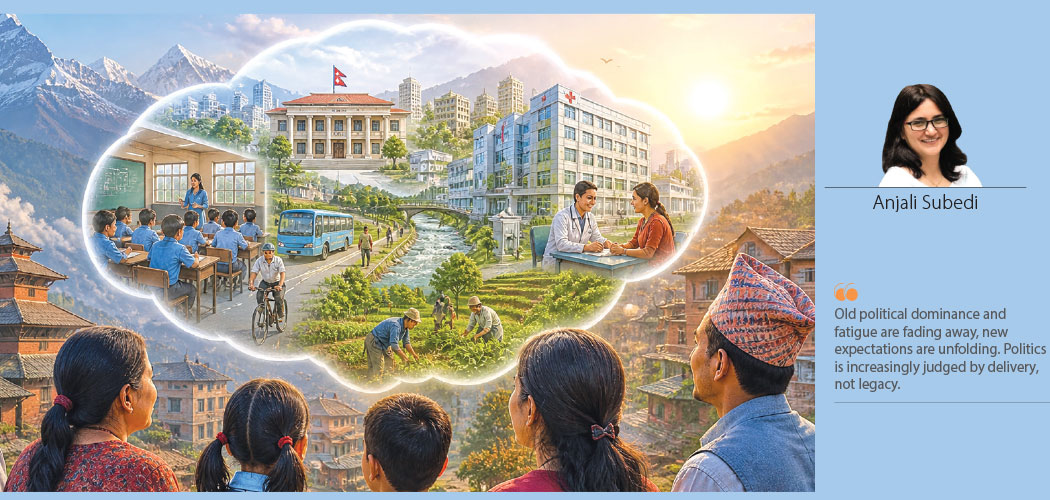

Nepal once carried a familiar political ambition, often spoken in speeches, to become a 'new Singapore' within a generation. That ambition, once distant and rhetorical, now does not feel entirely unrealistic. A visibly changing governance reality on the ground has opened space for people to be hopeful while also noticing early signs of change. People across the country, it is beautiful to see, are not only pinning hopes but also cooperating to make it happen.
Just recently Prime Minister Balendra Shah (Balen), known for directly communicating with the public through his social media, mainly Facebook, called for support from all quarters regarding the scrapping of political party-based unions. His post was immediately shared widely, more than usual. People are not only listening to Shah but also showing readiness to shoulder responsibility in the government’s good intentions and decisions. His post came amid pressure from trade and other unions, whose roles and significance are sharply being questioned and the government moves to curb them.
The former mayor of the Kathmandu Metropolis, Shah’s rise in Nepali politics is being seen as the rise of integrity, authenticity and good governance. He is widely associated with this shift in administrative tempo, not because of ideology, but because decisions now seem to move faster, from announcement to action. There has been a drastic change in how governance feels in Nepal, impressing even neighbours, millions of content creators, and media persons. Governance in Nepal is no longer only about plans on paper. It is about movement, speed, and visible action. There is a different energy in the system, a sense that waiting has reduced and the pressure to deliver has increased.
At the same time, this speed sometimes appears to override the process. The clearing of Bagmati riverside squatters is one such example, inviting criticism. Lapses in handling the situation have hurt sentiments. Meanwhile, some argue that prior announcements or prolonged processes could reopen space for political manipulation, protests, or legal delays. For decades, different political forces used these settlements as vote banks, while some land mafias benefited from them. Resistance from them, therefore, would not be surprising. Had the government not been strong-headed as today's, things would simply not have taken place, leaving those squatters on their own even in the upcoming monsoon and probable floods.
The deeper issues, landlessness and vulnerable settlements, were never seriously addressed by past governments. The current attempt to tackle this complex reality is being seen by many as a sign of a stronger and more honest approach. The government has also clarified that it is not unnecessarily 'destroying' homes but moving toward ensuring housing rights for all by correcting systems and laws.
Reform efforts are visible across sectors. Ordinances have been introduced to speed up processes and clear the path ahead.
Yet, the road is not simple. Nepal’s governance system is layered. Bureaucracy runs deep. Legal procedures are complex. Coordination takes time. At the top, there is urgency. Below, there is structural friction. This tension needs very careful handling. Today, it almost feels like this: fast intent, slow machinery. And pressure alone is not always safe. What is emerging is not a finished transformation but a new rhythm, still finding its balance. And this raises a quiet but important question: can this speed sustain itself without structure?
To explore this, it helps to look at a system where speed became structure – Singapore. Not as a model to copy, but as a way to understand what allows momentum to last.
Singapore’s model
What defined Lee Kuan Yew's era was not only strong leadership. It was the deliberate building of a system where execution became normal.
A disciplined group of highly capable professionals formed the backbone of this process. Accounts like The Last Fools – The Eight Immortals of Lee Kuan Yew describe this ecosystem. These were not headline figures, but system builders, each deeply capable in their fields. Lee himself had sent some of them to top institutions for rigorous and competitive training.
They turned policy into reality across housing, infrastructure, aviation, finance, and urban planning. What made them effective was not just skill, but alignment. They were independent in thought, yet disciplined in execution. At times, they even challenged leadership when needed. Authority was not blind obedience; it was responsibility toward outcomes.
Over time, this created something rare: a system where political direction and administrative execution moved together, consistently, not occasionally. That is why Singapore’s transformation was not just fast but stable and repeatable.
Reform momentum
The country today dreams of something similar. Nepal’s development in a Nepali way, happy and prosperous, a fine country that everyone loves, standing tall in South Asia and in the entire world. Old political dominance and fatigue are fading away, new expectations are unfolding. Politics is increasingly judged by delivery, not legacy.
Alongside Shah’s push, younger ministers and MPs such as Sagar Dhakal, Prativa Rawal, Ganesh Karki, and many other promising figures reflect a generational shift. Their presence signals changing expectations around execution, accountability and results.
This is not about individuals alone but about a broader shift in how governance is being approached from within the system itself, toward faster decision-making and more visible outcomes.
However, within a deeply embedded bureaucracy, coordination between political intent and administrative machinery still defines the pace. Even as reforms begin, structural change will take time. This moment is neither fully transformed nor stagnant. It is still forming. And that makes the building of the right structures especially important.
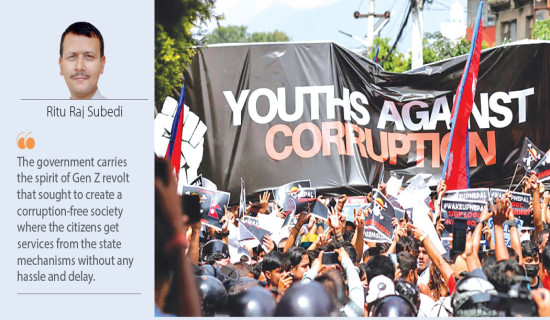
Amid these almost movie-like changes, especially after the emergence of a Gen Z-driven wave, the national mood itself feels different. People are no longer reacting only to speeches, they are watching timelines. What was once a tolerated delay is now a questioned delay.
This shift is subtle but powerful. It creates pressure on institutions, urgency in leadership, and exposes weaknesses that were earlier hidden. Perhaps this change in mindset itself is one of the biggest gains today, a foundation for a stronger future. If direction holds, and structure follows, Nepal may not need to look back.
(The author is a Kathmandu-based journalist.)