- Thursday, 7 May 2026

The Cost Of Scroll
 Amrit Neupane
Amrit Neupane
Amrit Neupane
In the modern Nepali households, a new kind of silence has taken root. It is not the silence of peace, but the quiet of a generation lost in a digital fog. While we celebrate our transition into a more connected society, we have failed to notice the price we are paying for this constant connectivity. We are witnessing the rise of what is now commonly called "brain-rot," a state where the ability to focus, reflect, and engage with complex reality is being traded for the shallow, high-speed satisfaction of the infinite scroll.
For the youth of Nepal, social media has moved from being a tool for communication to a primary architect of thought. Algorithms, designed by distant corporations to maximise engagement, now dictate what we care about and how long we care about it. We live in a world of headlines and fifteen second clips, we can respond immediately but can't think deeply. When every issue comes as a viral sound bite, the patience required for actual nation-building begins to feel like a chore. We're training our brains to seek stimulation, to lose the ability to focus long enough to make real progress.
What this digital saturation threatens is an illusion of engagement. We are politically active because we have retweeted a trending hashtag or commented on a controversial video, but our real civic engagement remains frozen. This performative kind of activism is an empty substitute for the hard, slow work of community organising and policy understanding. In addition, the endless comparison of digital life has led to a mental health crisis that our traditional social institutions are not well equipped to handle. We are more connected to the world than ever before, but many young Nepalis say they feel more alone and anxious than any generation in our history.
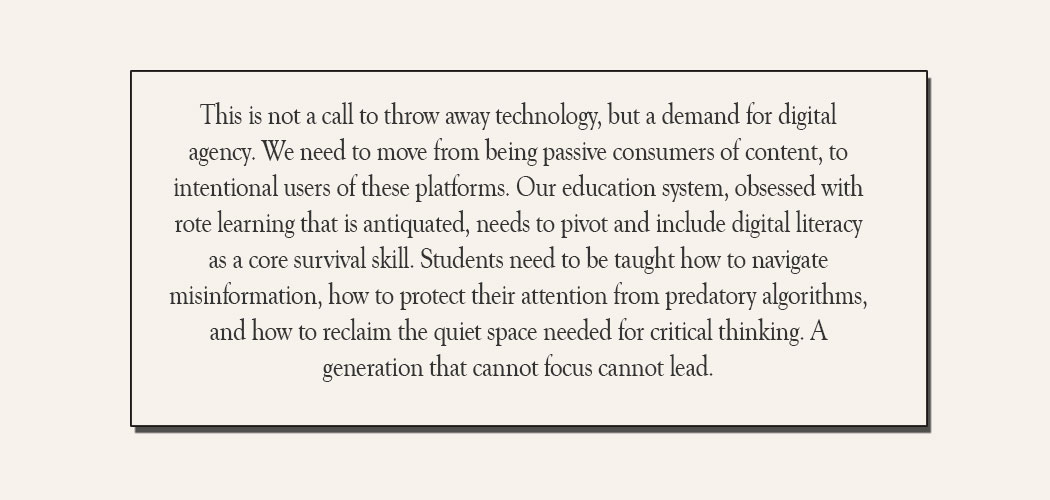
This is not a call to throw away technology, but a demand for digital agency. We need to move from being passive consumers of content, to intentional users of these platforms. Our education system, obsessed with rote learning that is antiquated, needs to pivot and include digital literacy as a core survival skill. Students need to be taught how to navigate misinformation, how to protect their attention from predatory algorithms, and how to reclaim the quiet space needed for critical thinking. A generation that cannot focus cannot lead.
Our future in Nepal will depend on our ability to take our eyes off our screens and engage with the real world. If we continue to give away our focus to the scroll, we will be reduced to watching our own story unfold as spectators. We have to rediscover the merit of the long-form argument, the deep conversation, and the uncomfortable silence of deep thought. Only by reclaiming our attention can we begin to address the structural issues that a viral video may bring to our notice, but can never resolve. The scroll is infinite, but our time is not. It is time we spent it on something that lasts.