- Thursday, 7 May 2026

Parents in schools, students at home to handle household chores
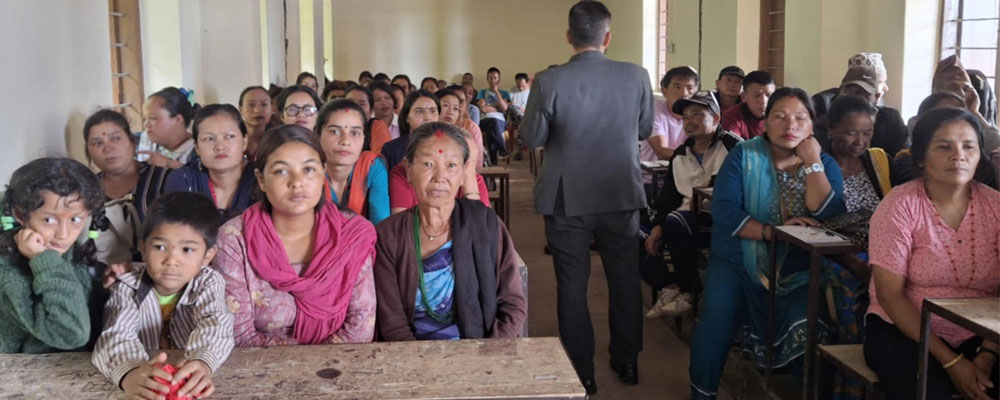

By Prem Adhikari,Pashupatinagar, Aug. 24: Despite her age, Bishnumaya Tamang, 65, of Rong Rural Municipality-3 attends the community school carrying a pen and an exercise book.
Gurung said, “I regret not being able to study at a younger age, but now I am attending school for the sake of my grandchildren.”
To enhance the quality of the community schools, the rural municipality has mandated that guardians of each student must attend school once a month and study.
Following the rural municipality’s decision, Gurung, along with other guardians, sets aside her household chores to attend school.
Like Bishnumaya, Dirghamaya Bhujel from Rong-3 also attends school once a month. Dirghamaya said, “After attending the school, I can better understand the situation of my children.”
Mani Kumar Syangbo, Chairman of Rong Rural Municipality, said that once a month, students studying above grade 8 stay at home to handle household chores typically done by their parents while the parents attend school to study.
Since the responsibility for improving the quality of education does not rest solely on the teachers, the municipality has launched this programme to educate the parents.
Syangbo said, “The municipality has made an effort to help parents understand their children’s educational status and to teach students household chores, making them more practical.”
The municipality has launched a parent education programme to educate the parents of the children by making them attend community schools once a month.
Syangbo said that this comprehensive campaign was expected to enhance the educational quality of the students.
This includes implementing the four-pillar policy involving teachers, students and the local government, developing school-based entrepreneurship through student programmes, and promoting technology-friendly teaching and integrated monitoring systems.
Additionally, the plan focuses on building the capacity of teachers, staff and community schools and enabling them to adapt to modern educational practices.
According to the rural municipality, a campaign has been launched to develop safe and high-quality physical infrastructure for schools, along with an effective local curriculum and sports programme. Syangbo mentioned that a plan to increase the internal resources of community schools had also been introduced.
To support this, tea, bamboo and bean plants have been cultivated on the school’s land to generate additional resources.
Shruti Tamang, head of the education division of the rural municipality, reported that 2,400 students are currently enrolled in 30 community schools within the rural municipality.
This time, the municipality educated 550 parents from 13 secondary schools about school education.
Previously, the municipality had selected and trained school teachers to serve as facilitators for this initiative.
Vice-chair of the rural municipality Bishnumaya Khawas mentioned that educating parents has positively impacted students’ academic performance.
She noted a significant gap between private and community schools. Children attending community schools are less privileged in terms of access to resources
Facilitator Lokmaya Chaulagai said that parent education has helped students become more regular in their attendance.
She added, “This campaign, is crucial for parents to understand the personal needs, education and health of their children.”
To enhance the quality of education, the municipality has introduced technology-friendly education, a one-rupee savings campaign, a student programme with the chairman, and implemented a local curriculum.

-square-thumb.jpg)