- Friday, 8 May 2026

Risk Of Being An Uncritical Reader

Some books are to be tasted, others to be swallowed, and some few to be chewed and digested: that is, some books are to be read only in parts, others to be read, but not curiously, and some few to be read wholly, and with diligence and attention.
- Sir Francis Bacon
In the above mentioned aphoristic lines, Bacon, popularly known as the father of English essays, argued that the readers should be critical, that they should “read not to contradict and confute, nor to believe and take for granted; nor to find talk and discourse; but to weigh and consider.” Also considered as the father of modern science, Bacon had the scientific flavour in his statement. He presented the metaphor of books as food items which have to be eaten in different ways depending on the quality of what the consumers have. By so saying he cautioned that book writers may have produced their books in their own interests which may not match the needs and interests of the readers. This is why he suggested that a reader must be a diligent one taking much attention while reading.
What Bacon said 400 years ago equally apply to the readers of our time. Sadly, our habits have turned the other way round. Instead of reading books and other educational materials critically aiming to scrutinise things in terms of quality, we tend to simply taste them partly or swallow them without even tasting their flavour. Instead of reading materials in the way Bacon suggested, our readers are becoming uncritical readers. One risky game of uncritical reading is being played by university students. They do not follow the set curriculum which may comprise several books that are related to their subjects.
Political creed
Instead they tend to read the shallow books that are prepared for the examination only. It is very likely that some of those books may be mistaken, which the students may not know. It is thus risky to read books and media news uncritically, especially the latter. Most books are written by scholars and intellectual wits, so they are reliable to a great extent. But many other books are the carriers of ideologies constructed by the authors who belong to one sect or the other. While some authors want to propagate the religious creeds, other writers write to inculcate political creeds into the minds of millions. Political doctrines may not be as risky as religious ones because views expressed in those books are subject to change.
Moreover, changes in political creed does not invite troubles to life. But the religious creeds leave indelible marks in the minds of people at early childhood. What people fear most is what will happen to them in the life after death. Furthermore, religious creeds are taken for granted in all cultures. Millions of people follow those creeds without questioning what, why, and how. They do not raise doubt about the assumptions constructed and propagated by the religious preachers. Looking at the way people follow religious preaching unquestionably, there is a risk of misunderstanding or no understanding the essence of religion. It is thus quite possible that uncritical reading is risky.
If political texts aim at indoctrinating ideologies of this or that kind, religious texts often tend to propagate the particular religious values constructed by the religious preachers, great or small. One of the most powerful ideologies that establishes such value is the belief that god is creator of the universe. Many readers of science, most notably, Charles Darwin, are critical about this taken for granted view. Despite controversy, the scientists are the critical readers raising doubt about the values established by the religious leaders. Even the social science readers are becoming critical these days. The general readers, however, are less critical, which involves the risk of misunderstanding the world.
Some of the media messages are more dangerous to follow because they might have spread propaganda and rumour. Although media are supposed to be neutral, they are not found impartial as they fail to pass fair judgments while reporting the news. When they are not neutral, they become the carriers of ideological contents which are constructed in the interests of the speaker. In this regard, Noam Chomsky says media are state-fed so they work in the interest of the state officials.
Sensational news
In Nepal too, there are sometimes sensations some media would like to create through their official posts. The messages they convey might be true or false, but the way they create sensations leave positive or negative impressions in the minds of the readers as they tend to read the news rather uncritically. Media have become so powerful we are sort of compelled to leave under the shadow of media images. Most surprisingly, even the apex officials of the state rely on what is written in the pages of media. What more can we find than the top officials running after the baseless messages that are disseminated through media without critically examining whether what is written is really true.
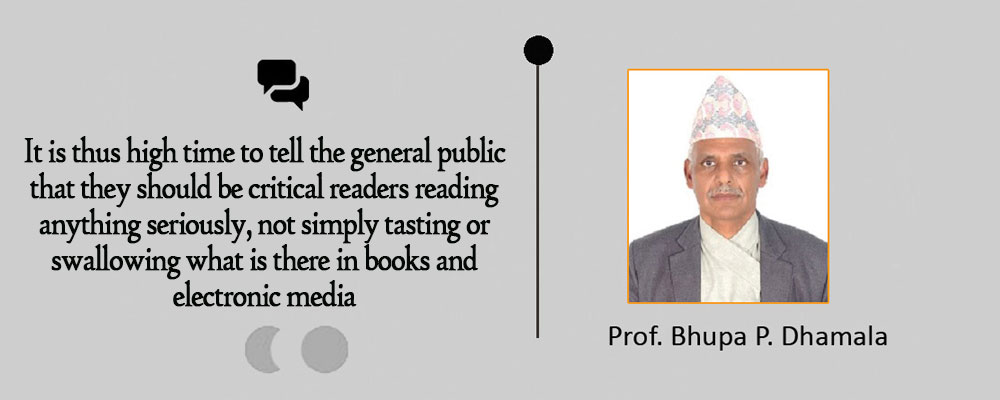
Media are also of various types. The most impactful media are the electronic social media such as Facebook, Messenger, Viber, Instagram, X (formerly Twitter) and YouTube. It looks like that these media have replaced the print media in Nepal. The number of readers to read the printed newspapers has drastically declined. It is difficult to understand why young readers like to read the electronic media and follow what is given in them uncritically. It is thus high time to tell the general public that they should be critical readers reading anything seriously, not simply tasting or swallowing what is there in books and electronic media, but chewing and digesting well as the sixteenth century sage suggested.
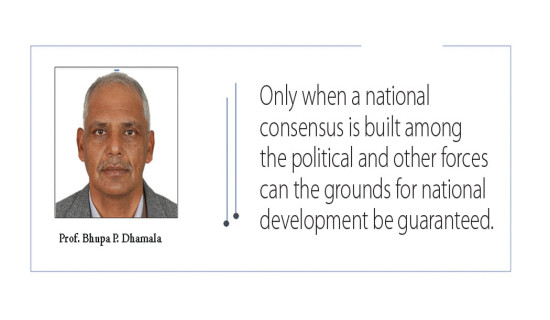
(The author is the chairman of Molung Foundation. bhupadhamala@gmail.com)