- Tuesday, 26 May 2026

Ban On Digitial Platforms Detrimental

The creation, publication, distribution, or dissemination of pornographic content is prohibited as obscenity under the criminal code of Nepal. Thus, banning pornography websites and apps has a concrete rationale and legal grounds. The same can be cited in the case of banning platforms relating to crypto trading and illegal gambling or betting. On the contrary, this core idea might not be relevant when it comes to banning popular social media platforms in Nepal, as it's often associated with freedom of expression and publication.
However, no matter how many times the government bans a platform, it will always end up being unable to enforce such a ban effectively. Despite having banned pornography websites in 2018, banned TikTok in 2023, and banned betting platforms in 2026, enforcement design in the country continues to show signs of failure. On 24 September 2018, the Ministry of Communication and Information Technology issued a directive to block pornography websites in the country. This was based on Section 121 of the National Penal Code and was related to the sexual violence that was occurring in the country at the time.
Porn websites
The Nepal Telecommunications Authority (NTA) was tasked with blocking porn websites across all internet service providers (ISPs) in the nation. However, as the internet service providers themselves revealed, they would only be able to block a few of the porn websites. On 13 November 2023, the Pushpa Kamal Dahal cabinet announced its decision to ban the TikTok social media platform. The NTA was given the job of enforcing the decision from the cabinet to the ISPs. The legal basis that they used for this ban, however, was not particularly strong. The blocking of TikTok at the level of ISPs allowed users to switch to proxies and virtual private networks (VPNs) to access the platform.
The Council of Ministers decided on 22 August 2024 to lift the ban on TikTok. The TikTok company had agreed to work with the officials of Nepal. On 6 September 2024, the NTA instructed the ISPs to lift the ban on the social media platform under Section 15 of the Telecommunications Act of Nepal. Therefore, the government had to negotiate with the platform to enforce a ban on it. In 2023, the government introduced the Social Media Operation Directive 2023, which stated that all social media platforms had to register with the country or would be banned. This was an ultimatum for social media platforms, which, if not followed, would result in the platform being blocked across the nation.
Finally, after the approval of the 100-point Governance Reform Action Plan on 27 March 2026 by the Council of Ministers of Nepal, the government directed the NTA to blacklist all websites that facilitated illegal betting and gambling in the country. The reason for the ban on illegal betting was that the act of placing illegal bets is already prohibited under Section 125 of the National Criminal Code of Nepal. However, despite the ban on the websites at one domain, the same applications would reappear through alternative means such as APK links, Telegram channels, mirror URLs, among others.
Despite the attempts by the government to ban specific digital platforms, there is a major technological gap between the enforcement of these bans and the capabilities of the Nepali ISPs to effectively enforce such bans. Using virtual private networks (VPNs) routes the users’ internet traffic to another country. The DNS server for a country’s internet can be changed. The domains of platforms can be banned on one server, but will quickly pop up on another. The applications can be banned on one route but will reappear through the installation of APK versions of the applications, through Telegram links, or through other alternative means. Digital platforms do not need to be part of Nepal’s digital infrastructure to have accessibility for the citizens.
The legislation that the government uses in the enforcement of the ban indicates a lack of understanding of the extent of the damage that such bans can do to the digital economy of the country. For instance, India banned the TikTok social media platform in 2020. However, it used specific legislation (Section 69A of the Information Technology Act), worked with the intermediaries of the social media platform, removed the social media application from the Apple and Google mobile phone application stores in India, and banned the platform’s ability to receive money from users through digital payment systems.
Targeted regulation
In contrast, Nepal bans digital platforms at the level of the ISPs. This is the reason for the failure of digital platform bans in Nepal. The government does not need to ban more digital platforms; it needs to find better means of enforcing the bans on digital platforms. The enforcement of digital platform bans can be made smarter through the use of targeted regulation of digital platforms rather than bans. The government should endorse and use diplomatic tools to negotiate with the tech companies to register their digital assets. In addition to requiring these intermediaries to be legally liable, the government can require these platforms to establish local officers of the platforms to manage complaints from citizens.
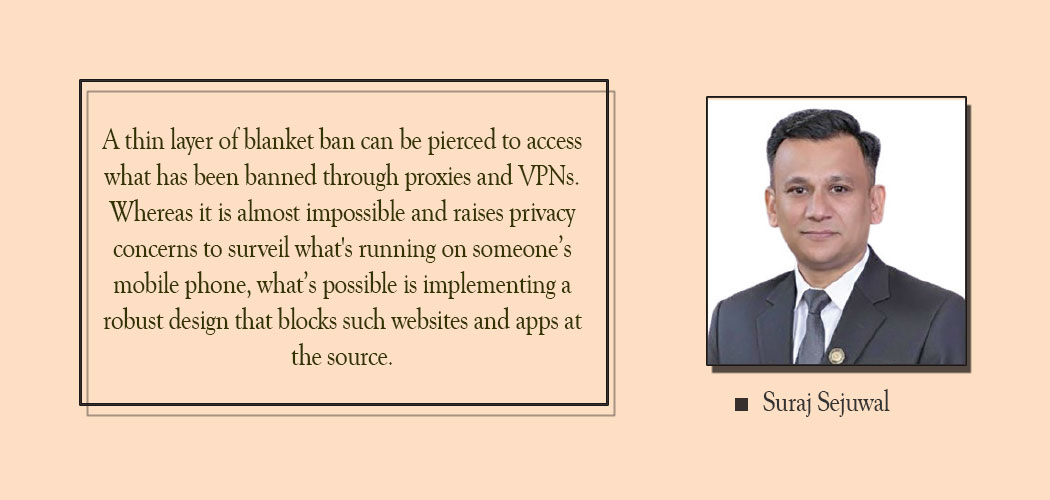
Finally, the government can introduce a means of negotiated platform regulations between the government of Nepal and each of the country’s digital platform producers. Furthermore, the government could improve its cyber investigation skills or improve digital literacy in its citizens. Lastly, A thin layer of blanket ban can be pierced to access what has been banned through proxies and VPNs. Whereas it is almost impossible and raises privacy concerns to surveil what's running on someone’s mobile phone, what’s possible is implementing a robust design that blocks such websites and apps at the source.
(The author is currently a PhD student enrolled at the Faculty of Law.)