- Saturday, 9 May 2026

Ukraine: Monumental Miscalculation

Many analysts and defence experts anticipated the on-going war in Ukraine to face fresh aggravation as a direct consequence of the massacre at the Moscow concert hall on March 22. At least 140 persons were killed. Four citizens of Tajikistan are held for the massacre rampage and about a dozen others are being investigated in connection with the terrorist act. Rejecting an early assertion by the US and its press that ISIS organisation was behind the crime, Moscow accused Ukraine of engineering it with “well-known” international agencies’ backing.
Russian military has stepped up action and made deep inroads into the defence of neighbouring Ukraine, and made significant territorial gains. A man of action, the Russian president is in a punishing mood. The former KGB chief sounded serious, furious and determined to get down to the bottom of the heinous act while Washington was erratic and frantic in defending Ukraine as having nothing to do with the terrorist act. The horrible incident occurred five days after Russian President Vladimir Putin’s latest election victory obtained with 85 per cent of votes cast, much to the chagrin of many in the US and Europe that would have liked to see the last of the former KGB spymaster.
Putin perceives the move as Rusia’s existential issue, as it gets encircled in the Black Sea. Ukraine’s bid to get aboard the NATO bandwagon triggered the war, when Putin felt security threat to his country. NATO membership allows troops of the alliance to be deployed between and among member countries. Sharing a long land sea border of 2,300 km, the former Soviet territory appeared to be siding with Moscow’s known opponents that are the key players in the NATO military partnership.
With stakes high for its very survival as a sovereign and independent country, Ukraine is in the thick of a war that has pushed back the development stride of Europe’s poorest state by decades. Apparently assured of adequate and uninterrupted supply of financial aid and weapons in the war with next-door neighbour who happens to be a nuclear power military might, Ukrainian President Volodymyr Zelenskyy risks losing credibility among 38 million Ukrainians.
Popular banner
Putin remains popular with his people, what with the latest public opinion surveys indicating a popularity rating of more than 80 per cent — something his counterparts in the most successful of democracies only of dream of. Russians in general might have welcomed the dismantling of the one-party communist system of governance in 1991 but not the disintegration of the country into 15 states. The economic chaos, rise of oligarchs, open cronyism and rampant corruption in political corridors caused painful hardships to most people. The new leadership of Boris Yeltsin allowed itself to swim with the new wave of opportunists and overlook the breakdown in rule of law.
Putin’s team takes a leaf from the 1962 Cuban crisis that is often cited by Washingtonians as a great example of American assertion of its right to put security risks at bay. Americans hail President John F. Kennedy of successfully playing tough and compelling Nikita Khrushchev to step backward by deinstalling the missiles he had ordered put up in the island state of communist Cuba, barely 160 km from the southern tip of Florida. By the same logic, Moscow sees Ukraine’s long land border with and adjoining NATO members as a prime target to be on constant guard of. If Kyiv were to get aboard the military alliance, the doors would open for the former Soviet state to invite military forces from other NATO members.
President Emmanuel Macron of France in February hinted that European troops could fight in Ukraine. Putin challenged him to join the fighting forces. After other major European capitals were against the suggestion, Macron climbed down from his proactive posture. For someone who said from the very start in 2020 when the war broke out, Russia cannot afford to lose the war without forfeiting its status as a superpower restored after a long hibernation throughout the 1990s. Withdrawal without gains would mean a heavy loss of face to Putin, whose political survival would be clouded in uncertainty.
Fiercely against foreign interference and fired by a desire for prestige at international forums, Putin is unwilling to kowtow to hegemons that have had overwhelming say in global affairs with a strategy of bringing to size any force that threatens to their monopoly in global agenda-setting that prioritises their interests first. The US did not anticipate the return of Russia as a major rival so soon, if ever. It went wrong in assuming that Communist China would not be anywhere close to emerging as the next No. 1 economy that also achieved technological breakthroughs at breathtaking pace.
First priorities
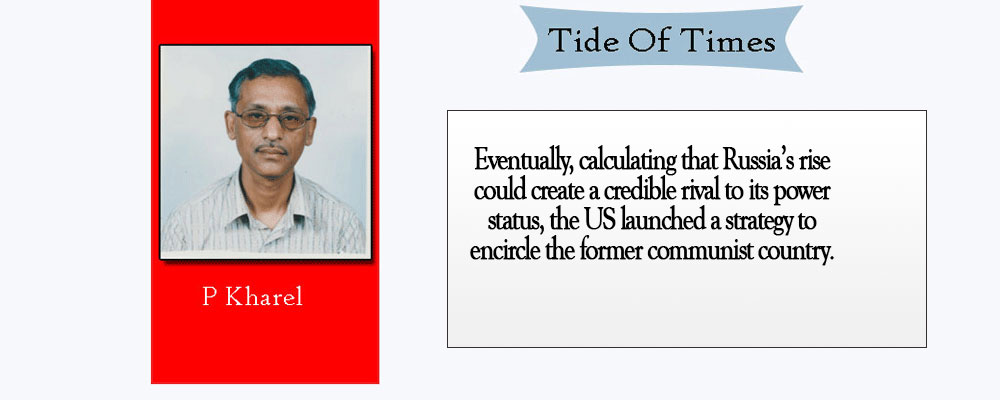
In the first decade since he came to power at the turn of the century, Putin seemed keen on recovery of law and order, accompanied by economic prosperity. He wanted international partners and not hegemons. His predecessor, Boris Yeltsin, was seen as Washington’s yes-man of the US. Yeltsin’s reelection was speculated to have been rigged at the behest of foreign powers, who found him to be a very accommodating leader that rarely said “no” to them. What the West failed to expect was the rise of nationalist ideas in Russia. Putin’s fault: putting Russia back to the superpower map as the most competent force to hit at the US if things come to a deadly pass. Russian missiles can target and hit deep into the US—something China is not yet able to. Eventually, calculating that Russia’s rise could create a credible rival to its power status, the US launched a strategy to encircle the former communist country.
Russia’s next-door neighbour China’s rise as an economic and military power is Moscow’s source of backup support. Aware of China in heavy need of powerful allies to cope with the challenges thrown at it by the US-led West, Putin believes that Chinese President Xi Jinping will be a like-minded partner in checking any Western threat. Granted that the US is still the world’s biggest military power, but Russia has enough firepower to cause colossal damage to the No. 1 superpower if things were to deteriorate to the worst. In March, Putin hinted at least three times that if the worst were to come, he would leave the nuclear option open. An early peace is the obvious answer to the ramifications of an expanded war.
(Professor Kharel specialises in political communication.)