- Saturday, 9 May 2026

Why Russians Endorse Putin

Much of the world is amazed at the staying power of Russia’s leader Vladimir Putin, 71, who last week won the presidential election for the fifth time. The United States and its close allies might sound hysteric over his long innings. The rest of the world are either impressed or indifferent to both Putin’s supporters and his bitter critics in the West. He obtained 87 per cent of the votes in a race that saw three other contestants, who the Western press and critics dismissed as state sponsored opponents fielded to avoid embarrassment for the incumbent president.
Alexei Navalny, 47, attracted sizeable crowds at his public rallies and was seen as a relatively serious contestant against Putin. But he was found killed savagely a month before last week’s elections. Putin’s arch-rivals and their Western allies tried to point the finger if suspicion at the Putin camp. But Russians in general seemed not to give much credence to the imputation, as shown by the numbers that turned up to cast their ballot and ignored a robust campaign by the boycott calling camp. In spite of a very proactive call and campaign by groups wanting people to stay away from polling booths and boycott the “farce”, voter turnout stood at 65 per cent.
Putin's high public ratings
The voter response and Putin consistently high public ratings stand in good stead for the huge percentage of votes the winner secured. Ironically, most Republican voters in the US continue believing that the 2020 election victory was stolen from Trump. Voter turnout in the last US presidential polls was 66 per cent, which was 1 per cent more than that recorded in the latest election turnout. And there was no election boycott movement in the US. In the 2019 general election, the United Kingdom registered a turnout of 67.3 per cent. India’s 2019 general election attracted 67 per cent voters. The second round of France’s presidential polls in 2022 recorded 58 per cent of eligible voters casting their ballot papers.
According to latest surveys, US President Joe Biden’s public approval rating earlier this year was 37 after three years in office as against Putin’s 80 per cent in February, that is, after more than 23 years, including a stint of four years as prime minister. On completion of eight years in office, stepped down for four years in 2008 in deference to the constitutional ceiling that did not allow more than two consecutive tenures. But he held the post of prime minister until he returned to the presidency. A constitutional amendment in 2023 broke the two-term limit for him and also gave a presidential term six years.
Widely appreciated in the West as a democrat, Russia’s post-Soviet collapse President Boris Yeltsin and his cronies were sunk in corruption. Fearing investigation, Yeltsin made a trade with his vice-president Putin with a proposal to step down a year ahead of completion of his term so that the deputy could take over the vacant seat. In exchange, Putin pledged to issue a reprieve to his predecessor by making legal arrangements that gave immunity to him and his family members from state investigation into their activity during the seven-year period when Yeltsin was in office.
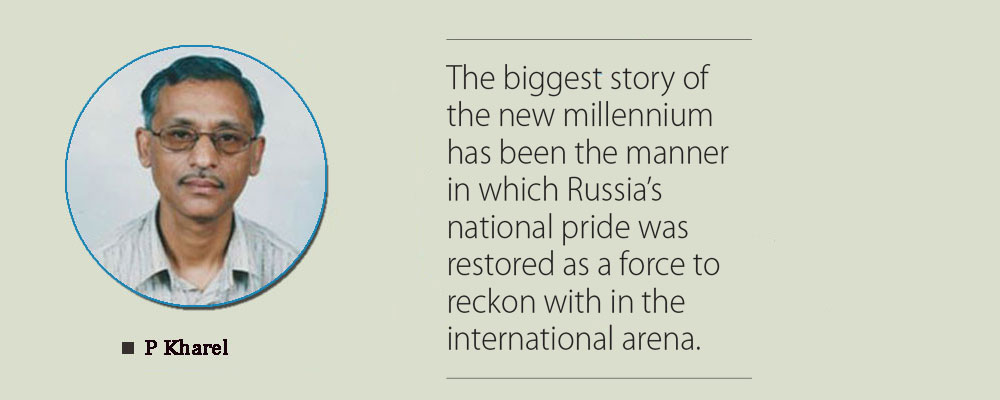
The biggest story of the new millennium has been the manner in which Russia’s national pride was restored as a force to reckon with in the international arena. Within a decade, the country regained the superpower status it had lost in the wake of the break of the Soviet Union in the 1990s. Criminal oligarchs, mafia dons and rampant corruption were steadily addressed. This did not displease the West. But when Moscow began to assert its position at international forum and chose to take stands many times different from the Western powers, the latter began to see a big competitor in the making.
Consistency might not always pay off deserving rewards early on. But, if appreciated on the basis of impartiality and hard facts with due deference to given context, it does ensure and eventual stamp of approval and respect. Selective approach by most advanced democracies —and silence over inconsistency practiced by their larger peer countries — has accumulated increasing distrust in political leaders and organisations. The election of Hameed Karazi for two terms in Afghanistan and Boris Yeltsin’s two-term elections in the aftermath of the Soviet Union offer examples when the West hailed not only their victories but sounded the bugle announcing that Russians and Afghans could not have opted for better leaders under their respective national political landscape.
As for Karzai, the Afghan people seem to like to forget that he ever existed. Selective condemnation and quiet support for military coups and weaponsing human rights issues and economic policies have ruined the Western world’s political credentials in the international arena.
Double dealing
Double dealing with Iraq and Iran to support the anti-left Contra rebels in Nicaragua, ganging up against Cuba for six decades, machinations in oil-rich West Asia and persecution of millions of alleged communists all over the world — from Indonesia through Europe and the Americas — are few of numerous instances that unmask hypocrisy. The manner in which the corrupt and authoritarian regime of Ferdinand Marcos for two decades in the Philippines was supported and the Shah was installed in Iran narrate how rules are made and interpreted in the post-World War II order.
Aware of such background of inconsistency in Western response to event in various countries, Europe is divided over Putin’s latest electoral victory. Hungary’s President Victor Orban called on his counterparts in Europe to accept the Russia’s election results. However, the American news channel, CNN, in an analysis commented on the Russian president’s victory: “Six more years of Putin will worry many countries. But not China.”
Having been a regular commentator on international affairs for nearly 40 years, let me submit my version, even with a slight twist: “Six more years of Putin will worry many NATO and EU countries. But not China — and most others.”
(Professor Kharel specialises in political communication.)