- Saturday, 9 May 2026

Coping With Natural Disasters

Now the weather could turn hotter every day, but we also know that the rainy season is also not that far away. And it is during this rainy season that we see many calamities, whether it be road accidents, landslides or floods. It is very unfortunate for this country with much natural diversity to see such calamities, because many of them are manmade. We tend to blame nature for such calamities, but most of the times, it is also due to the carelessness of individuals and encroachment of the hills, forests and also rivers by the people themselves.
This is a serious issue which has to be looked into by the government, political leaders and the bureaucrats too. We constantly read and hear from the media about the political wellness of the country, this is also important, but more important is the life of the people, especially those who are more vulnerable to disaster, accidents and other calamities, which could have been avoided if the authorities were more careful. But no such developments have been seen. Instead, we only hear politicians talk about their own parties and how they are defending democracy, not at all caring about how they should be first defending the 'right to live' of the common citizens.
Worse weather
To come back to the weather conditions, we all know that during the monsoons, the road conditions get from bad to worse, there are rock falls and landslides besides the flooding of rivers due to the constant rains which is a normal part during that season. The situation has been made worse with people blocking the natural flow of water, specially, in the hill areas. It is no different in Kathmandu. This place had many natural water spouts and also canals which ensured that the waters safely reached the rivers and it flowed on to other bigger rivers which eventually flowed into the seas or oceans.
But all such outlets have been blocked by the building of unplanned roads and the clog of houses which have been built in this small city, which once had lush green fields and local people who depended on these very lands for their livelihood. Now we only see many people who only want to buy land here and build whatever sort of house they can afford to build. Naturally this is their right and everyone wants to be at the place where they are within easy reach of different facilities, from health care to education and even to go abroad easily. Beside this, all other governmental facilities are also here. The provinces are important because it also contributes a lot in the decentralisation of power and also increases the reach of the common citizens to the government.
This is an important factor which should not be forgotten by anyone, especially individuals who always talk of the rights and welfare of the common people. The media also has a huge role in reminding everyone of their responsibility towards the nation and the people, who just follow whatever the so-called 'rights' protectors say. The media should rise above politics and the influence of some individuals and always guide the society to a correct path. Ethically, they must rise above any influence, whether foreign ones or from people who themselves are more interested in their own gains by acting as defenders of the rights of the people or democracy.
Similarly, they should also concentrate on educating the people about the hazards they may be creating towards climate change instead of depending only on the government or some INGOs for publishing advertisements. There must be sincere reporting and also articles regarding the dangers we are creating towards the changes in nature which is harmful for the entire world. This is the responsibility of all the media outlets, whether in the print sector or in the broadcast sector.
The developed world has already realised the dangers of the climate change and they have swiftly acted to stop this menace. But other countries, especially those with smaller economies, seem to be indifferent to these changes which are causing damages to almost all countries of the world, including even those pristine looking islands and naturally abundant Nepal, which are really going to suffer in the long run. But many of these countries seem ready to face the threats of global climate changes. However here, we do not seem to have an adequate infrastructure to deal with such disasters.
Permanent institution
This author has written time and again about a permanent institution to react quickly whenever there is such a natural disaster and also provide relief to the affected people. But we only see a sudden move by the authorities, who always mobilise the security forces for relief measures when any disaster or accidents take place. We can easily learn from our two immediate neighbours, China and India, both of which have special forces to deal with any such calamities and also in the rescue efforts and in providing relief to the victims. Like we already can predict what calamities the monsoon rains can bring in, we can be better prepared for such tragedies.
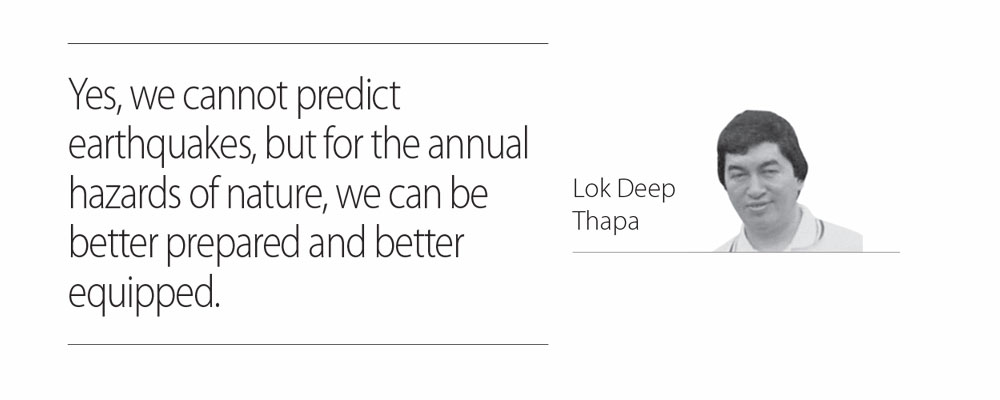
Naturally, the security forces come first in mind to help victims of these incidents which occur annually during certain periods like the monsoon season, for example. Yes, we cannot predict earthquakes, but for the annual hazards of nature, we can be better prepared and better equipped. Instead of only shouting populist slogans, the decision makers would contribute for the betterment of the nation by taking pragmatic decisions for such incidents. And coping with disasters and helping the victims is one major task ahead. Climate change and global warming are threats to the entire world and Nepal cannot escape from this threat as well, so we have to make policies and plans to protect our country and at the same time educate our people about this menace as well.
(The author is former chief editor of this daily.)



-original-thumb.jpg)