- Saturday, 9 May 2026

Women Leadership For Peace

International women’s day was marked in Nepal too in a very fitting manner last week. At least fifty young women pioneers were listed and projected as the most influential achievers in their respective domains to substantiate and prove that achievements and excellences are not the exclusive domain of males alone. Likewise, a report made public the other day, has hailed Nepal as a member state of the international community for implementing policy initiatives in enhancing political empowerment of women in line with the UN sustainable goals relating to inclusion. The report stated in no uncertain terms that the country has been much more ahead on this score than any other countries in South Asia.
In fact, Nepal treasures such a precedence and historic record where both men and women had been introduced to suffrage exercise at the same time when first nationwide multiparty competitive democratic elections was held in 1959 to elect the first democratic government. Today at least 33 percent women are represented in the federal parliament while 40 per cent women make up the councilors at the local level which surpasses all the provisions, practices and records of the democracies in South Asia. An interesting and positive aspect of local democracy in Nepal has been that women lead more than two-thirds judicial committees as the elected deputy executives and they are mandated to promote peace and harmony in rural communities. As coordinator of the committees, women chair the proceedings to help resolve different kinds of discords and disputes at the local level.
Voting prerogative
In the several democracies of the West up until a century ago, women had been denied voting right - which is characterised as a derogation of fundamental right of the people. The voting prerogative then was attached to and contingent upon property, educational and gender qualifications, with basically women and poor people barred from suffrage to elect their representatives. However, Nepal’s case, as mentioned above, has been qualitatively different as gender parity in every walk of public life has been an established authoritative norm for long.
Looking back to the history of women’s suffrage, it was only in 1893 when women first gained the right to vote in New Zealand. It ushered in a new era—one in which women around the world entered the political realm. Women’s votes would give rise to what Elizabeth Cady Stanton – a humanist thinker had predicted in 1868 in her write up stated as “a new evangel of womanhood, to exalt purity, virtue, morality to lift human being up into higher realms of thought and action.” Accordingly, as mentioned by Elizabeth Cady, women’s entrance into political life undoubtedly brought about profound effects and multiple changes worldwide. Research findings have also shown that women’s inclusion in democratic electorates has been a boon for peace and cooperation in the modern era.
The study conducted by Joslyn N. Barnhart and Santa Barbara at the university of California analysed the likelihood of militarised disputes erupting between specific pairs of countries over the period 1816 to 2010. The study results showed that pairs of autocracies and pairs of early democracies without women’s suffrage were both more than three times more likely to end up threatening, displaying, or using force than were two democracies in which women exercise the right to vote is guaranteed.
From the early days of the suffrage movement in the west especially in the US, the pursuit of peace was seen by many to be one and the same with the pursuit of the vote for women. Julia Ward Howe, author of the Civil War song “The Battle Hymn of the Republic” and eventual leader of the American women suffrage association, anticipated that once women freed themselves from their almost military subjection to men, they would exercise their superior moral force in pursuit of global cooperation, peace and harmony. The democracies where women are granted suffrage right they are believed to be peaceful seeking collaboration and compromise to solve domestic as well as global problems.
Emancipative shift
In fact, the world as a whole would enter a new era of peace — an era which liberal thinkers of the eighteenth century including Montesquieu and Kant had long anticipated if women took the lead in governing countries. It was also the argument of Bhagawan Rajneesh as he said that the political leadership should be given to women to establish peace and prosperity. He criticised men’s leadership for the last several centuries saying that it has brought more miseries, wars and conflicts. Anyway, women’s participation in politics and their empowered status, according to Barnhart and Santa Barbara, have started to alter the international conduct of countries. Women’s increasing role in politics has affected changes in foreign policies around the world. The women’s role has brought about reforms into the present and future workings of democracy and international politics.
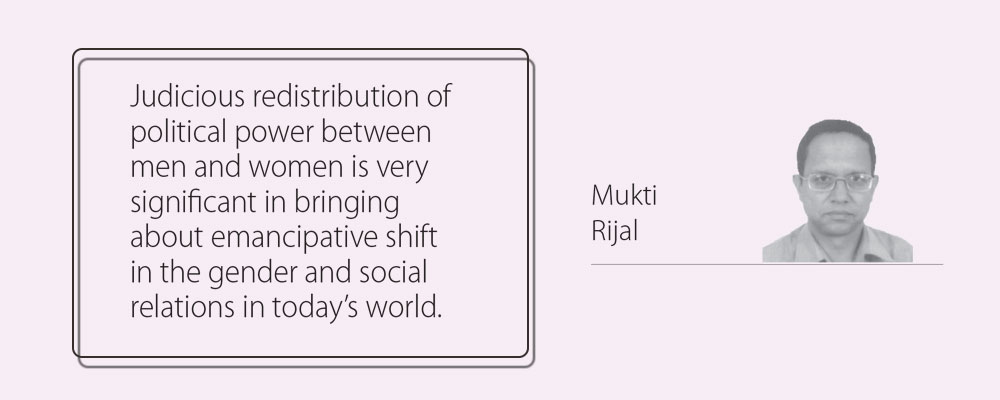
Moreover, the twentieth century has witnessed some of the most radical technological, economic, and political change in history. People around the world replaced centuries of arbitrary monarchical rule with democratic institutions aimed at aligning the will of the people with their leaders. Each of these extraordinary changes has been perhaps rightfully credited with reordering international affairs and fostering international peace in the twentieth century. But these accounts have long overlooked one of the most dramatic transformations of the twentieth century as a potential source of peace. Increased judicious redistribution of political power between men and women is very significant in bringing about emancipative shift in the gender and social relations in today’s world.
(The author is presently associated with Policy Research Institute (PRI) as a senior research fellow. rijalmukti@gmail.com)