- Saturday, 9 May 2026

Challenges in conservation of gharials released in Rapti river
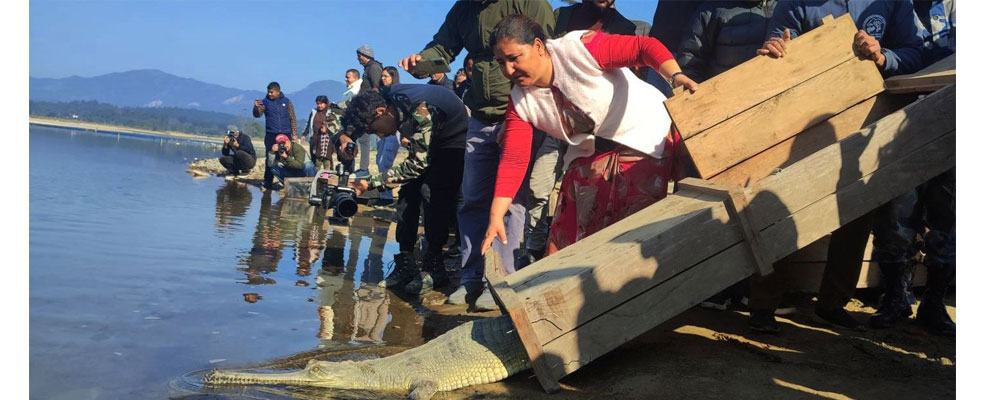

By Siraj Khan,Nepalgunj, Mar.1: Banke National Park has been releasing gharial hatchlings into the Rapti River for several years to help balance the environment, but there is a significant challenge in protecting them.
According to the park, 20 crocodiles were released into the Rapti River, which is a natural habitat for crocodiles, in the last two years. However, only 12 of them are currently in the river.
Manoj Kumar Sah, Chief Conservation Officer of Banke National Park (BaNP), said that while the Rapti River provides a suitable habitat for gharials, many areas around the river have human settlements, posing a challenge to their protection.
He said that protecting the gharials has become increasingly challenging, especially with wetlands coming under attack. “Due to nearby human settlements, there is a scarcity of fish in many river channels, which are a primary prey for gharials,” he explained.
Gehendra Kumar Khadka, Chairman of BaNP Buffer Zone Management Committee, emphasized the significant challenge in safeguarding the gharial crocodile population in the Rapti River until alternative sources of income can be identified for communities dependent on the river.
He further added, “A large community depends on the Rapti River, particularly those who earn their livelihood through fishing and gold mining. These communities are primarily dependent on the Rapti. Finding an alternative source of income for these river-dependent communities should be prioritised. Without timely intervention, the protection of gharials will remain unattainable.”
Conservationists have highlighted the challenge of protecting gharials, even in their natural habitat, due to the presence of numerous fishing and gold mining communities such as Khuna, Kumal, and Badi in the villages surrounding the Rapti River.
Krishna Chaudhary, a tourism businessman in the district, expressed concern about the challenge of protecting the species, noting that the community's unrestricted movement around the Rapti River and the increasing number of fishermen pose significant obstacles.
He added, “To safeguard gharials, it is crucial to raise awareness among the local community and involve them in the protection efforts.”
According to BaNP, gharials are considered calmer than crocodiles. They typically do not attack humans and primarily feed on fish. Gharials prefer clean water habitats.
However, the challenge in protecting them has intensified due to the scarcity of fish in the river.
The species has also been included in the list of protected wildlife under the National Parks and Wildlife Protection Act-2029. Strict legal penalties have been stipulated for anyone who kills a gharial.
According to the park, if someone is found to have hunted or killed a gharial, they may face a fine ranging from Rs. 100,000 to Rs. 500,000 or imprisonment for a period of one year to 10 years, or both.