- Saturday, 9 May 2026

Democracy Day
Impacts Of Social Media In Democracy

Democracy is the system of government that, among other things, aims to create an egalitarian society where every citizen enjoys equal rights and opportunities regardless of his or her social status, faith, race, age, gender, and other differences. This means no one is discriminated against, making them feel the presence of justice and the absence of injustice. In a democracy, people occupy the central stage, not the rulers. And people’s participation in it determines how robust it is. The greater their participation, the stronger it is.
Democracy in Nepal was achieved through the untold sacrifices of martyrs and several democratic movements. Today, we are fortunate enough to live in a world where the aspirations of democracy have never been easier to fulfil. This article seeks to discuss how this arguably best form of governance is faring in an era dominated by internet-powered tools like social media, such as Facebook, YouTube, Twitter, etc., and now artificial intelligence (AI).
Voice of voiceless
The rise of social media has empowered people to make themselves heard and to voice their concerns, rages, grievances, or opinions, enabling them to have a say in every decision, whether made by the government or otherwise, that affects them. No other medium has given such a powerful voice to the voiceless before. A sense of social inclusion is also formed as a wide variety of viewpoints and ideas get their due place, boosting social cohesion. As they have allowed citizens to follow a person or a party who echos or represents their grudges, those on the fringe have now found themselves in the mainstream. This is no small achievement.
What’s more, because they allow people to communicate seamlessly, they have created and powered influential social organisations working to improve the lives and livelihoods of the less privileged and marginalised. With billions of people now connected to social networks, they have emerged to be a formidable cultural and political force potent enough to alter the course of global events. Vibrant public discussions have galvanised governments to take decisive action or to retract their decisions in the face of backlash.
Its ability to influence public opinion, political discourse, and electoral processes is unparalleled, providing a platform for citizens to engage in political discussions, share information, and rally for social and political causes. Its immense power became evident with the election of Donald Trump as the president of the United States in 2016. Many, including the former US president himself, who extensively leveraged Twitter to win over people, have made it clear that social media played a determining role in the election. In its wake, a flurry of headlines that Russia interfered in the election to propel Trump to the presidency dominated the US mainstream media.
E-government, which heavily uses social media for governance, enables more efficient management processes. Its aim is both the efficient running of government and the promotion of transparency. This is achieved by the digitalisation of services and processes and the increased use and publication of government data. When more data is readily available for use, there is more accountability. These days, we see people filling out their taxes online, registering their vehicles or property online, and making payments online, among many other day-to-day activities. The goal is that as more services get digitalised, the demand for a digitalised government grows, leading to hassle-free and efficient governance.
Yet, social media has also been tapped to undermine democracy. They have been harnessed to spread misinformation, polarisation, and echo chambers, which has eroded trust in democratic values and institutions in some places. Additionally, they have been used for political manipulation, propaganda, and election interference, raising concerns about the integrity of democratic processes. Elections are one of the pillars of a vibrant democracy. In much of the world, periodic, free, and fair elections are indispensable to running a country. The smooth handing over of power by the outgoing government to the democratically elected incoming government forms the basis of stability. Many times, reluctance to transfer power peacefully has meant destablising violence.
The threats have been compounded with the dawn of AI, which can analyse vast amounts of data to identify specific demographics and tailor political advertisements to target them to influence their votes. AI-powered bots and algorithms can spread misinformation or manipulate social media discussions to sway public opinion in favour of a particular candidate or ideology. AI can analyse historical voting patterns and other data to make predictions about election outcomes, which can influence voter turnout.
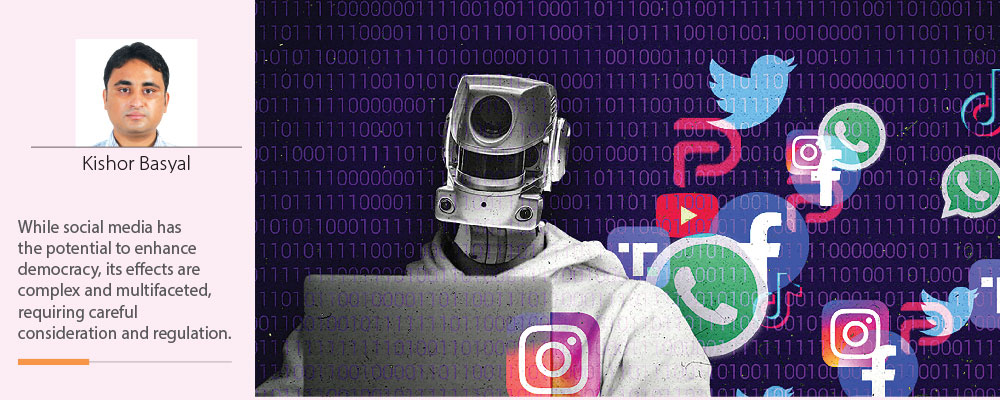
In some cases, AI algorithms may be used to identify and target certain groups of voters for suppression tactics, such as spreading false information about polling locations or voting procedures, mounting cyberattacks to manipulate voting machines. This has posed a grave risk to the fairness of democratic practices. That said, it has also come as a boon. Using it, we can enhance voter engagement and detect and prevent election fraud. With AI, the world is now equipped with a powerful tool capable of detecting and preventing election fraud. There is also a growing consensus among experts that AI is a force for good if used judiciously. Overall, while social media has the potential to enhance democracy, its effects are complex and multifaceted, requiring careful consideration and regulation.
Delivery
But, despite its merits, a democracy that fails to deliver can be a source of discontent among the masses. There are several countries in sub-Saharan Africa, for example, where non-functional democracies have given way to dictatorships, and that too without much opposition. Fed up with the lacklustre performance, anti-democratic forces are raising their ugly heads time and again. Forget the global south, even in Europe, which has played a pivotal role in the development and spread of democratic principles globally; populism has been on the rise, leading to the erosion of democratic traditions and norms. Reason? Disillusionment with the mainstream parties for failing to live up to the people’s expectations. So, making democracy deliver is essential if we want to keep it vibrant.
(Basyal works as a journalist at The Rising Nepal.)
-original-thumb.jpg)