- Tuesday, 2 June 2026

Of Precepts And Preceptors

Educationists in various incarnations, preceptors and their counselling receive considerable respect in many communities stretching over billions of people. Nepalis' calendars mark a special day for honouring and appreciating preceptors’ role in education and critical thinking. Some do with reverence, others observe the occasion with subdued element of “can’t ignore” attitude. Nepal’s cultural heritage is rich and amazingly vast. This is a personal conviction that joins in unison with our forefathers and scholars in the past and many today, who interpret and explain the legacy handed down from generations through generations to the present times. Journalism is lost and empty without the ingredient of literature — printed or oral, newspapers or broadcast.
Billions of people embrace religion as a god given gift and guideline, and not in any way manmade manipulation to mislead people. Rationalists might think otherwise in the absence of concrete earthly proofs of the existence of the absolutely perfect, all-knowing Great. Such are the majesty and mystery of life in the ever expanding universe, full of creative and brilliant variety of manifestations that never cease to amaze the inquisitive human minds whose brains, we are told, are active on only a dismal measure of its full potential. At some future date, more of that potential in action will transform human life quintessentially, including space journey and knowledge about other planets and much more.
Honour is acknowledgement, appreciation of someone’s contributions to something significant done for society. Indian scholar and Nobel litterateur Rabindranath Tagore returned the British knighthood after the Jalianawal killings. Hollywood actor Marlon Brando rejected an Oscar award for best actor essayed in a 1973 movie, in protest against how the Indigenous people in America were mistreated. Hence rejection, too, carries a message all its own.
Action in communication
Ancient texts in South Asia advised people to speak sparingly but with valued meaning; it helps people. Wasted words exhaust energy for no reason or even worse. Words are for significant query, assistance and the like. Silence adds to idea fertility and answers to many issues. Gentleperson’s words and behaviour liberate others. Tongue and water should be appropriately used for the good of others. The good vibrates in mind, soul and feelings, which all should be invoked appropriately. In unguarded moments, errors in judgement get committed intentionally or otherwise. Regular introspection and the resultant inner satisfaction are aspects of intra-personal communication.
At times, action can be word and vice-versa. Stages of action including preparation, warm up to action, action by order, action in decision, proposal, query and a host of others are among the strands of communication in action. Impatience, ego, anger and violence fall in the category of unrestrained communication triggering negative connections with various short-term and long-term implications.
As a calculated course, communication content can be under control. It pays off better, and delays and reduces the likely damage inflicted. Pretended, inherent meaning and received meaning. Style sales. Dissemination process, if handled with proper approach, fetches satisfactory results. Addressing a context for obtaining desired impact should shed casual and cavalier course. Quick thinking and careful planning brings a better outcome than do hasty decisions.
Information is a tool for good or bad. It is safety; it is security; it is prosperity; it is envy; it is affability; it is adjustment; it is precaution; it is pleasure; it is recreation. Its volume can be vast and valued in importance and significance — for immediate or future use, correction, revision and refinement.
Essential literary quality without which journalism would not exist. Great souls since time immemorial put emphasis on truth. The Buddha asked his disciples to verify what they heard. Socrates died for the cause of expressing his views on life, society and governance. He ignored the opportunity to escape from the capital punishment being meted out to him.
There are too many sources and too many occasions when facts are distorted in modern times, when technological development has achieved successes on a scale that human kind did not imagine in recorded history. Literature is living life and thought. Many millennia ago, learned persons composed ideas in the mind, memorised, stored, refined and passed the same to succeeding generations. The process enabled societies to recall, retrieve and repeat the same for sharing knowledge and by way of discussion and transfer of skills.
Some 2,000 years before the English literature’s greatest playwright, William Shakespeare, Bharat-Muni’s Natya-Sastra in Himwatkhand in present day South Asia earned the distinction of the earliest comprehensive literature on music and stage shows. Comprising 6,000 couplets in Sanskrit, it describes the director-audience relationship, structuring of a play, acting techniques, costumes, body makeup, music and musical instruments as well as stage decoration and hall management for seating audiences. The use of diction and dialogue in addressing specific audience and the code of ethics to be observed are also incorporated.
Listening power
Interviews are a vital part of news media. “Simplicity worked for me,” said Larry King, a celebrated CNN and Fox News anchor in the United States. King conducted 30,000 interviews in a career span lasting 60 years to become the most known figure on US TV. He let his guests answer the questions. King’s advice to TV anchors and talks show masters: “Don’t talk too much. Let your guests talk. (Audience) tune in to see your guests, not to listen to you talk about yourself.”
Some communicators achieve quick appreciation, others toil hard and long only to emerge as passable. In matters of newspaper writing, under constant deadline pressures, speed is a major factor. The rush could blunt or derail content quality. Factual errors could creep in. Journalism, after all, is accepted as literature in hurry. An event or individual in focus defines the theme and setting in addition to giving a broad idea of the characters for the story.
News outlets, particularly of the print variety, offer space to opinion write-ups and pure literature as well. Most people write for the present — to circulate and opinionate. Even more people love to be simply registered as a member of the tribe of scribes. The ones writing for sheer pleasure of writing and airing views belong to a rare type. “Any fool may write a valuable book,” wrote the 18th century English poet, Thomas Gray, “if he will tell us what he saw with veracity.”
Integrity is the ultimate quality. At worst, exercise inordinate restraint or refrain from making hasty conclusions but don’t dish out lies. Conviction should serve as the clincher but by no means ulterior motive.
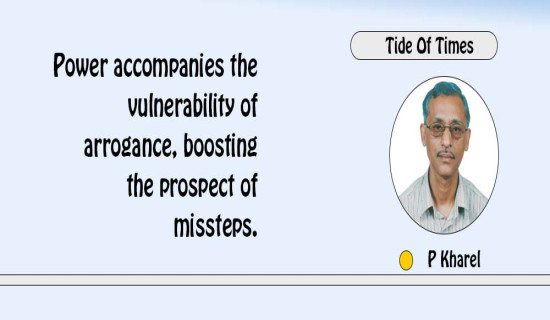
(Professor Kharel specialises in political communication.)