- Tuesday, 2 June 2026

Limit Use Of Social Media Among Kids
 Dr. Shyam P Lohani
Dr. Shyam P Lohani
Dr. Shyam P Lohani
Smartphones have revolutionised how we communicate and have made a lot of things more convenient. Social media can help young adults to learn and thrive but it can also create risks. With increased affordability and easy availability of smartphones, data packages, and free Wi-Fi connection, connecting to different people through social media sites has never been easier. However, as the rate of accessing the internet and being an active member of social sites increases, so does the risk of developing a range of psychological issues.
As accessibility and availability of the internet increased in recent times, social media usage has risen exponentially over the years. Parallel to the increased use, individuals are developing excessive use habits and symptoms similar to traditional addictive disorders. Even though the majority of people’s use of social media is non-problematic, there is a small percentage of users that become addicted to social networking sites and engage in habits of excessive or compulsive use.
Dangers
Overuse is just one of the many dangers of social media that kids and teens face in recent times. No doubt, social media has become a large part of most children’s lives irrespective of the type of social media such as YouTube, TikTok, Snapchat, Instagram, or other social media apps. However, social media allows us to share our feelings, values, relationships, reactions, concerns, and thoughts.
But with the increased time on social media, a high probability exists that ultimately there is a chance that they succumb to harmful contents or situations. It is to be acknowledged that not all the contents on social media are great; social media can also expose your children to cyber bullying, online predators, identity thieves, and inappropriate contents. People show more courage to write something bold rather than to say it in person, thus, discrimination and cyber bullying are more prevalent online. Social media use rose considerably during the pandemic. These risks are only getting worse.
The content on social media is not always palatable and it is not definitely usual to wake up at night to use it or spend hours every week even though the content can make us feel depressed and lonely. None of these behaviours were normal a few decades ago, nor are they especially useful to us today, but they are practiced by billions of people across the world. The use of social media for two hours every day sums up to an extra fourteen hours per week which we can utilise for other recreational activities that are healthier.
The various contributory factors complicate the relationship between social media use and mental health problems such as impaired sleep as an important complication. Needless to say, internet addiction is affecting people’s waking hours and a large majority of adolescents are getting inadequate sleep. Studies also show that a lack of sleep due to internet use during night hours may be one of the biggest contributing factors to the increasing number of teen mental health issues.
Internet use is sedentary behaviour, which in excess raises the risk of health problems. A recent meta-analysis indicated that sedentary behaviour has a negative effect on physical as well as mental health in young people. It is a known fact that people with mental health problems may additionally be more likely to be less physically active. Social media addiction can cause or affect depression and loneliness.
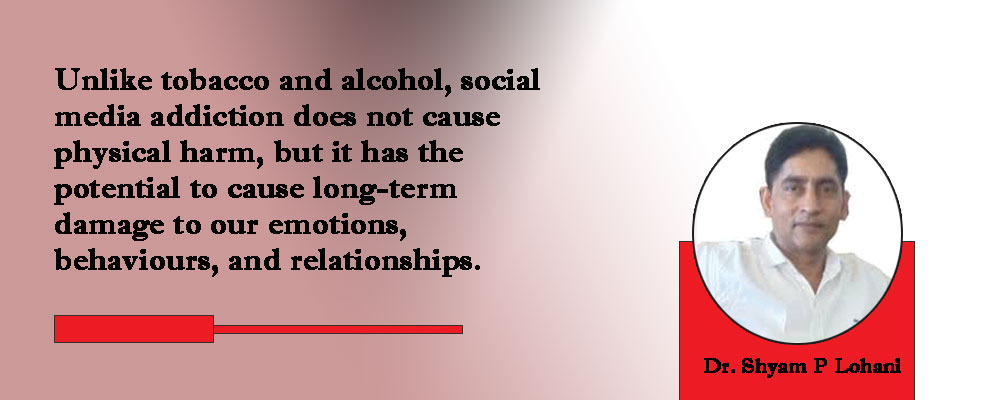
Adolescents are compulsively checking social media profiles and updates frequently. They can make riskier decisions and are prone to online exploitation. Social media addiction is a recent phenomenon that has evolved in the last two decades along with social media hype. Unlike tobacco and alcohol, social media addiction does not cause physical harm, but it has the potential to cause long-term damage to our emotions, behaviours, and relationships.
Solution
But there is no straightforward and well-recognised treatment for social media addiction. However, we are starting to become aware of this growing problem; there is no classification of social media addiction as a mental disorder in the same way as substance/drug misuse. Governments and organisations should work together to minimise and prohibit the use of mobile devices in special circumstances. Smartphone use has been banned while driving in many countries. This measure has proved to be effective in reducing the number of road traffic accidents. Parents should come forward to limit social media use among children or for how long they can use them. Moreover, there are apps available that can block harmful or inappropriate contents.
It is a well-known fact that social media use may lead to poor performance in educational settings. Therefore, schools and colleges need to come up with better policies to ensure that people are focused on their required tasks and activities. Many schools throughout the world, including a few in our country, have banned the use of smartphones in the classroom. And similar prohibition in other contexts such as workplace settings is equally justified.
(Dr. Lohani is the clinical director at the Nepal Drug and Poison Information Centre. lohanis@gmail.com)