- Friday, 29 May 2026

Venus, Jupiter Make Tight Rendezvous
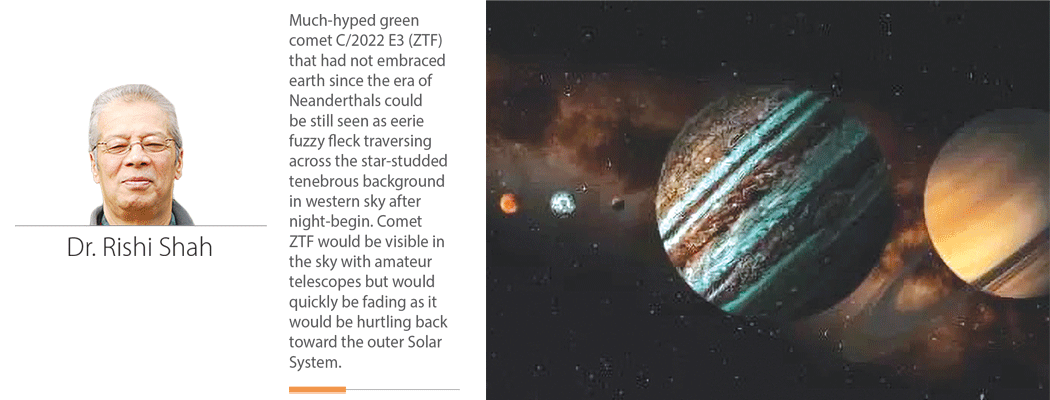

The night skies of this month would enthrall sky-gazers with spectacular sights of planets Venus, Mars and Jupiter along with other mystical marvels of copious celestial entities that are spreading stunningly all over the heavens. Fleet-footed planet Mercury and ringed planet Saturn with blue-hued distant planet Neptune would be lost in solar glare because of their proximity to the Sun. They would be gliding through confounding constellations Aquarius (water bearer) and Pisces (fishes) mostly during day-time. Saturn could be glimpsed tersely towards the end of the month in eastern sky before sunrise.
Romantic planet Venus could be viewed in western sky after nightfall. It would be sailing serenely across the sprawling southern section of constellation Pisces towards the western horizon. The captivating circlet asterism of Pisces could be commended above Venus. The mighty planet Jupiter could be observed to the east of Venus. It could be appraised in western sky after sundown. It would be descending towards the western horizon succinctly by late night. Planets Venus and Jupiter would make very tight rendezvous on 02 March. The pair would be hovering over the western horizon as dusk would fade to darkness.
They would then sink towards the horizon and eventually set late in the evening. Both objects would be relaxing in the constellation Pisces. Venus has been revealing the very intriguing runaway-greenhouse-effect. Its baffling thick shroud of atmosphere would contain cryptic carbon dioxide and sulfuric acid clouds. The planet’s hot temperatures could melt lead as the Venusian surface would measure scorching 480 degrees Celsius.
Red Planet
Red planet Mars could be marked among the scintillating stars of charming constellation Taurus (bull) in south-western sky after sunset. It would be slipping slowly towards the horizon by mid-night. Amazingly effulgent red-giant star Aldebaran (Rohini) could be admired below Mars. Arcane Aldebaran meaning the follower seemingly of opulent open star cluster the Pleiades (Seven Sisters) in Arabic would be agreeably 65 light-years away.
The far-flung planet Uranus could be perceived pensively as lambent spot of light to the west of Mars in the sparsely barren expanse belonging to the comely constellation Aries (ram). It would be sliding towards the western horizon briefly after eventide. Strangely slanted Uranus has been scooting around the Sun on its side with its twirl axis aiming at the Sun. Uranus has been eerily experiencing extreme seasonal variations over its 84 earth-year revolution around the Sun.
The full moon would betide on 08 March. It has been popularly known as the worm full moon because during this time of the year the ground would commence to soften and the earthworms would reappear. The full moon would lie in the constellation Leo (lion) and be circa 403 thousand kilometers away from earth. Colorful Holi would be delightfully reveled on 06/07 March. The new moon would befall on 21 March. Ghode Jatra would be manifested merrily on this day. Festivals of Chaitra Dashain and Ram Navami would be celebrated cheerfully on 29 and 30 March 2023 respectively.
The March equinox would transpire on 21 March 2023, when the Sun would shine directly on the equator and nearly equal amounts of almost 12 hours of day and night throughout the world could be enjoyed. It would herald the first day of spring (vernal equinox) in the Northern Hemisphere and the first day of fall (autumnal equinox) in the Southern Hemisphere., The word equinox has been derived from the Latin words aequus (equal) and nox (night). Equinoxes would be caused because the axis of the earth's spin would be tilted at an angle of fairly 23.5 degrees to the plane of its circuit around the Sun. As a result, sometimes the earth's North Pole would incline towards the Sun (in June) and sometimes it would lean away from it (in December). These events would trigger earth's seasons. At the intermediate places between the solstices with longest and shortest days, the Sun would lie over the earth's equator on around 21 March and 23 September.
In March, the Sun would be travelling northwards across the equator and in September it would be wandering southwards. The earth would orbit the Sun once every 365.242 days and consequently all the earth's seasons would repeat from one year to the next. On 2023 equinox the Sun would be resting peacefully in constellation Pisces.
Jupiter has currently become the largest and most massive gas giant planet in the Solar System and additionally been boasting of maximum number of moons, thus bringing the behemoth planet's total moon-number up to whooping 95. Scientists have ascertained 83 moons to date around Saturn, the second biggest planet in the Solar System. These presently identified moons circle Jupiter from afar. They have retro-grade paths, betokened as they would be rushing around the gas giant in the opposite direction of its rotation.
The inner Jovian moons, in contrast, possess pro-grade course in the same route as the planet's whirl. Some newly found moons are in pro-grade tracks. They have been located in middle swath of space sharing with Io, Europa, Ganymede and Callisto, which have been referred to as the Galilean moons because they were first confirmed by famed Italian astronomer Galileo Galilei during early 1610.
These pro-grade moons were tougher to detect than the outer retro-grade Jovian moons, because they were closer to Jupiter and the scattered light from the planet had been tremendously reflected and consequently these moons were obscured. These quirky Jovian moons could make excellent targets for future space ventures that are being planned for flybys of Jupiter. European Space Agency (ESA)'s JUICE mission would be launched probably in April 2023, while NASA's Europa Clipper would hopefully lift-off in October 2024.
Dwarf planet 1 Ceres would arrive at opposition on 21 March, when it would lie opposite to the Sun. It would become accessible around evening in eastern sky and would ascend to the highest position at about mid-night in southern sky. It would evanescent in dawn twilight before day-break above western horizon. At around the same time Ceres would make its closest approach (perigee) to the earth. This upshot would happen because when Ceres would lie opposite to the Sun, the earth would pass between Ceres and the Sun. At opposition, Ceres would be picked out for much of the night. It would rise at around the time the Sun would set and would go down when the Sun would come up.
Ceres Reaches Peak Brightness
But even when it would be at its nearest point to the earth, Ceres would be so far away from the earth that it would not be easily possible to distinguish it as more than shimmering star-mimicking speck of light even through telescopes. At the moment of opposition, Ceres would be simply 1.59 AU (237.86 million kilometers) away and reach peak brightness. It would inhabit comfortably the faintly petit constellation Coma Berenices (Berenice’s Hair).
Much-hyped green comet C/2022 E3 (ZTF) that had not embraced earth since the era of Neanderthals could be still seen as eerie fuzzy fleck traversing across the star-studded tenebrous background in western sky after night-begin. Comet ZTF would be visible in the sky with amateur telescopes but would quickly be fading as it would be hurtling back toward the outer Solar System. It may pay earth and the Sun another visit in fifty thousand years after receiving the gravitational buffet from our life-giving star and flinging it out of the Solar System altogether.
ZTF would be skirting the star-filled spiral galaxy NGC 1637 and would be curving through lengthy constellation Eridanus (river) towards dim reflection nebula with startling sobriquet Witch Head Nebula (IC 2118) that has been illuminated by and been unfurling to the west of the resplendent star Rigel residing in iconic constellation Orion (hunter or Kal Purush). NGC 1637 would be sheer 31.9 million light-years away. IC 2118 would be merely 900 light-years away. The blue dazzling supergiant star Rigel would be the colossal component of fascinating four star configurations that would emerge as a single blue-white dot of light. This arrangement would be approximately 863 light-years away.
(Shah is an academician, at NAST and Patron of Nepal Astronomical Society or NASO).






-original-thumb.jpg)