- Friday, 29 May 2026

Great Hornbill spotted in Sudhurpashim lowland
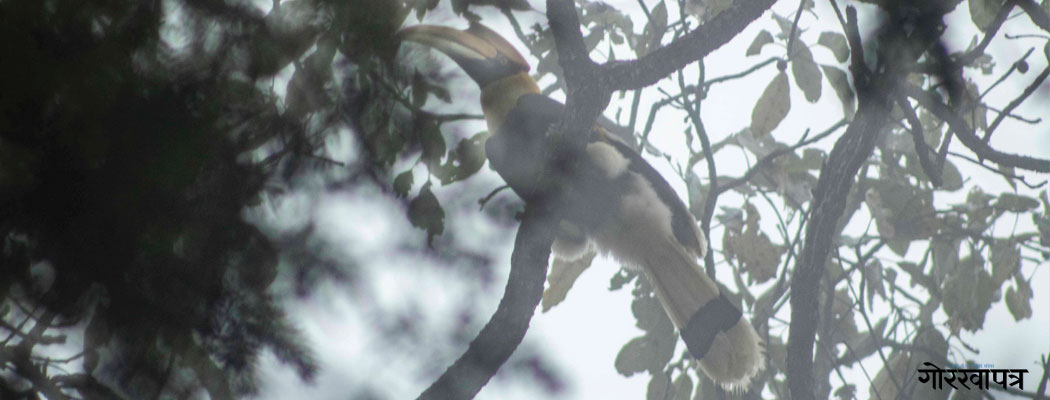

By Abinash Chaudhary,Dhangadhi, Feb. 15: Great Hornbill (Rajdhanesh), a bird on the protected list in Nepal, has been sighted in the lowland area of Sudhurpashim Province.
Birds of this species are found in the lowland areas of the Kailali and Kanchanpur districts. The birds are said to live in the forest where tall sal trees are found in abundant numbers.
Due to their low numbers, the International Union for Conservation of Nature (IUCN) has put the bird on the protected list. The National Parks and Wildlife Protection Act-2029 has listed this bird as a protected wildlife. Legal action will be taken if anyone is found hunting the Great Hornbill in Nepal.
Great Hornbill, which is close to the world's rarest list of birds, has also been found in a group in Kailali and lowland areas of Kanchanpur.
According to ornithologist Hirulal Dangaura, up to six Great Hornbills have been spotted at the same time in the Ghodaghodi Bird Sanctuary in Kailali. Similarly, a flock of 16 Great Hornbills has been recorded in the Brahmadev area of Kanchanpur.
At least one Great Hornbill was sighted in the Banda Lake area of Kanchanpur, Khutia IBA (Important for Birds and Biodiversity) area of Kailali. The birds are typically found in an area up to 1,000 meters above sea level. However, it has not been recorded in the Basanta Corridor, the largest forest area of Kailali.
According to Dangaura, the bird is sometimes sighted in Anjani Community Forest located in Bhajani Municipality-7, which is connected to India's Dudhuwa National Park.
The birds appear only occasionally. Conservationist Bhojraj Dhungana said that although he has been watching birds for a long time, he saw a bird of this species for the first time in his life last week at Ghodaghodi Bird Sanctuary. "I had seen photos of Great Hornbill taken by others earlier, but I am happy to see the bird for the first time,” he said.
It is unclear how many of such birds reside in Kailali and Kanchanpur, though.
It is said that the birds number under 150 in our country. The bird is often seen in small flocks. The beautiful and attractive bird is called 'Homerai' in the local language, which means king bird of the forest.
According to Dangoura, the bird shows interesting and unique behavior in the process of nesting and breeding.
The male keeps the female in the nest at the top of the tree. It is said that after the female lays eggs, they clog the toads with the help of mud and the female's dung and leave small holes. The female is believed to take air and food through that hole to survive.
The male Great Hornbill regularly feeds the female from outside during the breeding period, and after the hatching, the male bird also feeds the young.
This has earned the male Great Hornbill the title of ‘the most devoted husband in the Avian world’. The rainy season is the breeding time of the bird.
The bird is found only in certain types of habitats and is considered an environmental indicator. Called the forest farmer, the bird eats fruits of bar tree (Banyan) and pipal (Ficus religiosa) and also carries seeds from one place to another.


-square-thumb.jpg)



-original-thumb.jpg)