- Thursday, 28 May 2026

Tilak Prasad: A Democratic Stalwart

Narayan Prasad Ghimire
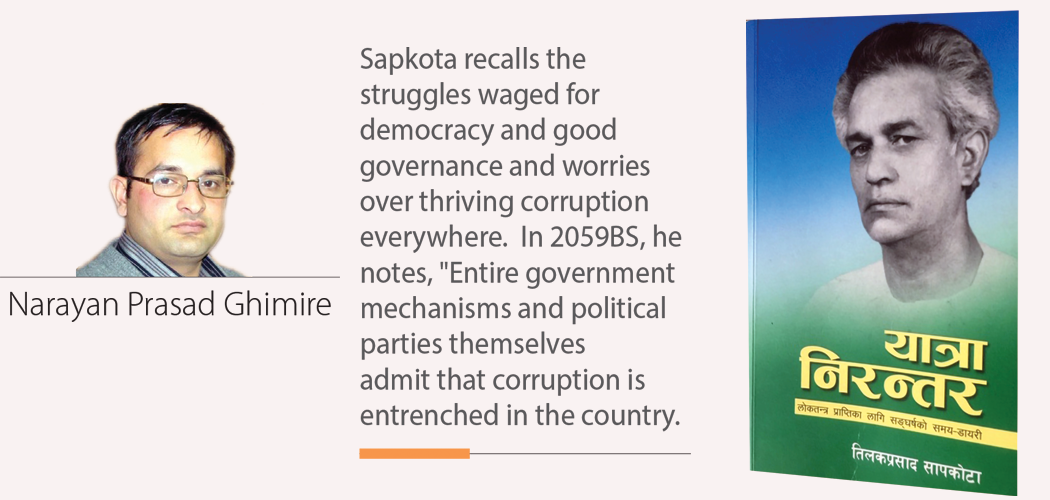
Tilak Prasad Sapkota pens the book. A staunch follower of the late BP Koirala, Sapkota fought for the restoration of democracy, suffered imprisonment, faced lethal attacks, and braved atrocities of security persons - but, was gradually marginalised owing to party politics. Despite this, Sapkota remained unfazed; he did not budge from his belief in democracy.
The book is a compendium of his diary. He has maintained his diary- sometimes regularly and sometimes in a gap. He has chronicled the political, social, and educational events surrounding his individual, family, community and country from 2040BS to 2077BS. He waded with the Narayani River umpteen times- with hope, and with despair as the security persons in the party-less Panchayat system chased him, fixed price tag on his head.
At the end of septuagenarian life, Sapkota is still cultivating local democracy. The experience he brings in community building is unrivalled. Whether it is the establishment and management of a school and a social organization or the protection and promotion of the Hindu faith, he devoted his significant time to social causes in addition to politics. A guardian of a family having a dozen of members, he was afflicted with financial crises several times, but managed the difficulty with utmost patience and taught lessons to the new generation.
The notes he made have spoken well that his philosophy, faith and practice are democratic. He has a firm belief that party democracy cannot fare well without a robust foundation. It is however appalling that the party leadership has ignored and belittled the role he played to restore and strengthen democracy.
In the diary, he even makes frank notes on the behaviour of his family members. He does not feel it qualms to disclose the foibles of family members, but, skillfully relates it to the management of life skills, struggle for success, and strengthening of family bonds and social harmony. He often sympathises with his spouse that he has failed to give adequate time for family management due to his busyness in political struggles. Such a problem is common for many leaders who fought royal atrocities and put their lives at risk. But, a certain section of party leaders reaped the benefit of democracy while the leader and cadres like Tilak Prasad and his family were pushed away from mainstream politics and its benefit.
As is natural for every party leader to have the willingness to get elected, he fights in the general election held after the restoration of democracy. But, he loses it. Later, he was appointed a member of the Landless Squatters' Commission, and a member of the Devghat Area Development Committee as well where he devoted himself to addressing the problems faced by the landless people, and by those living in a religious shelter.
Down-to-earth, Sapkota meets every family that has faced difficulty in his town, Gaidakot, in his district and vicinity. He is a true friend in need. The present generation can learn a lot from his untiring struggle for democracy. Needless to say, the blend of passion and patience has enlivened this man.
The social activities he initiated and was involved in are exemplary of Nepal. The establishment of the Vijay Development Resource Centre (VDRC) not only enriched his social prestige but also built the capacity of numerous youths. The leadership development, organisation building and public awareness ensured through VDRC also have significance in creating a civil society and propelling democratic values.
Similarly, his role and courage in establishing and running Kalika Sanskrit Vidyapeeth in Nawalparasi is a huge contribution to Sanatan dharma and culture. He often recites Bhagawat Geeta. In 2063BS, he writes, "At a time when the country was witnessing a huge change, I was never for the secular nation. I am for Sanatan dharma, for a ceremonial king." He adds although federalism is a matter of debate, the change is however acceptable to him. "It would take time for the institutionalization of federalism," he noted.
He hardly misses any event relating to the late BP Koirala. When he lost his father, he felt vacuous and listless as it was during the demise of BP Koirala. In 2077BS, he noted, "Now, I remember the gloomy moment of Saun 6, 2039BS- the day BP Koirala passed away. I felt the figure who inspired me to struggle had departed.
Today, the moment of my father's demise has left me in similar loneliness and dejection."
Sapkota recalls the struggles waged for democracy and good governance and worries over thriving corruption everywhere. In 2059BS, he notes, "Entire government mechanisms and political parties themselves admit that corruption is entrenched in the country. But, I don't see any sign of corruption subsiding in the country." He also underscores the need for wiping out moral corruption, which is related to individual behaviour.
He has also mentioned well about the non-cooperation he faced from party colleagues such as Krishna Chandra Nepali, Ramchandra Poudel and other district leaders. Mr Sapkota, after being forced out of mainstream politics, finds it difficult even to meet the leaders in Kathmandu where he wants to relay the district issues and problems. His notes on leaders' lies make it clear that our top leaders are picketed by a selfish layer of sycophants that distance the true leaders and cadres from the centre.
The book, published at a time when politics and democracy have derailed much with rising erosion of public trust and thriving corruption, can be a reminder of how democracy was restored with trial and tribulations of every cadre and leader, and why the centre should recognise it. An equally important message the book has is - democracy can be served with social development and community building as well.
The book is published by Shangri-La Books.