- Saturday, 16 May 2026

Lipulek: Land Of Nepal, Test Of Friendship

We have a beautiful country with two giant, friendly neighbors—India and China. We have an excellent relationship with them due to the loving and cordial understanding established by our country’s wise rulers for centuries. Both are our well-wishers, supporters, and helpers in our development and infrastructure. In size, they are big, and we are small. According to the saying of great King Prithivi Narayan Shah, the creator of modern Nepal and the father of our nation, our country is like a yam between two giant stones. We can learn a lot from this saying. One who has experience digging deep to get yams between big stones understands the true meaning of this saying. I have this experience. We have varieties of yams. But such yams are called Ban Tarul (yam from the forest.)
I know how a big boulder can fall on you when you have no skill in moving the stones while harvesting yams. I know that some of the present leaders of our republic, Nepal, think they do not need to learn from this, as they consider themselves the wisest and think they know everything. I know one of our prime ministers proposed changing or replacing that proverb with his progressive version. But I think the great King’s proverb is still the big mantra for dealing with our neighbours and establishing good relations with them for mutual benefit.
Agreement
After Chinese Foreign Minister Wang Yi visited India in August 2025, India and China reached a series of new understandings to normalise relations. In this context, they also reached an agreement to reopen the border through key Himalayan passes, including Lipulek, on our land, without our consent. This became a big issue, a significant concern, and a worry for us. Naturally, we need to react and correct the mistake. According to the report, our government had sent a diplomatic note to India and China some years ago. Our people were in the streets to voice their opposition, and our parliamentarians expressed their anger and concern about this grave issue. The present government, under the premiership of Balendra Shah, sent a diplomatic note to both the governments of India and China on the topic on May 3, 2026.
This is the scene we see today. I think the problem suddenly hit us because of mishandling and a lack of skill in yam harvesting. In this context, I remembered a Newari proverb - a sparrow annoys with its loud chirping, but a pigeon strikes with force (chhakhunchaya tiri tiri, bakhunchaya twak). This is similar to an English proverb: The sparrow chirps, the eagle strikes. We are mercilessly stricken. We need to solve our problem of reclaiming our land with goodwill, good intentions, and love and kindness. We need to understand everything with the intention of cooperation. I firmly believe that one can achieve anything through love and trust, which cannot be done by enmity.
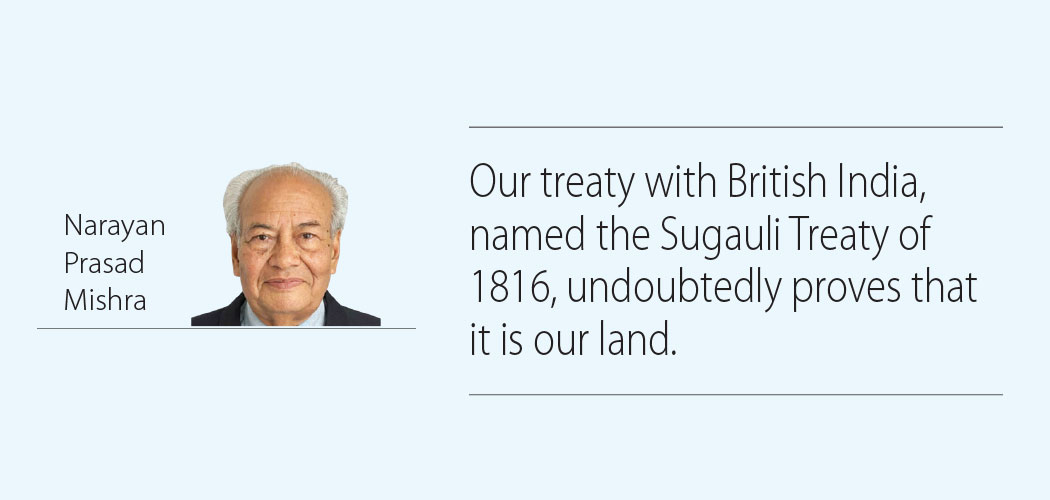
There is no doubt that Lipulek, Kalapani, and Limpiyadhura cannot be separated from our country. They are an inseparable part of our body. Buddhi Narayan Shrestha, the foremost border expert, has written many books and articles, drawing on convincing historical evidence and historical documents. He has been speaking tirelessly on the problem. According to him, the history of the land proves that it is unquestionably ours. Our treaty with British India, named the Sugauli Treaty of 1816, undoubtedly proves that it is our land. Several other documents and maps he possesses also clearly prove it. Similarly, however, there are controversial maps created by British India between 1827 and 1879 that showed it differently, to their advantage, before India’s independence.
Good relations
We all understand that, despite centuries of mutual love and good relations, misunderstandings and problems may sometimes arise with our neighboring countries, just as disputes can occur over land and property within our own neighborhoods. We also know that if we fail to consider each other’s views and documents, we risk becoming entangled in disputes for years, depriving us of peace and rest. We need to clarify the misunderstanding created by British India regarding our friendly present-day India to resolve the issue in a spirit of brotherhood. With this understanding, we must resolve our problems with love, kindness, cooperation, and mutual support, drawing on our history of standing together in both joy and sorrow.
In the context of our talks with India, our government must allow experts to present our case with documented evidence. I urge India, as a true friend of our country, not to avoid dialogue. The people of Nepal have grown increasingly distressed over this issue in recent years, even though it was not so before. The way forward lies in peaceful solutions and mutual understanding—for fights and disputes have no place between true neighbours. The Lipulek controversy now stands before us as a test of our long friendship.
(The author is former chief of the Office of the Tribhuvan University Service Commission.)