- Saturday, 16 May 2026

US-China summit ends with Xi and Trump claiming progress but differences remain
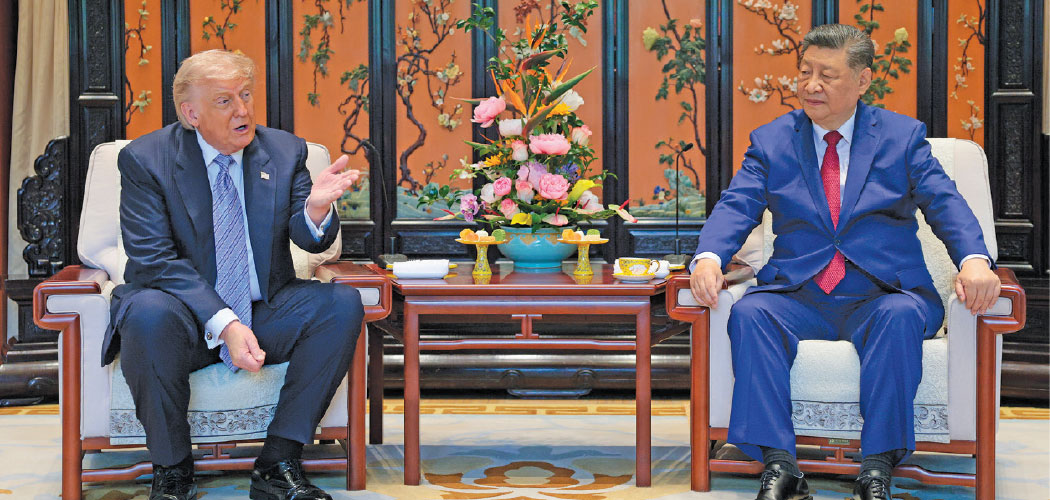

Beijing, May 16: U.S. President Donald Trump departed Beijing on Friday following a final meeting with Chinese President Xi Jinping. The leaders said they made progress in stabilizing U.S.-China relations, but deep differences remained after two days of meetings and meals.
On Friday they walked the grounds of Zhongnanhai, Xi's official residence, and had a working tea and lunch. During a series of meetings and events Thursday, the two discussed divisive issues such as the Iran war, trade, technology and Taiwan.
China has shown little public interest in getting more involved in solving the war in Iran. Xi also suggested differences over Taiwan could put his country and the U.S. on the path toward conflict. Threats of each side imposing steep tariffs also still loom.
Trump said Xi told him China wants to help negotiate an end to the war and a reopening of the Strait of Hormuz. China is the largest buyer of Iranian oil and Trump hopes Xi will use that leverage to prod Iran into a deal on U.S. terms. Trump also said Xi assured him that China wouldn't provide Iran with military equipment.
The two countries agreed to establish boards on trade and on investments to address each other's concerns on agricultural goods' market access and to promote expanded trade under a framework of reciprocal tariff reductions, Chinese Foreign Minister Wang Yi said.
The two sides have yet to announce any concrete trade deals, but the boards are expected to serve as a channel of communications to address economic and trade issues.
Wang said the economic and trade teams from the two sides have reached results that are "overall balanced and positive."
President Trump extended a Sept. 24 invitation to Xi and his wife during his reciprocal toast at a banquet Thursday.
According to a readout about Wang's briefing to media outlets on the summit, Wang said Trump and Xi agreed to keep close contact through meetings, phone calls and letters, the Chinese official news agency Xinhua reported.
Wang said both sides should work together to make thorough preparations for the leaders' interactions and create an appropriate atmosphere to accumulate more results.
Merz on Friday said he spoke to Trump on the phone as the U.S. president traveled home from China.
"We agree: Iran must come to the negotiating table now. It must open the Strait of Hormuz. Tehran must not be allowed to have nuclear weapons," Merz wrote on X. "We also discussed a peaceful solution for Ukraine and coordinated our positions ahead of the NATO summit in Ankara. The U.S. and Germany are strong partners in a strong NATO."
German Chancellor Friedrich Merz on Friday said he wouldn't recommend that his children work in the U.S. because of its "social climate."
"I am a great admirer of America. My admiration isn't growing at the moment," he said during a panel discussion at the Catholic Congress in Wuerzburg, Germany. "So, I wouldn't recommend to my children today that they go to the U.S., get an education there, and work there. Simply because of a social climate that has suddenly developed there."
He added: "by the way, the question of what well-educated young people can achieve used to be answered very differently in America up until a year ago than it is today. Today, the best-educated in America have great difficulty finding a job."
Trump told reporters on Air Force One that China would buy 200 planes from Boeing with the possibility of expanding the deal to 750 "if they do a good job with the 200, which I'm sure they will."
The order would represent Boeing's first major sale to China in nearly a decade, and it would mark a significant breakthrough for the plane maker in a market that was once central to its long-term growth.
China has high demand for new aircraft as they expand and modernize fleets, while giving Trump a high-profile win for his trade agenda. (AP)